On this page+
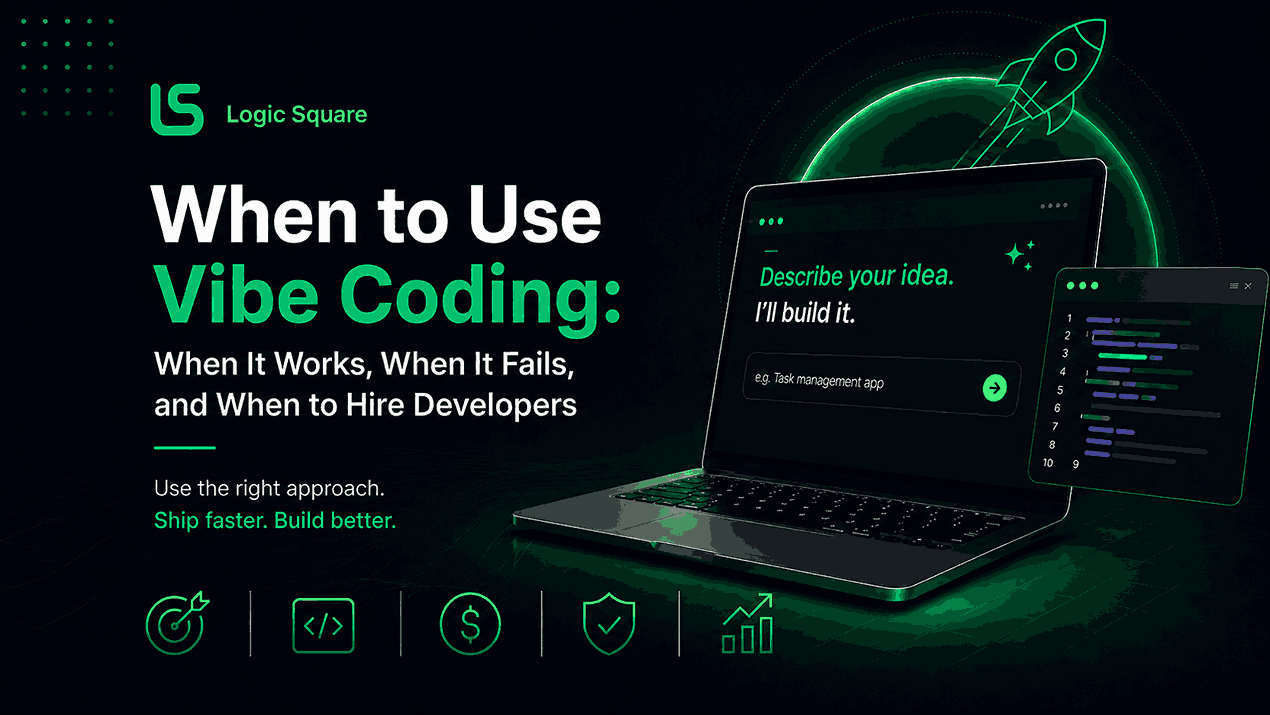
When to Use Vibe Coding: When It Works, When It Fails, and When to Hire Developers
Vibe coding is using natural-language prompts to have AI generate an application, rather than writing most of the code manually.
Quick answer: Vibe coding is a rational choice for simple, low-volume products with capable supervision. It is a poor choice for anything holding sensitive data, moving money, or serving multiple tenants. We maintain AI-built apps that were the right call, and we get hired to rescue ones that weren’t. The difference is rarely the tool alone. It is whether anyone with engineering judgment is supervising the output.
Who this is for
Founders and operators who built something with Lovable, Bolt, Cursor, v0, Replit, or Claude Code and are wondering whether it will hold, and people deciding right now whether to vibe code the first version or hire developers.
The market has picked a side, loudly, and it’s half right
Recent numbers are striking. Stack Overflow’s 2025 Developer Survey found 84% of developers use or plan to use AI tools while 46% actively distrust the accuracy of what those tools produce. That gap between adoption and trust is the entire story. Veracode’s 2026 research found roughly 45% of AI-generated code samples contained known security flaws, and one 2025 analysis across more than 100 language models measured AI-generated code carrying around 2.7 times more vulnerabilities than human-written code. Columbia’s DAPLab research identified silent error handling as the most common production failure in AI-built apps: the write fails, the webhook never fires, the error gets swallowed, and the user sees a success message.
So the fear content writes itself, and plenty of agencies are writing it. Here is what that content leaves out: some vibe-coded apps are fine. We know because we maintain a couple of them.
Two vibe-coded apps that were actually good enough for production
What we’ve learned from production
Project 1: A lawn and landscaping platform handling jobs, payments, and payment splitting at roughly 50 to 100 jobs per month. Built on Bolt. The scope and expected volume were limited, and for that use case Bolt was a reasonable choice. It runs.
Project 2: A school audit application built on Lovable by the client’s technically capable project manager. It serves around ten schools with quarterly audits and simple workflows. The original plan was a full rebuild by us. Instead, we reviewed it, quality-checked it, and now maintain and improve it. It was good enough to launch and did not need to be thrown away.
Lesson: A vibe-coded product with 50 users does not need to be discarded because it hopes to reach 100,000. Sometimes it needs a migration plan. Sometimes it just needs maintenance.
Notice what both cases share: limited scope, low volume, and a capable human supervising the output. That last part is doing most of the work.
When should you use vibe coding?
Green zone, best use cases for vibe coding: prototypes, landing pages, internal tools with a handful of users, experiments you may throw away, and simple products with limited volume where someone technical reviews the result.
Yellow zone, vibe coding with engineering review: customer-facing MVPs, anything with logins and a database, apps with third-party integrations. These can start vibe-coded but need a review pass and a migration plan before growth arrives.
When should you not vibe code?
Red zone: payments and payouts, healthcare and other sensitive data, multi-tenant SaaS, authorization logic, and regulated workflows. AI can assist the engineers here. It cannot replace them. We would not fully vibe-code Smoothire, our own recruitment platform, because it holds substantial personal information and multi-tenant isolation requires rigorous engineering controls.
Use case | Vibe code? | Why |
|---|---|---|
Prototype | Yes | Speed is the point |
Internal tool | Usually | Low user and transaction risk |
Simple MVP | Yes, with review | Validate before investing |
Customer-facing SaaS | With supervision | Auth, data, and security matter |
Multi-tenant SaaS | Not without engineering review | Tenant isolation |
Payments | No, not unsupervised | Financial risk |
Healthcare | No, not unsupervised | Sensitive data and compliance |
Lending, payroll | No, not unsupervised | Financial consequences |
Vibe coding vs AI-assisted development
These are different things, and the difference is our whole position. Vibe coding means relying on AI to generate the implementation with limited code-level oversight. AI-assisted development uses AI throughout the engineering process while developers remain responsible for architecture, security, testing, review, and production decisions.
We recommend AI-assisted development for virtually every software project.For a broader decision framework, explore when AI actually helps and when it becomes theater.
Deliberately ignoring AI in 2026 is the wrong extreme in the other direction. Fully vibe-coding is the selective tool. Use AI aggressively as an engineering tool. Don’t use “AI-generated” as a substitute for engineering judgment.
What we look at first when auditing an AI-built app
We do not start by rewriting. We assess. We examine the stack, the database architecture, authentication, APIs, deployment, dependencies, and code structure, and ask one framing question: do the technology choices fit what this product actually needs to do at the scale it actually operates? A Supabase-based architecture is not inherently bad. For a simple application it can be exactly right. For a product with complex relationships, heavy business logic, or real performance requirements, it needs closer examination.
Then the specific things AI tools reliably get wrong: duplicated components, unnecessary dependencies, weak database design, missing error handling, broken authorization, exposed secrets, weak tenant isolation, and security gaps around authentication and data access. The research on silent failures matches what we find in practice.
Can a vibe-coded app be production-ready?
Yes. A vibe-coded app can be production-ready, but production readiness depends on the application’s risk, architecture, security, testing, infrastructure, and expected load, not on whether AI generated the code. The school audit app we maintain is production-ready for ten schools and quarterly audits. The same stack would not be production-ready for a lender. Readiness is a property of the match between product and load, not of the tool.
How we review AI code in our own shop
Claude is our primary AI development tool. We then use GPT and Gemini as independent second and third opinions to flag missed requirements, security issues, and unnecessary complexity. Automated checks run after that, and engineers focus their review where judgment is actually required rather than reading every generated line. The goal is not eliminating AI mistakes. It is stacking enough layers that far more of them get caught before production.
FAQs
What is vibe coding?
Describing what you want in natural language and letting an AI tool generate the application, iterating through conversation rather than writing the code yourself.
When should you use vibe coding?
For prototypes, internal tools, experiments, and simple low-volume products with technical supervision. See the green zone above.
When should you not use vibe coding?
For payments, sensitive data, multi-tenant systems, authorization logic, and regulated workflows. Engineer those properly with AI assisting, not driving.
Is vibe coding safe for production?
It can be, for low-risk products at low volume with review. The published security data (45% of AI-generated samples with known flaws) is why unreviewed AI code and production don't mix.
Are Lovable and Bolt good enough for production?
For the right product, yes; we maintain production apps built on both. For complex, sensitive, or high-volume products, they're a starting point that needs engineering.
Can a vibe-coded app scale?
Some can with a migration plan executed before the architecture becomes the constraint. That's an assessment question, not a yes or no.
Does a vibe-coded app with problems always need a rebuild?
No. We first assess the architecture, security, database, integrations, and deployment. Depending on findings, the right answer may be maintenance, targeted fixes, staged migration, or a rebuild. A rebuild should be the last option, not the starting assumption.
Not sure whether your vibe-coded app is ready for production? Send us what you built and we’ll tell you honestly whether we’d keep it, migrate it, or rebuild it
Work with us