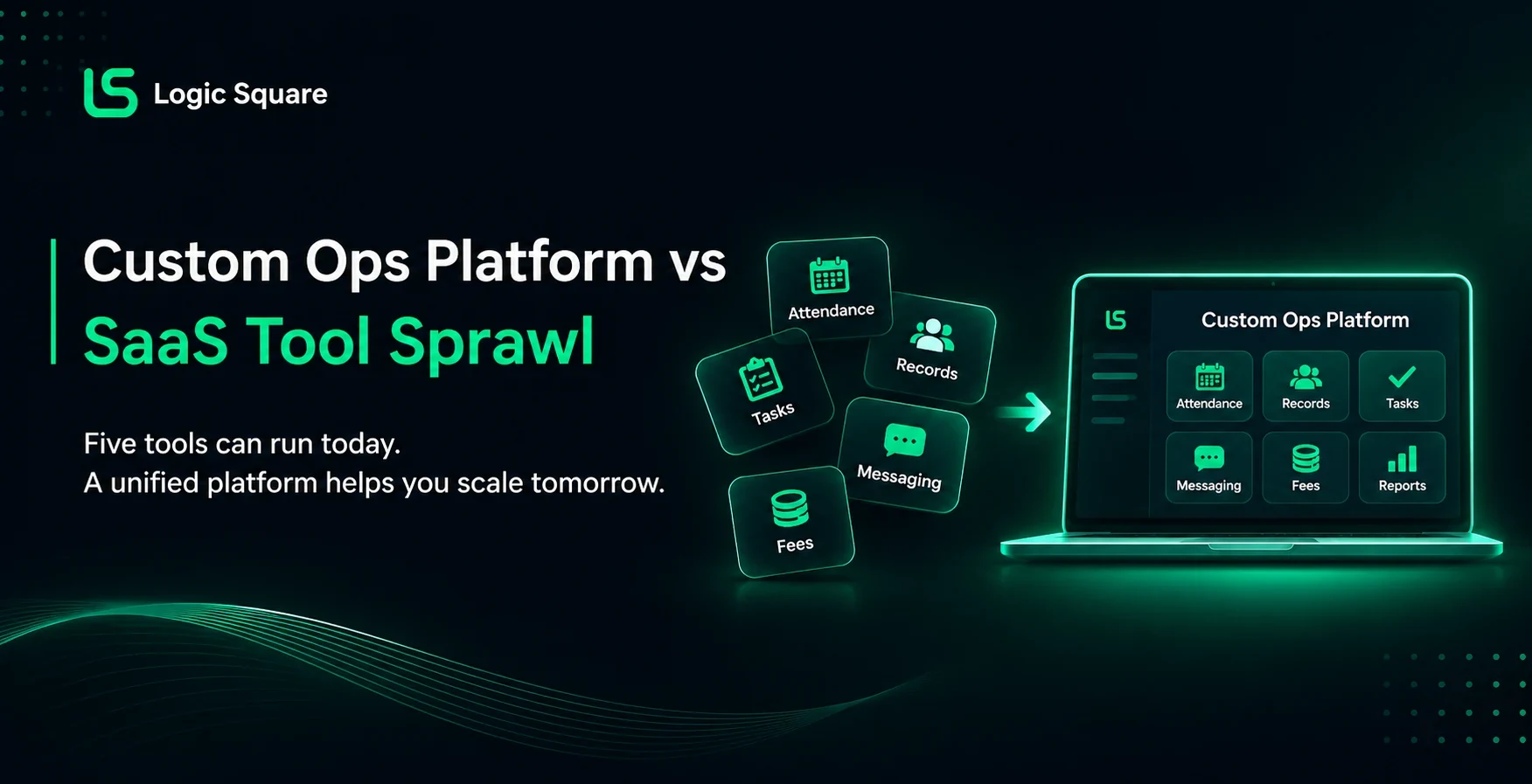
Tool sprawl is what happens when every workflow gap gets its own subscription: one tool for attendance, one for records, one for tasks, one for messaging, one for fees, plus the spreadsheets that glue them together. The surprising lesson from organizations we’ve worked with: the reason to consolidate is rarely the subscription cost. It is ownership, coherence, and the ability to scale a process that currently lives in five places at once.
On this page+
A real stack, added up
One multi-site organization we assessed ran four to five separate tools per site across attendance, student records, task management, messaging, and fee collection, at an estimated $500 to $1,000 per site per month once everything was counted. Multiply by sites and the number gets attention. But here is the honest part: that number alone did not justify a custom platform, and we would not have pretended it did.
What actually justified consolidation
Two things the stack could not provide without owning the underlying workflow.
- Ownership: every workflow lived inside someone else’s product, on someone else’s roadmap, with the organization’s operating knowledge scattered across five vendors’ data models.
- Scale: the organization intended to grow from five sites toward fifty or more, and renting five different vendors’ assumptions is a viable way to run five sites and an unmanageable way to run fifty. They consolidated to own the process they planned to scale, and the subscription savings were a side effect.
The integration tax nobody invoices
Between every pair of tools lives unpaid work, and the pattern is always concrete: the same record updated in one system and stale in another, the export reshaped by hand for the next tool, and the monthly hour someone spends reconciling when two systems disagree about the same fact, the onboarding of every new hire into five products and the informal rules connecting them. This tax rarely appears as a line item, but it shows up repeatedly in operational time and reconciliation work, and it grows with headcount even when the subscription line doesn’t.
When sprawl is fine, honestly
If each tool is genuinely good at its job, your team is small enough that the informal glue holds, and you are not scaling the process, keep the stack; five excellent tools beat one mediocre platform. And when one specialized system already handles part of the operation well, integrating with it usually beats replacing it: we tell clients this even when replacement is what we sell, because a platform that rebuilds what already worked is sprawl with a single logo.
What consolidation actually looks like when it's done right
The organization above did not rip out five tools on a Friday. The working pattern: the platform absorbed the workflows one at a time, starting where the integration tax was highest, while the tools it hadn’t yet replaced kept running. Specialist systems that were genuinely good stayed, integrated rather than replaced, because a platform that rebuilds what already worked is sprawl with a single logo. Data migrated per workflow with a parallel-running period, so every cutover was reversible until proven. And the informal rules, the real reason consolidation was needed, were written down as the platform encoded them, which is the step that makes fifty sites operable by people who never met the founders. Consolidation is a sequence of small, reversible moves that ends with ownership; the big-bang version is how organizations end up owning nothing but a migration horror story.
The three questions that decide it
Count the real monthly cost, tools plus the integration tax in hours. Ask who owns the workflow you intend to scale, you or five roadmaps. And ask what breaks when you double: if the answer is “the glue,” the stack has told you its ceiling.
FAQs
How many SaaS tools is too many?
The count matters less than the seams: when the same fact lives in three systems and a human reconciles them, the stack has told you its answer regardless of the number.
Should we consolidate onto one big platform or build custom?
If a suite genuinely models your workflow, use it. The build case begins where the workflow is the business and the plan is to scale it; the organization we watched consolidated for ownership and a five-to-fifty ambition, not for the subscription savings.
What does tool sprawl actually cost?
The visible part was an estimated $500 to $1,000 per site per month in one real stack; the invisible part, the integration tax in hours, grew with headcount and never appeared on any invoice.
One more test worth running before any decision: ask a new hire in their second week to describe how a record flows through your stack. Their confusion is a map of your integration tax, drawn by someone with no stake in defending it.
Running your operation across five tools and some spreadsheets? Send us the list; we’ll tell you honestly whether it should become one platform or stay five good tools:
Work with us