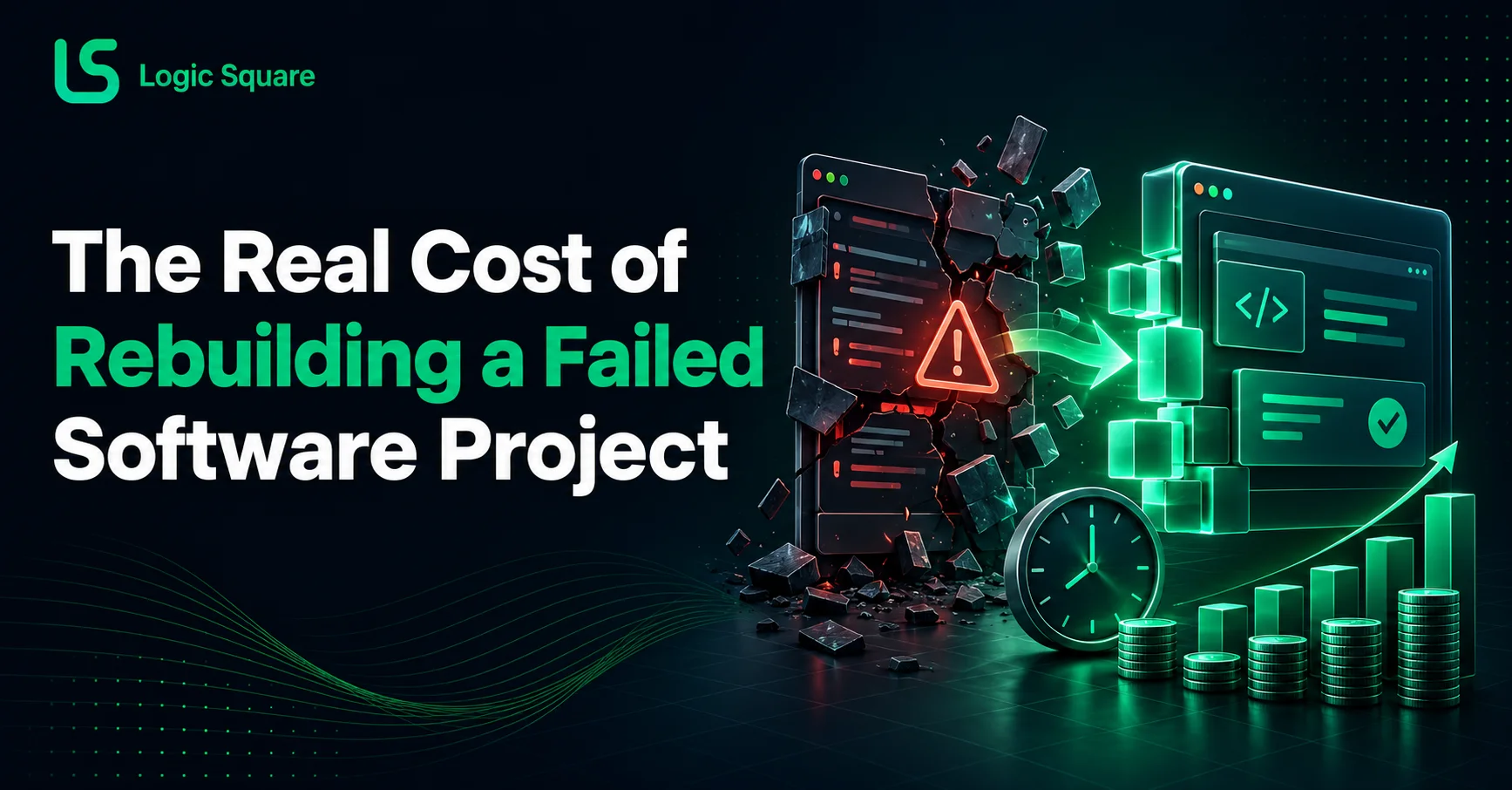
The Real Cost of Rebuilding a Failed Software Project
AT A GLANCE The cost of a failed software project is never just the rebuild quote. It’s the money already spent on the first build, the months of lost time, the opportunity cost of what the team couldn’t do while it was stuck, the erosion of trust inside the organization, and the extra work of untangling the failed system before anything new can replace it. Understanding the full cost is what stops a company from repeating the mistake — because most failed projects fail for reasons that have nothing to do with the code. |
If you’re reading this, there’s a decent chance you’ve lived it: a software project that was supposed to take six months and didn’t, that cost more than planned and delivered less, that technically launched but never really worked, or that quietly died before it shipped. It’s one of the most common and most expensive experiences in business software — and the instinct afterward is to get a quote for the rebuild and move on. That instinct skips the most important part.
The rebuild quote is the smallest number in the whole equation. |
On this page+
Where the money actually went
The rebuild estimate is the visible cost. The real cost is the sum of several things that rarely make it onto a spreadsheet:
The sunk cost of the first build.
Whatever was spent on the failed project — often a substantial sum — is gone, or mostly gone. Some of it may be salvageable; much of it usually isn’t. That’s the obvious loss.
The time, which is worse than the money.
Months spent on a project that didn’t work are months the business didn’t spend on something that would have. In a competitive market, that lost time can cost far more than the dollars — a window that closed, a competitor that moved first, a season missed.
The cost of untangling it
A failed build is rarely a clean slate. There’s data trapped in it, half-finished integrations, workarounds the team built to cope, and undocumented decisions nobody can explain. Before anything new can be built, someone has to understand and unwind all of that — which is often harder than starting from nothing.
The erosion of trust.
After a failed project, the organization is wary. Leadership is skeptical of the next estimate, the team is demoralized, and the next software proposal — even a good one — faces a harder room. That cost is invisible on paper and very real in practice.
Why software projects actually fail
Here’s the part that matters most for not repeating it: most failed software projects don’t fail because the code was bad. They fail for reasons that were set in motion long before anyone wrote code:
- The wrong thing was built — the project solved a problem the business didn’t actually have, or missed the one it did.
- The scope was never stable — requirements kept changing, so the target kept moving and nothing ever got finished.
- It was built for the demo, not for production — it worked in the showcase and fell apart under real users, real data, and real load.
- The cheapest bid won — a vendor was chosen on price, delivered something that technically met spec, and disappeared, leaving software nobody could maintain.
- Nobody owned the outcome — the build was treated as a deliverable to hand off rather than a system someone had to stand behind.
None of these are exotic. They’re the same forces that show up in every study of why projects fail — poor alignment, unstable scope, thin requirements, missing executive support — just described in plainer terms. The pattern is consistent: software projects fail upstream of the engineering, in the decisions made before anyone opened a code editor.
The failure looked like… | The real cause was usually… |
|---|---|
The code didn’t work | The wrong thing was built |
It went over budget and time | Scope was never stable |
It broke after launch | Built for the demo, not production |
The vendor vanished | Chosen on price, with no ownership |
What to do instead of just rebuilding
The reflex get a rebuild quote, pick a vendor, start again is how companies fail the same way twice. A better sequence starts before any rebuilding:
- Understand why it failed first. If the first project built the wrong thing, a faster rebuild of the wrong thing is not progress. Diagnose the cause before commissioning the cure.
- Salvage what’s genuinely salvageable. Some of the data, integrations, and working components may be worth keeping. A structured legacy system modernization assessment can determine what should be retained, replaced, or rebuilt before more money is committed.
- Re-examine whether to build at all. Sometimes the honest answer after a failed build is that an off-the-shelf tool fits, or that the project should be scoped far smaller. The failure may be telling you something about the original decision.
- Choose the next partner on accountability, not price. The cheapest bid is what caused many of these failures. The thing worth paying for is a partner who diagnoses honestly, scopes realistically, and stands behind the result.
If you want that as a concrete first-response sequence, it looks like this: freeze the scope so the bleeding stops, inventory exactly what exists, identify what’s genuinely salvageable, classify why it failed, and only then decide whether to rebuild, buy, or shrink the scope. To be clear about salvage it’s rarely all or nothing. Some of the data, some integrations, parts of the working code, and the hard-won learnings about what the business actually needs are usually worth carrying forward, even when the system as a whole isn’t.
A faster rebuild of the wrong thing is not progress. |
The honest version of the conversation
When someone comes to us after a failed build, the most useful thing we can do is often not to quote the rebuild immediately. It’s to ask why the first one failed, look at what’s actually there, and tell them honestly what we find — including, sometimes, that they don’t need the full rebuild they came in asking for. A failed project is expensive enough the first time. The whole point of understanding its real cost is to make sure the second attempt is the last one.
Frequently Asked Questions(FAQ's):
How much does it really cost to rebuild a failed software project?
Far more than the rebuild quote. The full cost includes the sunk cost of the first build, the months of lost time and opportunity, the work of untangling the failed system, and the erosion of trust inside the organization. The rebuild estimate is usually the smallest number in the equation.
Why do most software projects fail?
Rarely because of bad code. Usually because the wrong thing was built, scope never stabilized, it was built for the demo rather than production, the cheapest bid won and the vendor disappeared, or nobody truly owned the outcome. The causes are set in motion before code is written.
Should we just rebuild it with a new team?
Not until you understand why it failed. A faster rebuild of the wrong thing repeats the mistake. Diagnose the cause, salvage what’s genuinely worth keeping, re-examine whether to build at all, and then choose a partner on accountability rather than price.
How do we avoid this happening again?
Fix the upstream causes: get clear on the actual problem before building, stabilize scope, build for production rather than the demo, and choose a partner who diagnoses honestly and stands behind the work. The cheapest bid is what caused many of these failures in the first place.
Recovering from a software project that didn’t work?
Logic Square Technologies help companies figure out why a build failed, what’s worth salvaging, and what the right next step actually is — including telling you when you don’t need the full rebuild you came in for. Veteran-led, building production software since 2012.
Work with us