On this page+
At a Glance
Multi-campus education networks rapidly become too complex for spreadsheets and adhoc administrative solutions. School management software is designed to bring the multiple campuses into one space with streamlined audits and reporting, role-based access for administrators and teachers, professional development workflow, and stronger accreditation compliance.
The challenges for education organizations are not only software functionality but also long-term adoption, operational consistency, and responsible use of student data in the context of FERPA and COPPA.
In the era of scaling school networks, it becomes more and more necessary to have centralized and privacy-friendly operation systems to keep reporting accuracy, administrative efficiency, and organizational visibility.
Introduction
Multi-campus education networks eventually outgrow spreadsheets, disjointed tools and manual administrative workflows.
Operational complexity grows as campuses grow, in areas such as audits, evaluations, professional development tracking, compliance reporting and daily administration. Workflows that work for a single school often become disjointed and hard to manage across multiple sites.
That’s where custom school management software would be operationally useful.
At Logic Square Technologies, education organizations often turn to custom platform development when broken systems make reporting consistency, operational visibility, and administrative coordination difficult to achieve.
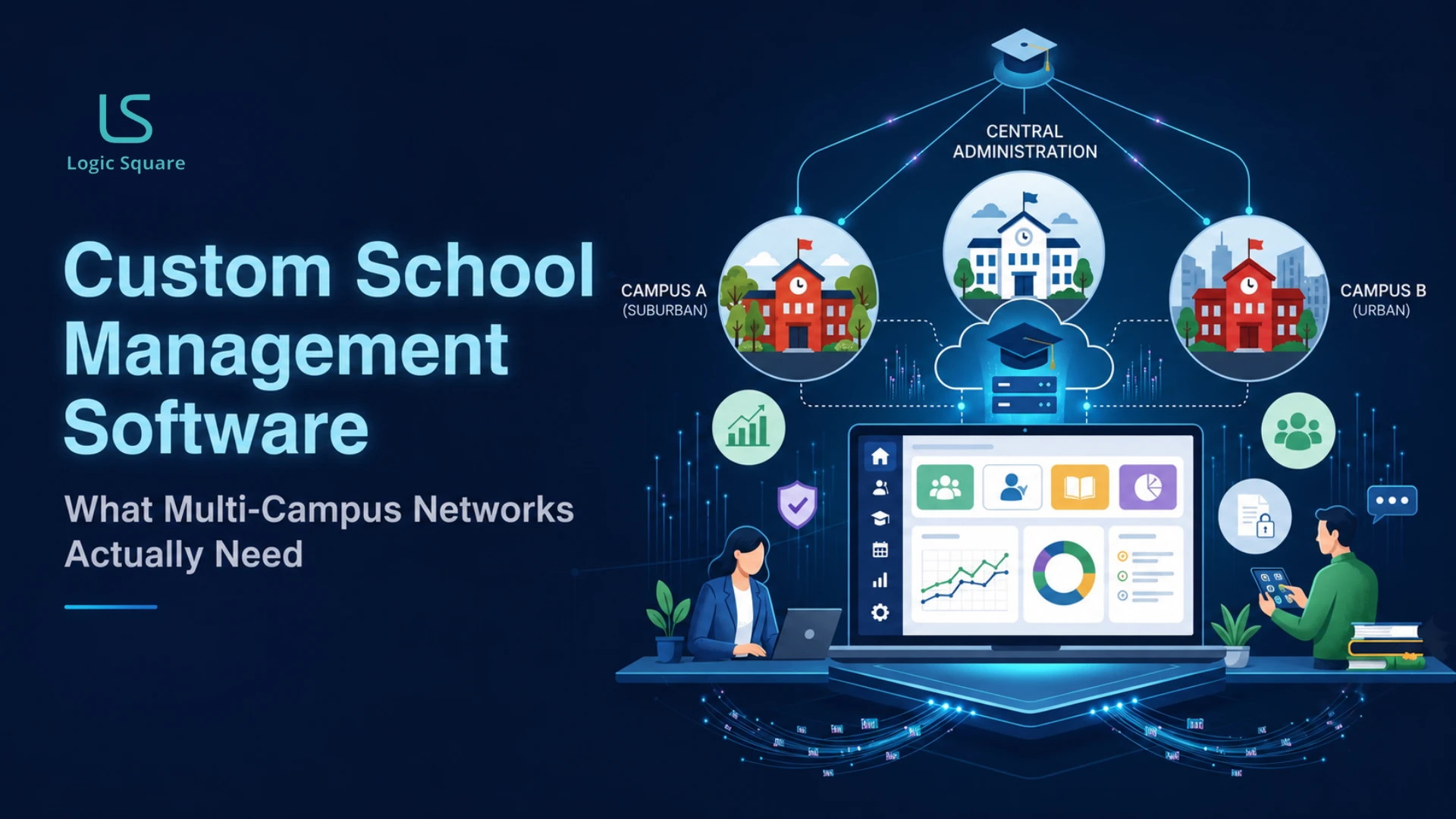
For multi-campus organizations, the need is increasingly for more than just digitization. It\’s for centralized operations, configurable workflows, real-time reporting, role-based access control and student-data privacy integrated into the platform\’s foundation.
However, successful education software is not just about functionality. Adoption, operational consistency and the proper treatment of student data in frameworks such as FERPA and COPPA are equally significant for organizations as they grow.
Why Adoption Matters More Than Feature Count
Foundations of an education software initiative’s failure are often rooted in the low level of organization adoption.
Even if business-critical non-technical educational systems are capable, they remain underused when campuses keep using uncoordinated spreadsheets, varied reporting formats or manual administrative procedures in parallel.
Thus, for multi- campus educational software, it was crucial to consider everyone who already exists; educator, administrator and their support teams. The software can be successful when it feels familiar, has simple usage and meets reporting needs and becomes a simple task.
Therefore, the best education software isn’t defined by the features but by operational success, ease of use in workflow and reporting.
Core Capabilities Multi-Campus Networks Typically Require
1. Centralized Multi-Campus Operations
Education networks require visibility across their campus staff, audits, evaluations and reporting from a centralized system.
Relying on disparate spreadsheets and tools managed independently across each site, without such a system results in ultimately inconsistent operations, reporting breakage and additional admin loads.
A centralized operations platform allows leadership teams to:
- Standardize workflows across campuses
- Improve reporting consistency
- Reduce duplicate administrative work
- Monitor operational performance network-wide
- Improve audit and accreditation readiness
2. Configurable Audits and Automated Scoring
Audit management is one of the most time-intensive administrative functions within education networks.
Manual audit workflows often involve:
- Creating forms manually
- Distributing evaluations across campuses
- Collecting responses through multiple channels
- Consolidating results manually
- Calculating scores and summaries separately
Custom platforms can facilitate this process through configurable audit templates, automated scoring, workflow tracking and centralized reporting.
For organizations with more than one campus, automation can greatly reduce administrative workload while enhancing reporting consistency and audit visibility.
3. Role-Based Access Control
Education systems involve multiple stakeholder groups, including:
- Network administrators
- Campus leadership
- Teachers
- Evaluators
- Auditors
- Support staff
- Read-only stakeholders
Each group requires different levels of access and visibility.
Role-based access control helps ensure users can only access information relevant to their responsibilities while protecting sensitive operational and student data.
In education environments, access control is not simply a security enhancement. It is foundational infrastructure for operational governance and data responsibility.
4. Professional Development and Evaluation Tracking
Managing teacher evaluations and professional development across multiple campuses becomes increasingly difficult through manual processes alone.
A structured platform can support:
- Professional development submissions
- Evidence uploads
- Supervisor approvals
- Automated reminders
- Evaluation tracking
- Organization-wide reporting dashboards
These workflows help reduce administrative coordination while improving operational visibility for leadership teams.
5. Real-Time Reporting and Accreditation Readiness
Education reporting requirements extend beyond internal administration.
Schools and education networks frequently need standardized reporting for accreditation bodies, audits, leadership reviews, and compliance processes.
Real-time reporting infrastructure helps organizations:
- Generate reports quickly
- Maintain standardized evaluation criteria
- Reduce manual compilation work
- Improve reporting accuracy
- Increase organizational visibility across campuses
For accredited education networks, reliable reporting capabilities become operationally critical.
In one school network, a purpose-built platform cut audit preparation from days to under four hours by replacing spreadsheet-based reporting with automated report compilation.
6. Student-Data Privacy and Security
Education software platforms manage sensitive information involving minors, which introduces significant operational and ethical responsibilities.
Frameworks such as FERPA and COPPA influence how educational institutions evaluate software systems, particularly around:
- Data access controls
- User permissions
- Record visibility
- Storage practices
- Data handling procedures
As a result, privacy and security considerations must be integrated into platform architecture from the beginning rather than added later as secondary features.
For education organizations, student-data privacy is foundational operational infrastructure.
Common Operational Challenges Schools Encounter
As education networks scale, several operational issues appear consistently:
- Low adoption of administrative systems
- Duplicate data-entry workflows
- Inconsistent reporting standards across campuses
- Limited visibility into operational performance
- Weak access-control structures
- Overreliance on spreadsheets beyond sustainable scale
These challenges rarely come from technology limitations.
They’re typically the result of operational processes that were never designed to scale across multiple campuses and stakeholder groups.
When Custom School Management Software Makes Sense
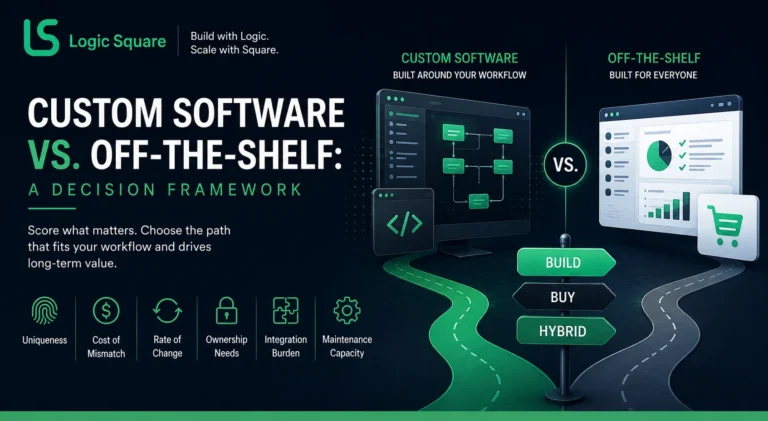
| Custom Software Is Often Appropriate When | Off-the-Shelf Software Is Often Sufficient When |
|---|---|
| Multiple campuses operate under centralized oversight | A single campus operates independently |
| Audit or accreditation workflows are highly specific | Operational workflows are standardized |
| Reporting requirements are complex and recurring | Reporting requirements are relatively simple |
| User-role structures are complex | Access-control requirements are limited |
| Existing workflows have outgrown spreadsheets | Current tools continue meeting operational needs |
Frequently asked questions (FAQs)
When should a school choose custom software over off-the-shelf?
When operational complexity becomes unique enough that spreadsheets or generic tools force painful compromises , multiple campuses, a unique audit or accreditation process, a heavy recurring reporting burden, or complex roles across stakeholders. A single school with standard workflows is usually better served by an off-the-shelf product, and we’ll say so.
Why not just use an off-the-shelf school management product?
For one school, you probably should. For a multi-campus school network with its own audit standards and style of evaluation and reporting, off-the-shelf systems force painful compromises—you shape your school to fit the system. Custom is only better when the operational complexity in question is real and part of how the network operates.
How long does it take to build a platform like this?
Time depends on the scope, but platform development is a matter of weeks to a few months for a first version that can run at a multi-campus system that will then be refined based on real usage. One microschool network platform we built took four weeks, then a couple more for feedback and tweaking.
How do you handle student-data privacy?
By treating it as a foundational design decision, not an add-on: role-based access so people see only what they should, careful handling and storage of sensitive records, and privacy considered from the first architecture conversation. Software touching data about minors carries real responsibility, and we build accordingly.
Can it integrate with the systems we already use?
Usually yes. Much of this work involves connecting to systems a network already depends on rather than replacing everything at once, so the new platform fits into the existing operation instead of forcing a disruptive switch.
Final Thoughts
For networks of multi-campus education, the operational complexity eventually grows beyond what spreadsheets and disparate administrative tools can manage.
Custom school management software can help centralize operations, standardize reporting, streamline audits and evaluations, improve visibility across campuses, and support responsible handling of student data.
At Logic Square Technologies, the focus is on building operational platforms designed around how education networks actually function — including multi-campus reporting, configurable workflows, role-based access control, and privacy-conscious system architecture.
The most effective education platforms are not simply feature-rich systems. They are systems designed for long-term operational usability, reporting consistency, organizational adoption, and scalability across the network.
Work with us