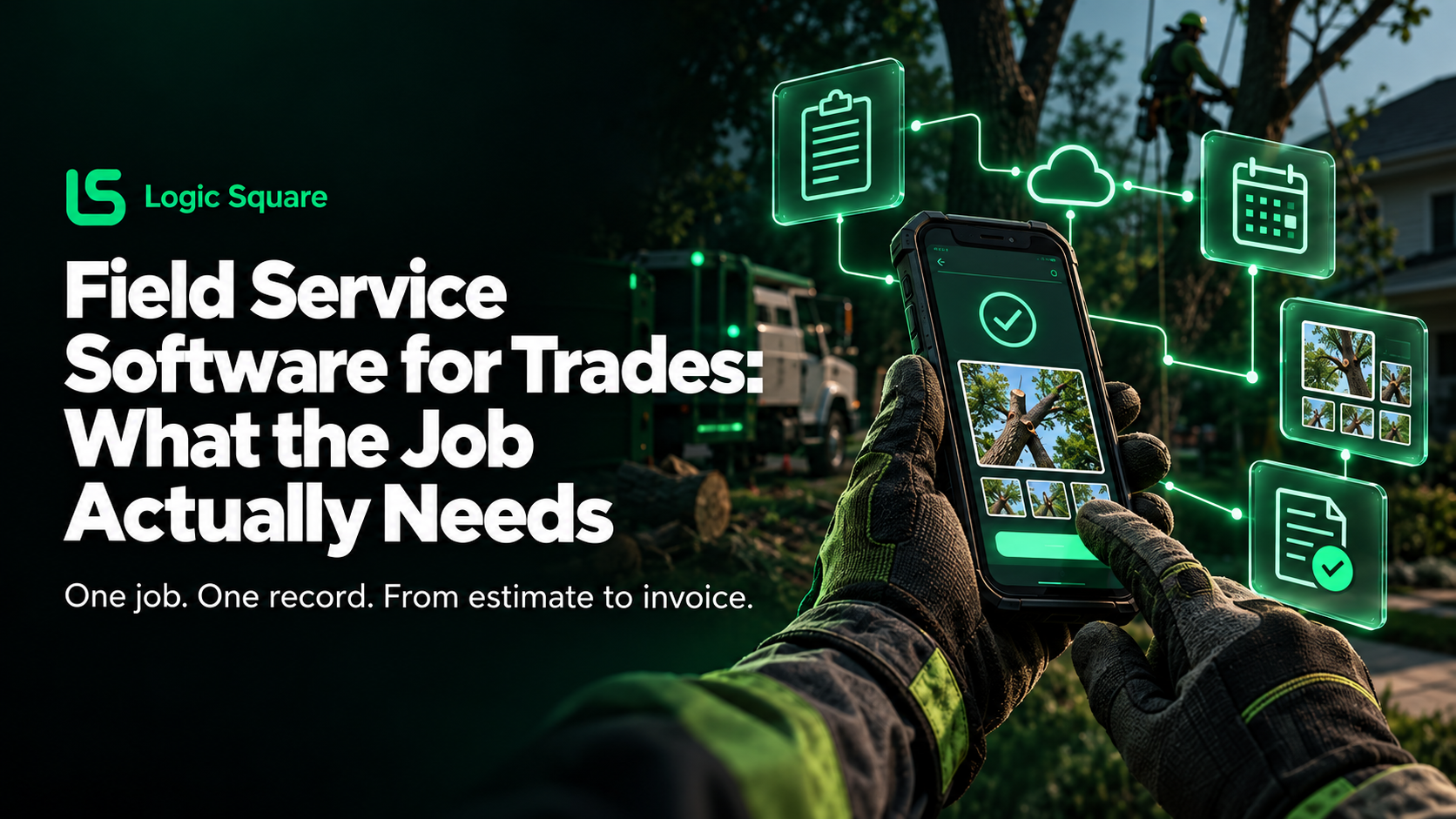
Across the trades and field-service operations we have designed for, the recurring backbone is similar: win the work, estimate it, get approval, schedule it, execute it in the field, bill it, and report on it. Software succeeds in this market when it models that chain end to end and remains usable by the least technical person on the crew, in gloves, in glare, with no signal. It fails when it models an office instead of a job.
On this page+
The backbone, and why point tools break it
Win, estimate, approve, schedule, execute, bill, report. Most trades operations run this chain across a quoting tool, a calendar, texts, paper, and an invoicing app, and the chain breaks at every seam: the approved estimate that never reaches the crew, the completed job that waits weeks to become an invoice, the report assembled monthly by hand. The value of an operations platform is not any single feature; it is that a job flows through the whole chain as one record.
The usability rule that decides adoption
Our design doctrine for field products, learned from building them: the system must work for the least technical user in the company, or it does not work. Field conditions make that concrete in ways office software never faces: gloved hands need big targets, sunlight glare needs high contrast, and connectivity cannot be assumed for even part of a job; some sites have none for the entire duration, which makes offline capture with background sync an architectural requirement, not a feature request. A platform that demands two-handed, small-target, always-online interaction will lose to the notepad it replaced.
The feature owners underestimate: customer visibility
The capability that has surprised trades owners in the field-ops products we have engineered is customer-facing visibility: letting the client see job status, approvals, and progress without calling the office. It converts the office’s most repetitive interruption into a screen, and it reads as professionalism the trade’s competitors cannot match. We have built this pattern into unreleased field-operations platforms for tree care and contractor trades; we make no usage claims for products that have not launched, but the design lesson stands on the engineering.
One job, walked through the chain
Take a single tree-removal job through the backbone and the leaks become visible. The inquiry arrives by phone and lives in someone’s memory until the estimate visit. The estimate gets written on paper or in a quoting app that doesn’t know the calendar exists. Approval comes back by text, to one person’s phone. Scheduling happens on a whiteboard the crew photographs on Mondays. Execution generates photos scattered across three phones and a WhatsApp thread. Billing waits until someone reconstructs what actually happened, days later, from memory and the photo thread. Reporting is a month-end argument with a spreadsheet. Every seam in that chain is a place where information is retyped, lost, or delayed, and the billing delay alone is often worth more than the software costs: work performed is cash the business has earned and cannot yet collect. An operations platform’s job is to make the same job one record from first call to paid invoice, so completion triggers invoicing instead of archaeology.
The adoption objection, answered from the field
“My crew won’t use software” is usually correct as stated and wrong as a conclusion, because the crew is rejecting the wrong software. The designs that survive field reality share traits you can verify in a demo: capture by photo and voice instead of typing, single-action updates (arrived, done, blocked), interfaces that assume gloves and glare, and full function with zero signal. If a platform demo requires a clean-handed person at a desk to look good, the crew’s skepticism is accurate. The doctrine holds: the field user’s job is the job, and the system that wins is the one that costs them the least attention while capturing what the office needs.
Where AI genuinely fits in the field
Two patterns from our field-ops engineering are worth stealing. Photo verification: AI checks completion photos against job requirements before the crew leaves the site, so a missing photo becomes a resubmit-now prompt instead of a return visit. And voice: crews who will never type a form will talk to one. Both respect the same doctrine: the field user’s job is the job, and software wins by demanding less of them, not more. In the field, usability is not a polish layer. It is part of the architecture: if the least technical person cannot capture the job quickly, offline, with gloves or glare, the system has not modeled the job.
Do we need custom software or a field-service SaaS?
If a good vertical SaaS models your chain, use it; the build case begins where your workflow, pricing, or customer experience is the business. See our custom-vs-off-the-shelf guide for the decision logic.
What breaks first when a trades business grows?
The informal glue: the estimate in one person’s head, the schedule on one phone. Growth doesn’t break tools; it breaks unshared context.
Run a trades operation on five apps and a whiteboard?
Walk us through one job’s journey and we’ll show you where the chain leaks: book a strategy call.
Work with us