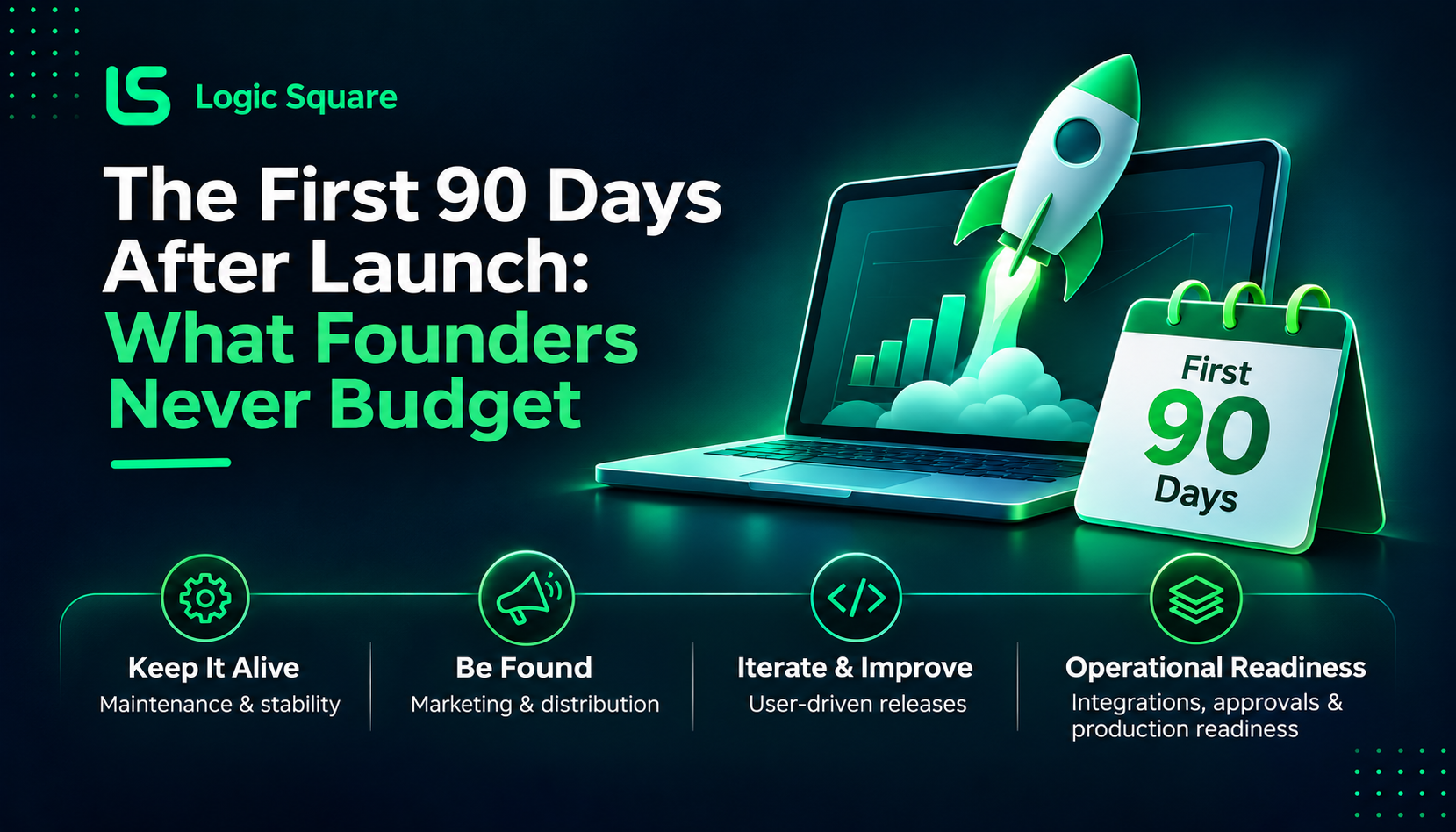
Launch day is not the end of the budget; it is the day the budget changes shape. In our experience, founders consistently plan to the launch and not through it, and a good product can still run out of runway because marketing, iteration, and operations were treated as someone else’s later problem. The first 90 days have four predictable cost centers, even though the amount you should reserve for each will vary by product.
On this page+
Cost one: keeping it alive
Maintenance begins immediately: dependency updates, compatibility, monitoring, and the bugs that only real usage finds. Our standard model prices this at 20 percent of build cost annually (with a quarterly option), and whether you buy that from us or staff it yourself, the number exists. A launch plan without a maintenance line is a plan to be surprised.
Cost two: being found
The most common post-launch failure we observe is not technical. The product ships and the founding energy that drove the build does not transfer to distribution: marketing, sales motion, and the unglamorous repetition of putting the product in front of people. Software rarely sells itself, regardless of how good the product is, and the first 90 days are when that either becomes a funded workstream or becomes the reason a good product stalls. Budget distribution like a feature, because it decides whether the features matter.
Cost three: the iteration you promised yourself
Real users immediately generate the truest roadmap you will ever have, and acting on it costs engineering. The discipline that protects this budget: batch the learnings into releases rather than streaming them (streamed changes are how a $25,000 scope became five times that in our history), and let usage data, not stakeholder enthusiasm, pick what ships. The first 90 days’ iteration budget is where the MVP becomes a product; spend it on evidence.
Cost four: operational readiness
The launch-week class of problems is operational: the integration partner whose configuration changes, the store review that adds a week, the payment provider whose production readiness turns out to differ from its sandbox. We have lived each of those. They cost calendar more than cash, and the budget for them is buffer: dates promised to customers should carry the operational slack your dependencies deserve.
A worked example of the four numbers
Take a $60,000 build as the concrete case. Maintenance at our standard 20 percent is $12,000 for year one, so $3,000 a quarter is spoken for before any growth spending. Distribution needs either money or named hours: a founder committing ten hours a week to sales conversations is a real budget line even though no invoice exists; zero of either is the demo-with-a-domain scenario. The iteration reserve is a judgment call made explicitly, and the honest way to size it is to treat the first-quarter fix list as one planned release, scoped like any release. The runway floor is whatever number, if crossed, ends the company’s ability to keep operating while the above plays out. If the four lines don’t fit inside the money available, the correct early move is a smaller version one, which is precisely how the $13,000 build that later supported $8M+ in sales was sized: to leave room for everything after launch.
FAQs
Isn't 90 days of iteration a sign the build was bad?
The opposite. A build that generates a sharp correction list quickly is one users actually touched; silence is the bad sign.
Can the dev team handle post-launch informally?
Someone specific on the hook, with a scope and a number, beats goodwill every time; our vetting guide's question eight exists for exactly this.
What if we can't afford all four lines?
Shrink the build, not the lines. A smaller product that can be marketed, fixed, and maintained beats a bigger one that launches into silence.
The 90-day budget, on one line
Treat maintenance and iteration as separate lines rather than one blended percentage. Our standard maintenance model is 20 percent of build cost annually; add an iteration reserve sized to the product’s expected learning rate, which is a judgment call and should be made explicitly rather than hidden inside a rounded number. Then add a real distribution budget sized to your market, and two to four weeks of calendar buffer for operational reality. If the total breaks the plan, the plan was smaller than the product, and it is far cheaper to learn that before launch than during month two.
One habit that makes all four numbers easier next time: log actuals against the plan for your own first 90 days, because the gap between them is your company’s personal correction factor, and it is worth more than any industry benchmark, including ours.
Planning a launch? Show us the post-launch budget; if it’s a blank cell, that’s the meeting.
Work with us