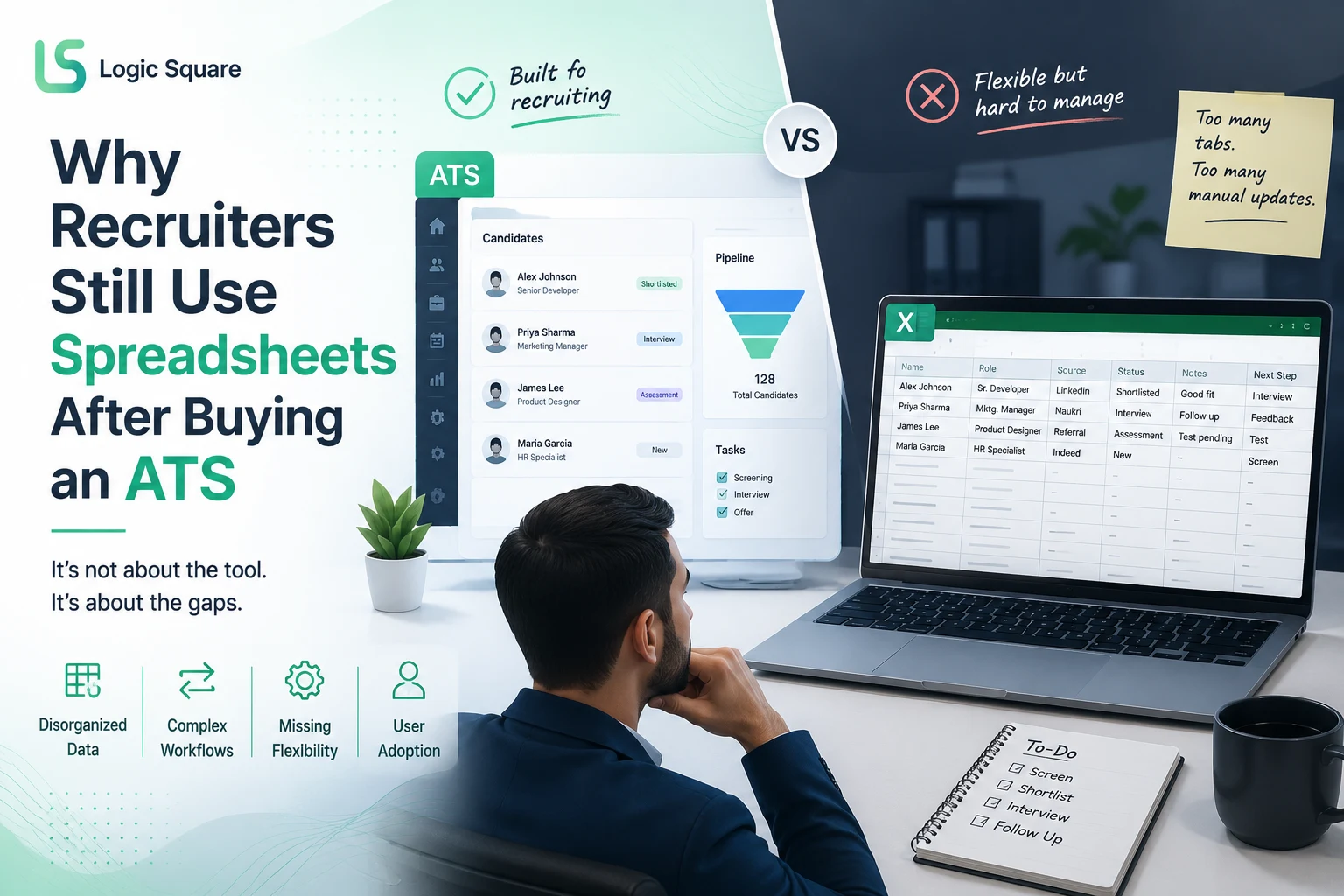
Recruiters fall back to spreadsheets after buying an ATS because the spreadsheet was never just a data store. It was a bundle of informal workflows, habits, and workarounds, and the ATS has to absorb every one of them or the team quietly routes around it. We know because we built an ATS, watched a real agency pilot it, and watched Excel survive three separate elimination attempts.
On this page+
The pilot that taught us how adoption actually works
The agency piloting Smoothire ran on very large Excel files before the system existed: tens of thousands of candidate records in spreadsheets heavy enough to hang while loading. The database grew from roughly 50,000 records to around 150,000 as the team scaled from seven people to about 25. At seven people and 50,000 records, Excel genuinely worked; everyone knew the informal rules. The complete Smoothire case study explains how the platform was built around the agency’s actual recruitment processes and growing candidate data. At 25 people and 150,000 records, the informal rules stopped being shared knowledge, new hires interpreted them differently, and the process that lived in people’s heads stopped being a process.
That threshold matters more than any feature list: the old process didn’t suddenly become bad. The organization outgrew the assumptions that made it work. This is often when spreadsheets stop scaling: the information still exists, but the processes, ownership and shared understanding around it begin to break down.
Excel's three survival strategies
Round one: the stated objection. The team happily moved candidate records into the system but refused to use it for the workflow that actually touched clients, sending selected candidates out. Their reasons were real: they didn’t want product branding visible to their clients, and different clients demanded different submission formats. We treated those as requirements, not resistance: a default export format, client-specific configurable formats, and per-submission overrides.
Round two: the silent one. Weeks later, usage still lagged. It felt, honestly, like pushing schoolchildren to do homework. The eventual discovery: emails weren’t going out. A small bug, easily fixed. The real problem was that nobody told us. They just went back to emailing Excel sheets to clients, and by the time we found out, weeks of old-process momentum had rebuilt itself.
Round three: none. Once the bug was fixed, adoption held. The lesson we now design and manage around: when users resist a new system, something specific is usually stopping them, and they will rationalize reverting rather than report it. The question that fixes adoption isn’t “why won’t you use the software.” It’s “what is the spreadsheet still doing for you?”
What agency software has to model that corporate ATSs don't
A recruitment agency’s spine is client, mandate, submission, placement, with different formats, rules, and commercial arrangements per client. Corporate ATSs model a company hiring for itself. That mismatch is why agencies in particular end up with spreadsheets bolted to the side of expensive software: the tool models the wrong business. Effective staffing and recruitment software development starts by modelling these agency-specific relationships and workflows instead of forcing them into a generic corporate ATS structure.
This is a titleWhat the software changed, said carefully
The agency grew from about seven people to 25 to 27 in the pilot period, and we won’t claim the software caused that growth; more people produce more business. What the system did was make the growth operationally survivable: centralized data, permissions, standardized workflows, and search at a volume where Excel had already started hanging. Owners got something else too: activity visibility. Not for hour-by-hour micromanagement, but because measurable activity creates its own accountability, and when performance questions eventually come, the conversation starts from data rather than impressions. With AI on top, the system surfaces the handful of patterns worth a manager’s attention instead of asking anyone to read thousands of activity records.
FAQ
Why do recruiters resist new ATS systems?
Because the spreadsheet encodes workflows the ATS doesn't model, and because small blockers get worked around instead of reported. Solve the stated objection, then go find the unstated one.
When does a recruitment agency actually need an ATS?
Our observed threshold wasn't a number; it was the point where informal rules stopped transferring to new hires. For the agency we watched, that was the jump from seven people and 50K records toward 25 people and 150K.
Does activity tracking mean micromanaging recruiters?
Used well, the opposite: visibility replaces surveillance, and managers investigate exceptions instead of monitoring everyone.
Running an agency on spreadsheets plus an ATS nobody loves?
Tell us what the spreadsheet still does for your team and we'll tell you what would actually fix it: book a strategy call.
Work with us