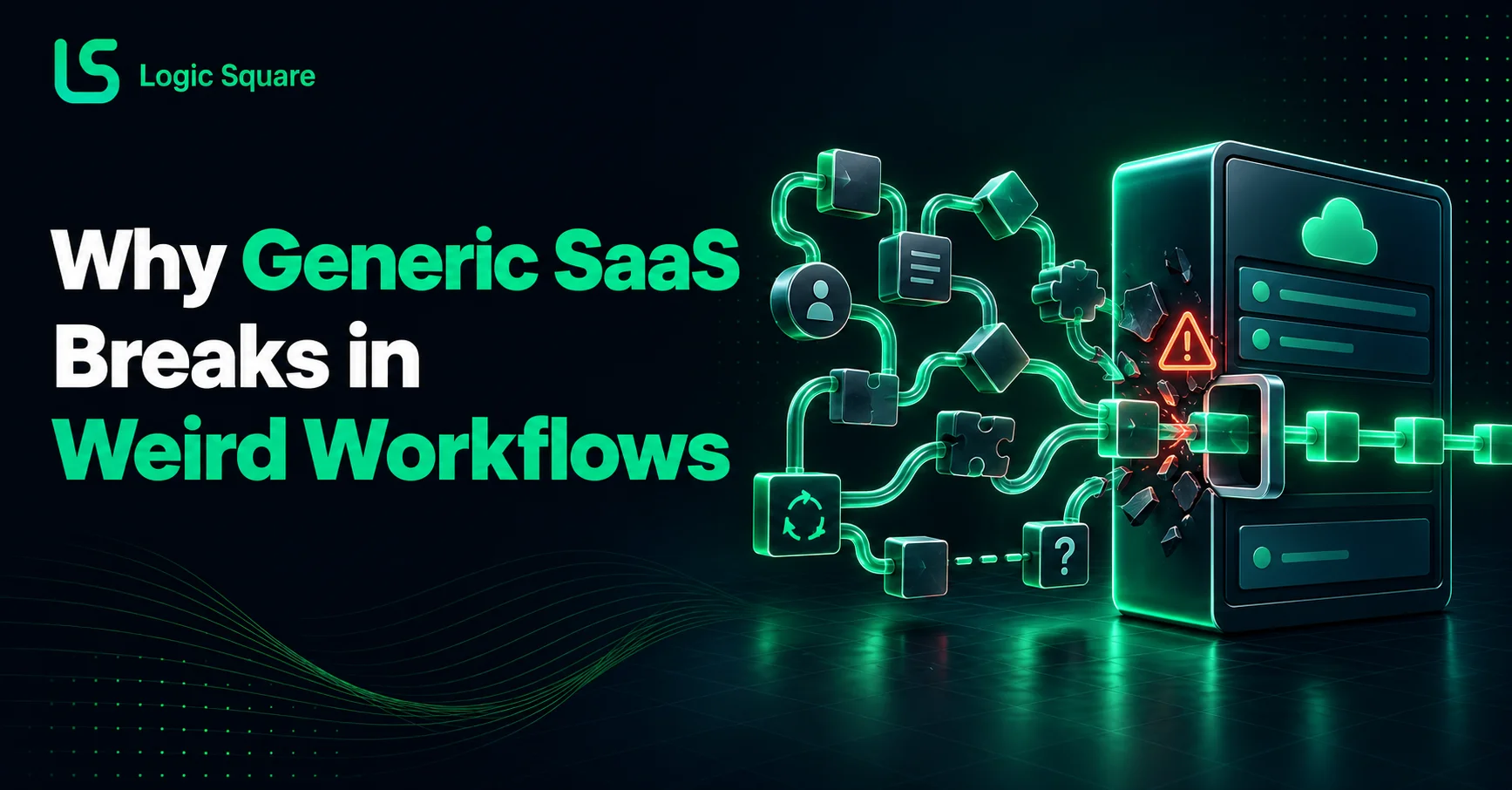
| AT A GLANCE Generic SaaS is built around the common case the way most companies do a given task. That’s exactly why it works so well for standard work and breaks on unusual work. When your workflow has a genuine quirk — a step out of order, an extra approval, a relationship the tool has no concept of the software can’t bend to it, so your team bends instead: workarounds, duplicate entry, spreadsheets alongside the tool, steps done by hand. The breakage isn’t a bug. It’s the tool doing exactly what it was designed to do, on a workflow it was never designed for. |
Almost every company has at least one workflow that’s a little strange a process that grew around how the business actually works rather than how the textbook says it should. For most tasks, that’s fine, because off-the-shelf software handles the standard 80% well. The trouble starts on the weird 20%, and understanding why it breaks there tells you a lot about when to stop fighting the tool.
| Generic SaaS doesn’t break on the unusual parts by accident. It breaks there by design. |
On this page+
Why “generic” and “flexible” aren’t the same thing
SaaS vendors sell flexibility — custom fields, configurable workflows, automation rules — and within limits, it’s real. But flexibility inside a generic tool is flexibility within the shape the vendor anticipated. You can rearrange the furniture; you can’t move the walls. The tool was built around a model of how the work is done, and that model is baked into its data structure, its assumptions, and its logic. When your workflow fits that model, configuration is plenty. When your workflow contradicts the model — not just decorates it no amount of configuration reaches it.
The three ways the breakage shows up
- The tool has no concept of the thing you care about most.
This is the deepest kind of mismatch. A generic applicant tracking system, built for companies hiring for themselves, has no concept of a client — but a staffing agency’s entire business is placing candidates with external clients. You can’t configure your way to a concept the data model doesn’t contain. The tool isn’t missing a feature; it’s missing the idea.
- The workflow runs in an order the tool won’t allow.
Sometimes the tool has all the right pieces but insists they happen in a sequence that isn’t yours. It wants approval before submission; you submit then approve. It assumes one step finishes before the next begins; yours overlap. The software enforces an order that fights your reality, and your team spends its days working around the enforcement.
- The exception is the rule.
Generic tools handle the common path well and treat the unusual path as an exception to be handled manually. That’s fine when exceptions are rare. But in many real businesses, the “exception” is a large part of the work — the special client, the non-standard deal, the edge case that’s actually half your volume. When the exception is the rule, a tool built for the common case quietly pushes most of your real work into manual workarounds.
| The symptom | The underlying cause |
|---|---|
| Spreadsheets running alongside the tool | The tool can’t hold part of the real workflow |
| The same data entered twice | The tool’s model doesn’t match yours |
| “We just do that part by hand” | The exception is actually the rule |
| Endless custom fields and workarounds | Configuration is reaching its limit |
Why the workarounds are the real cost
When a tool can’t bend, people bend. That’s the hidden cost, and it compounds. Every workaround is manual work the software was supposed to remove, every duplicate entry is a chance for the numbers to diverge, and every “we just handle that part outside the system” is a piece of the business the tool isn’t actually running. The subscription says you have software for this. The day-to-day says your team is the software for the part that matters. That gap is the true cost of forcing a distinctive workflow into a generic tool, and it doesn’t show up on the invoice. Here’s a useful threshold: if the workaround has become a permanent part of how the work gets done — not a temporary patch, but a step everyone now just knows to do — the workflow has probably outgrown the tool. A one-off exception is fine. A workaround that’s effectively part of the business is the signal. It shows up across industries. A multi-campus school using a student system built for a single campus ends up keeping a master spreadsheet to reconcile across locations the tool treats as separate. A telehealth operator whose intake, consult, and storefront live in three disconnected tools spends staff time shuttling information between them. A finance team whose approvals run in an order their software won’t allow does half the process by email. Different industries, same mechanism: the tool’s model didn’t match the workflow, so the people filled the gap.
| When the tool can’t bend, your team bends. That’s the cost and it never shows up on the invoice. |
What to do when you hit the wall
Hitting this wall doesn’t automatically mean build custom. It means the question is now worth asking deliberately. The useful next step is to look honestly at the weird workflow and ask three things: is it genuinely core to how we compete, or just habit we could change? Is the workaround cost real and growing, or a minor annoyance? And is there a more specialized tool — built for our kind of business rather than for everyone — that already fits? If you’re weighing whether to leave the tool altogether, start with the signs you’ve outgrown SaaS. Sometimes the answer is to change your process to match a good tool. Sometimes it’s to find software built for your specific industry instead of the general market. And sometimes — when the workflow is genuinely distinctive, core to the business, and expensive to force — it’s to build custom software around the part that makes you different, while still buying the commodity pieces. Our custom software development solutions are designed around these distinctive workflows, connecting the systems you already use while giving you ownership of the operational layer that differentiates your business That’s the same build-versus-buy judgment we apply everywhere; weird workflows are just where the question gets asked most often. Use this custom software versus off-the-shelf decision framework to evaluate workflow fit, integration requirements, ownership, maintenance, and the operational cost of compromise.
Frequently Asked Questions
Why does off-the-shelf software break on unusual workflows?
Because it’s built around the common case — a model of how most companies do a task, baked into its data structure and logic. Configuration lets you adjust within that model, not contradict it. When your workflow genuinely differs, the tool can’t reach it, and your team absorbs the gap through workarounds.
Isn’t SaaS supposed to be configurable?
It is — within limits. You can rearrange what the vendor anticipated, but you can’t move the underlying model. Configuration handles workflows that fit the tool’s assumptions; it can’t add a concept the data model doesn’t contain or reverse an order the tool enforces.
Does a poor SaaS fit always mean we should build custom?
No. First ask whether the workflow is genuinely core or just habit, whether the workaround cost is real and growing, and whether a more specialized tool already fits. Build custom only when the workflow is distinctive, central to the business, and expensive to force — and even then, usually only around that part.
How do I know if my workflow is the problem or the tool is?
Look at where the workarounds cluster. If your team keeps spreadsheets alongside the tool, enters data twice, or handles a big chunk of work “outside the system,” the tool’s model doesn’t match your workflow. Whether to change the workflow or the tool is the judgment worth making deliberately.
Fighting a tool that won’t fit how you actually work?
We help companies figure out whether the answer is changing the process, finding a more specialized tool, or building custom around the distinctive part and we’ll tell you honestly which. Veteran-led, building production software since 2012. Book a Strategy Call
Work with us