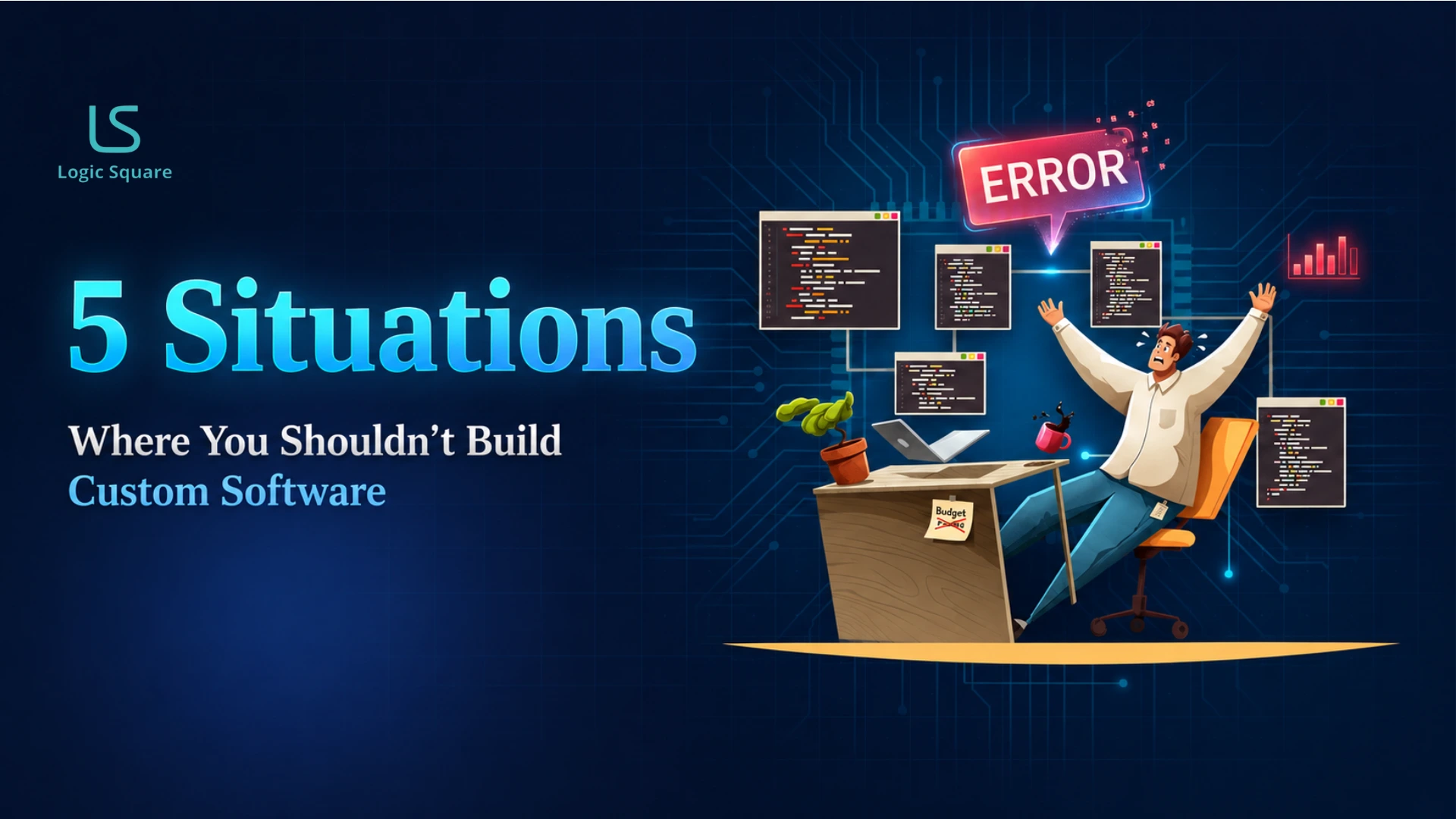
Custom software is not always the right answer. There are five situations where building custom software usually creates more complexity than value: when a mature SaaS product already fits, when workflows are still evolving, when no one internally will own the system, when the real issue is process rather than technology, and when a prototype can answer the question more affordably.
The most successful software investments happen when the workflow is stable, strategically important, and clearly owned internally. In many other situations, the better decision may be to buy, prototype, wait, or improve the process first.
Many software companies will recommend building custom software by default. In reality, experienced software teams know that building is only the right decision in specific situations.
At Logic Square Technologies, one of the most important lessons from years of delivering production software is this: recommending software a business does not truly need creates long-term friction, while honest guidance builds long-term trust.
Here are five situations where custom software is often the wrong move — even for a company that builds custom systems professionally.
On this page+
1. When a Mature SaaS Product Already Fits
When an established SaaS platform works well for most of the problem, and the remaining pieces are largely about choice and comfort, buying has advantage.
Creating an in-house version of a product, developed over many years by a large engineering team, almost never offers an advantage. It ends up costing more, it develops slower, and you take on a long-term maintenance responsibility.
A useful test is this:
- Is the missing 10–20% creating measurable operational cost?
- Or is it simply not designed exactly the way you would prefer?
If the issue is preference, custom development is often an expensive way to solve it.
In many cases, the smarter approach is to adopt the SaaS platform and build only a lightweight differentiating layer around it, if needed.
2. When the Workflow Is Still Changing Every Few Weeks
Custom software works best when it\’s built on a stable process.
If workflows are still in flux, because the business is early-stage, the market is shifting, or the team is still finding the right way to operate, building too early means rebuilding again and again.
Which is one of the most costly ways to figure out what the business really needs.
When workflows are still evolving, the better path is often to:
- wait until the process stabilizes, or
- prototype the workflow inexpensively before committing to full-scale engineering.
3. When a Prototype Can Answer the Question More Affordably
4. When No One Internally Will Own the System
Not every idea requires production-grade software immediately.
Sometimes the real goal is simply to validate whether:
- users actually want the solution,
- the workflow makes sense, or
- the operational model works in practice.
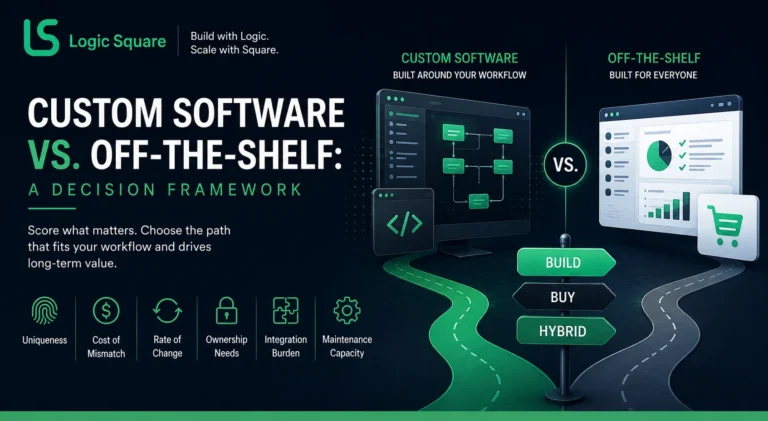
AI tools, low-code systems, and rapid prototyping approaches can often provide these answers quickly. Our build vs buy vs AI framework breaks down how to choose between them.
The key distinction is understanding that:
- prototypes are for learning,
- production systems are for scale, reliability, and long-term operations.
One common mistake businesses make is pushing a successful prototype directly into production without properly rebuilding the system for operational use.
Use prototypes to validate assumptions first. Build production software deliberately once the business case is proven.
Software is not a one-time purchase. It is an operational system that requires ongoing ownership.
Every successful custom platform needs someone internally who:
- understands why the system exists,
- prioritizes changes,
- monitors operational drift, and
- drives long-term adoption.
Without internal ownership, even technically strong software gradually becomes outdated and underused.
Before beginning a custom build, one critical question should always be answered:
Who will own this system after launch?
If there is no clear answer yet, that issue should be solved before development begins.
Software that nobody owns is software that nobody maintains.
5. When the Real Problem Is Process, Not Software
This is often the hardest situation for organizations to recognize.
Sometimes operational friction is not caused by missing technology. The actual issue may be:
- unclear responsibilities,
- inconsistent workflows,
- disconnected teams, or
- lack of agreement on how work should happen.
In these situations, building software does not solve the problem. It simply digitizes the confusion.
Software is extremely effective at scaling processes that already work well. It is equally effective at scaling broken processes.
That is why process clarity should come before software implementation.The same principle applies when employees adopt unofficial tools to work around unclear or broken processes. Understanding the hidden cost of shadow IT helps businesses treat these workarounds as signals of an organisational problem rather than automatically building more software.
In many cases, the most valuable next step is not a development project — it is an operational conversation about how the business actually functions.
So, When Should You Build Custom Software?
Custom software becomes a strong strategic advantage when:
- the workflow is core to the business,
- the process is stable enough to standardize,
- existing SaaS products create measurable operational limitations,
- the system will have clear internal ownership, and
- the underlying process already works effectively.
In those situations, custom software can create operational advantages that generic tools simply cannot provide.
The real value is not in building software for everything. It is in knowing which problems are actually worth building for.
At Logic Square Technologies, that judgment is considered part of the service — not a lost opportunity.
The Decision, in One Table
| Your Situation | The Better Move |
|---|---|
| A mature SaaS product fits 80–90% of your needs | Buy it |
| The SaaS gap is causing measurable operational cost | Build only the differentiating layer |
| The workflow is still changing frequently | Wait or prototype first |
| You need to validate whether the idea works | Prototype to learn |
| No one internally will own the system | Don’t build yet |
| The real issue is process confusion | Fix the process first |
| The workflow is core, stable, and owned | Build custom software |
Frequently Asked Questions(FAQs)
Isn’t it against your interest to tell clients not to build?
Short term, sometimes. Long term, no.
Businesses value software partners who provide honest guidance rather than pushing unnecessary development. Trust compounds over time, while poorly advised software investments usually do not.
How do you know whether a workflow is stable enough to build around?
A practical benchmark is whether the core process has remained largely consistent for the last six to twelve months.
If the workflow is still changing every few weeks, it is usually better to wait or prototype first.
What if SaaS almost fits, but not completely?
The key question is whether the gap creates measurable operational cost.
If the limitation genuinely impacts efficiency, scalability, or revenue, building may make sense. If it is primarily a design preference, buying is usually the better decision.
Often, the ideal solution is combining SaaS with a lightweight custom layer for differentiation.
Can Logic Square help evaluate whether custom software is the right move?
Yes, Many engagements begin with evaluating whether custom development is actually necessary. If building is not the right decision, the recommendation may instead be to prototype, optimize processes, or adopt existing tools more effectively.
Not Sure Whether Your Business Should Build?
Custom software creates the most value when it supports a stable, strategically important workflow that cannot be handled effectively through existing tools.
But not every operational challenge requires a custom platform. In many cases, the smarter decision is to improve the process first, validate assumptions through prototyping, or adopt an existing SaaS solution that already solves the problem well.
The strongest technology decisions are not driven by the desire to build software everywhere. They are driven by clarity around where software will create meaningful operational advantage.
At Logic Square Technologies, helping businesses make that distinction is considered just as important as the development itself.
Work with us