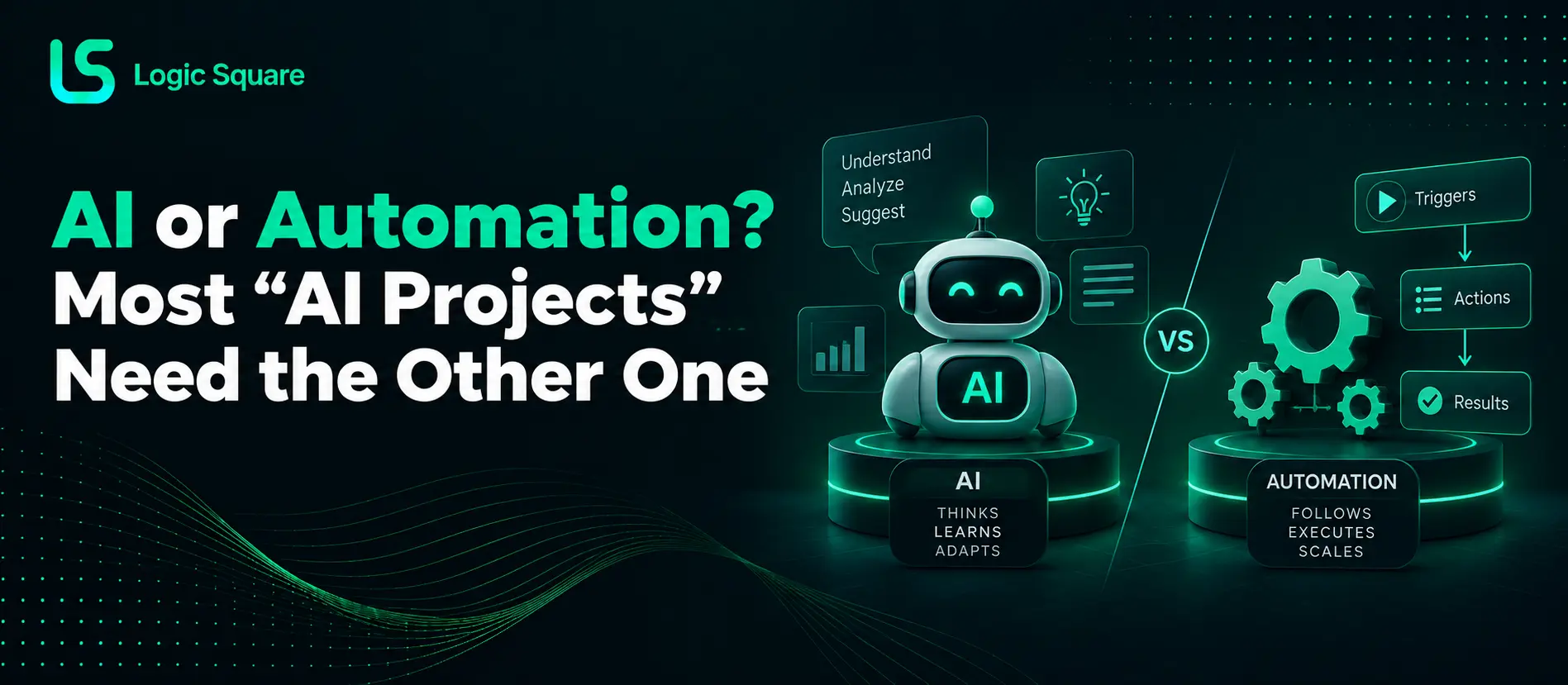
The AI decides what you meant; the automation decides what happens. That is the working rule from our builds, and it matters because a surprising number of “we need AI” requests contain large stretches of deterministic work that should not be delegated to a model. If a task follows explicit rules, deterministic automation is cheaper, faster, and more reliable. If a task requires interpretation of unstructured input, that is where AI belongs. The best systems use both, in exactly those places.
On this page+
The rule, applied to a real system
Our own AI assistant is the cleanest illustration because it uses both halves deliberately. The AI’s job is interpretation: understanding what a person is asking for in natural language, which no rule set can do. Everything after interpretation is deterministic: the actual data retrieval runs as structured queries with explicit permission checks, because when the outcome has one correct answer (permissions, balances, status transitions), the final business-state decision should remain deterministic and testable. Swap those responsibilities and you get a system that is expensive where it should be cheap and unreliable where it must be exact.
How to classify your own process
Ask of each step: could a competent new hire execute it correctly from a written checklist alone? If yes, it is automation: approvals routing, status updates, notifications, data transfers, calculations, permission checks, report generation. If the step requires reading something messy and deciding what it means (a resume, a document, a photo, a free-text request), it is an interpretation task and a genuine AI candidate. Many business processes are mostly deterministic, with a few steps that genuinely require interpretation. That is why AI often belongs at two or three points rather than everywhere. Our guide to where AI actually belongs in an application explains how workflow position, user behavior and evaluation requirements determine which AI features deserve to be built.
What choosing wrong costs
AI where automation belongs: you pay inference costs forever for answers a rule computes free, you accept probabilistic behavior in steps that have exactly one correct outcome, and you inherit evaluation and guardrail engineering for a task that never needed judgment. Automation where AI belongs: you build brittle rule trees that shatter on real-world input, then maintain them forever. Both mistakes are common; only one of them is currently fashionable. Apply the when AI actually helps framework before scoping the project to separate genuine interpretation work from predictable rule-based execution.
Worked triage: an invoice-processing request
“We want AI to handle our invoices” arrives weekly somewhere, and the rule dissects it cleanly. Reading a PDF that could be any vendor’s layout and extracting what it means: interpretation, genuine AI work, and the part worth paying for. Matching the extracted vendor against your records, checking the PO number, validating totals, routing for approval by amount, posting to the ledger, and notifying the requester: every one of those is a checklist step with one correct outcome, and every one should be deterministic automation with an audit trail. The honest project is one AI component wrapped in workflow automation, priced accordingly. The project that gets sold instead is “AI-powered invoice management,” end to end probabilistic, expensive where it should be free and unreliable where it must be exact. Run any process request through this dissection before any vendor conversation, and you’ll arrive knowing what you’re actually buying.
The staging discipline
Even where AI genuinely belongs, stage it behind evidence. We once automated a compliance-adjacent onboarding workflow before demand justified it and lost roughly two months; the anecdote is about staging discipline, not about automation being wrong, and the same discipline applies double to intelligence. Ship the deterministic spine first, watch where humans actually spend interpretation effort, and add AI exactly there. The workflow will tell you where it needs a brain; you don’t have to guess.
FAQs
How do we budget a mixed AI-and-automation project?
Price the deterministic spine as normal workflow engineering, price each interpretation point with evaluation work included, and refuse any quote that prices the whole process at AI rates.
Isn't AI just better automation?
No. Automation executes rules; AI interprets ambiguity. Conflating them is how projects end up with both technologies' costs and neither's strengths.
Can we add AI to our existing automations later?
Usually yes, and it's often the right order: see our guide to building AI into existing software.
Can automation and AI share one workflow safely?
Yes, and the seam is the design: interpretation produces a structured claim, and deterministic code validates and executes it, so a model's mistake becomes a rejected input rather than a wrong action.
How do we know if a vendor is selling us the wrong one?
Ask them which steps of your process are deterministic and watch whether the answer is specific. The rule above takes one meeting to apply.
The dissection also rewrites vendor conversations: instead of asking “can you add AI to our process,” you arrive saying “these two steps need interpretation, the rest is deterministic,” and the quotes you receive become comparable, because everyone is finally pricing the same project. Our AI workflow automation and integration services apply this structure by placing AI around interpretation while keeping permissions, calculations and business-state changes deterministic.
Work with us