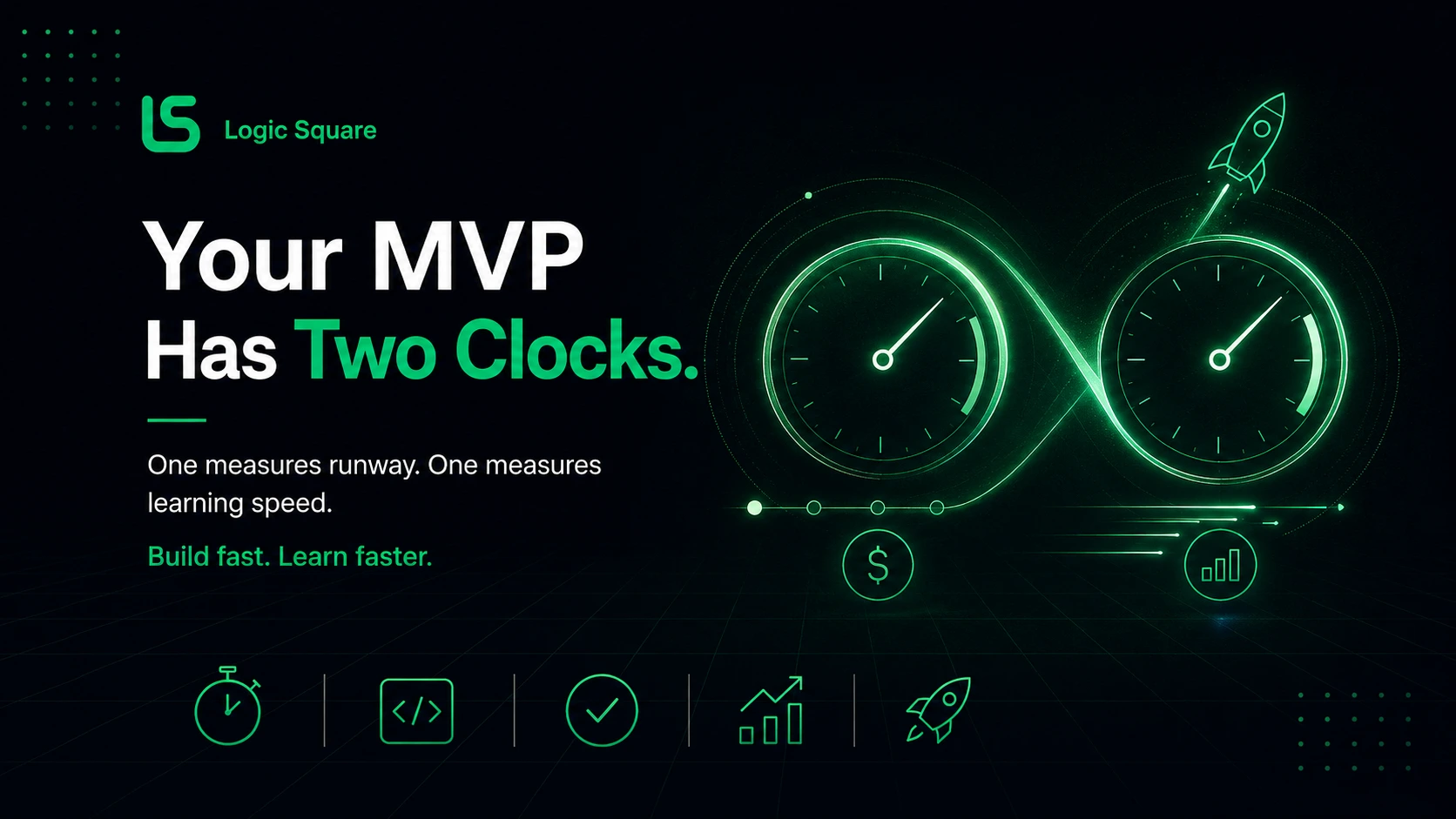
Every MVP runs on two clocks. The Build Clock covers design, development, testing, and deployment, and AI has compressed it dramatically: for focused products in our current delivery mix, work that once took months can sometimes be engineered in roughly six to eight weeks, and planning that took one to two weeks now takes one to two days, prototype included. The Waiting Clock covers approvals, stakeholder reviews, third-party onboarding, and operational readiness, and it has barely moved. Founders plan the first clock. The second one decides their launch date. Our custom software development cost guide explains how scope, complexity and delivery choices affect the budget behind that timeline.
On this page+
The two clocks in one real project
One recent engagement, end to end: approval took four months. Development took six weeks. Client review took two to three more weeks. The pilot then slipped another two months for operational reasons on the client side. The Build Clock ran under a fifth of the elapsed time. Another engagement: ten weeks of development, then roughly eight months of operational rollout. If you only plan the Build Clock, you are planning a minority of your own timeline.
What compressed the Build Clock
AI-assisted development, and something less discussed: accumulated knowledge. We rebuilt the third version of one of our own products, at least 80 percent improved, in roughly two and a half months, and the biggest accelerant was not the tooling. It was building with everything two operated versions had taught us. Speed compounds with knowledge; tools multiply it.
What the Waiting Clock is made of
Your approval chain and your stakeholders’ calendars. App store review: one of our launches took an extra week in Apple’s queue. Payment-provider onboarding, which in our hardest case consumed months across five processors. Integration partners whose readiness you don’t control. Internal operational rollout. None of these care how fast the code was written, and every one of them belongs in your plan with a date next to it.
The trap inside the fast clock
Compressed building creates its own delay: AI-assisted teams produce much more code in far less time, and someone still has to review, understand, and maintain it. The same volume of decisions lands in a fifth of the calendar. This compression changes both the timeline and the cost of developing an MVP, but only when review, scope control and production readiness are included in the estimate. The teams that stay fast are the ones with rules, conventions, and review protocols set before generation starts; without them, the Build Clock’s savings quietly leak into rework, and in one project we watched, streamed changes turned a $25,000 scope into roughly five times that: scope itself grew about 40 to 50 percent, and rework on already-built features did the rest.
How to actually shorten your timeline
Resolve arguments at the prototype stage, where a change costs a conversation instead of rework. Batch ideas into releases; features abandoned midway and picked up months later cost extra every time. Start payment and integration onboarding on day one of the build, not week one of launch. And write your own approval dates into the plan next to ours, because in our experience they are the longest line items on it. See how we approach software product development for founders, including phased delivery, production readiness and the operational work surrounding launch.
FAQs
Does a bigger budget shorten the timeline?
Only on the Build Clock, and only somewhat; no budget accelerates your own approval chain, a processor's onboarding queue, or an app store's review. The money that most reliably buys time is the money spent resolving decisions at the prototype stage.
How long does an MVP take in 2026?
For focused products in our current delivery mix, engineering can sometimes be completed in roughly six to eight weeks. The elapsed calendar is usually longer once the Waiting Clock is counted, often two to three times.
Can AI build my MVP in days?
It can build a prototype in one or two, and we often provide one free. A production system is engineering; one founder we know assumed otherwise and spent about a year finding out.
Do agencies quote the Waiting Clock?
Rarely, because it isn't theirs to control; that silence is why founders plan a minority of their own timeline. Ask any vendor to mark, line by line, which dates on the plan belong to you.
Which clock should I optimize first?
The one you own. Most founders hire for the Build Clock while their own Waiting Clock sets the launch date.
Budgeting both clocks, practically
Write two timelines into every plan, on the same page. The Build Clock line comes from your development partner and is now genuinely short. The Waiting Clock line comes from you, and it should name real things with real dates: who approves scope and by when, how long each stakeholder pass takes, when payment-provider and integration onboarding begins (the correct answer is day one), the app stores’ review buffer, and when your operations side will actually be ready to receive the software. In our delivery history the second list, not the first, has set the launch date on most projects, and the two-line format makes that visible before it becomes an argument in month three.
Work with us