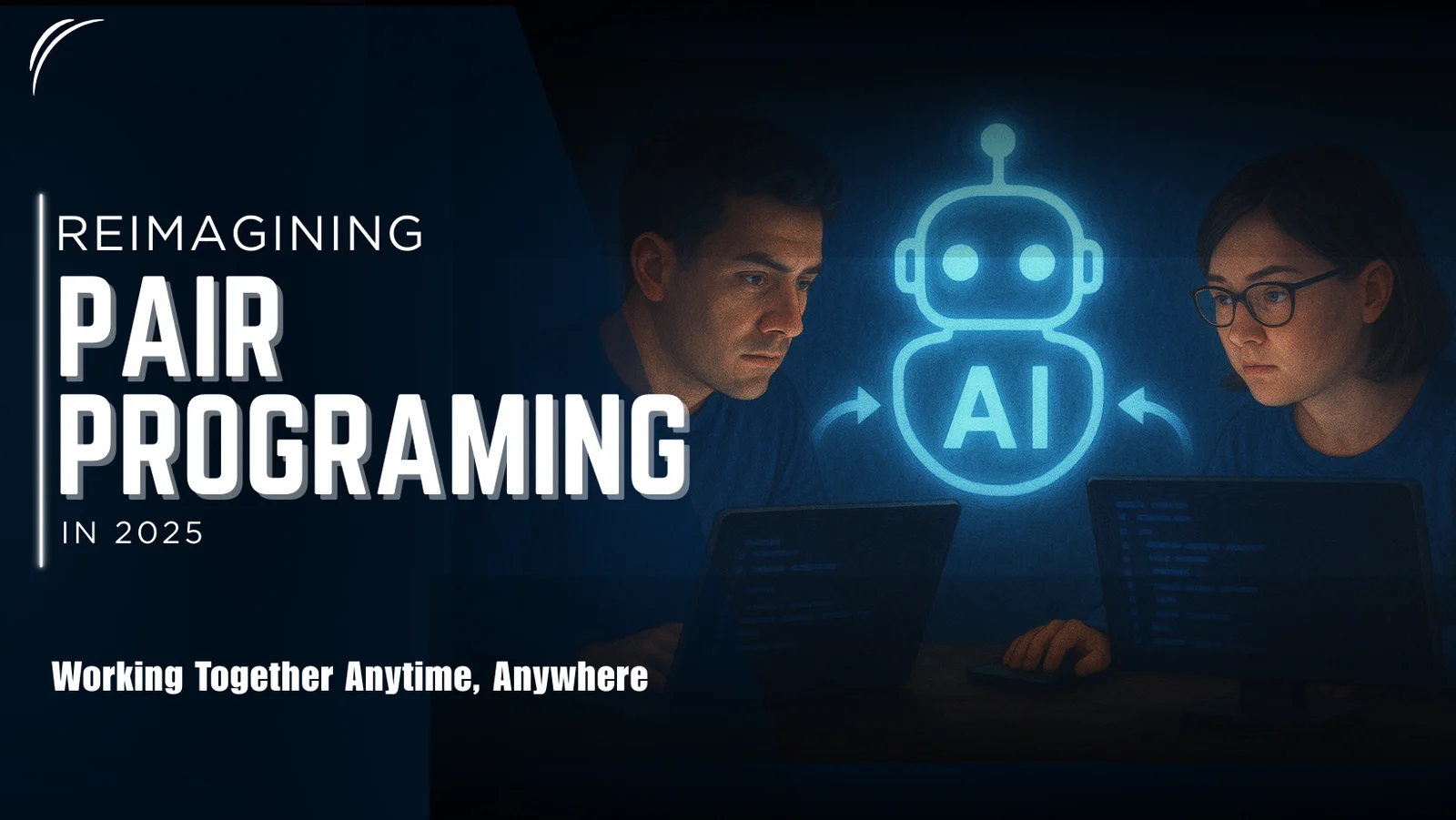
Agentic coding tools do more than suggest the next line. They read a repository, propose a plan, change several files, run tests, read the failures, and prepare the work for review. That has rewritten pair programming. Sometimes two developers still pair, sometimes a developer pairs with an agent, and often the agent sits alongside a human pair and does the searching. Humans keep architecture, security, and final approval.
Whether AI can write code that compiles is settled. The real question is narrower. How much of a task can you hand to an agent before review costs more than the work saved? That differs for a CRUD endpoint and a payments flow, and getting it right is most of the skill.
On this page+
What Is Agentic Programming?
Agentic programming is a workflow where you give an AI system an outcome rather than a line, and it takes actions inside an approved environment to reach it.
A conventional assistant completes what you are typing. An agent runs a loop: read the relevant files, propose a plan, change code across the stack, run tests, read the failures, revise.
The loop is the difference. Autocomplete guesses. An agent checks its own work, notices it was wrong, and tries again. Ownership has not changed: someone still confirms the change solves the problem actually asked for, which is frequently not the problem in the ticket.
What Is an Agentic IDE?
An agentic IDE is an environment where the agent is part of the editor rather than a sidebar suggesting text. It can open files you have not opened, run commands and tests, and hold context across a long task. Two shapes matter.
In-editor agents. You watch the work and accept or reject each diff. Good for ambiguous work where you are still forming an opinion.
Background and terminal agents. You hand over a scoped task and come back to a pull request. Good for well specified work, bad for ambiguity, because the agent resolves it by guessing and you will not see the guess until review.
Most teams use both. The choice is about how well specified the task is.
Agentic Coding Tools in 2026
This category moves fast. Check current capabilities before committing.
Tool | Shape | Suited to |
|---|---|---|
Claude Code | Terminal first, also IDE | Long multi file tasks, codebase investigation |
Cursor | AI first editor, agent mode | Agent work in a familiar editing experience |
GitHub Copilot | IDE agent mode plus cloud agent | Teams on GitHub, issue driven work |
Windsurf | Agentic IDE | In editor work with codebase awareness |
OpenAI Codex | Cloud engineering agent | Scoped tasks returned as reviewable changes |
Amazon Q Developer | Agent inside AWS tooling | AWS stacks, security scanning, migrations |
Choice depends on where your code lives, what security review allows, whether the team wants to watch or delegate, and how good your tests are. An agent with no tests to run is a fast writer with no editor.he same production discipline applies to AI-generated applications, as this guide to AI DevOps for vibe-coded apps explains through code audits, automated testing, security hardening, CI/CD, and observability
What This Did to Pair Programming
Pairing worked because a second brain catches what the first is too deep in to see. Agents do not replace that person. The pair becomes a trio: the driver implements, the navigator thinks about product edges, the agent searches and checks. The gain is not speed. It is that people stay on the work that requires having been there before.
Where It Helps Most: Frontend and Backend Actually Agreeing
The most expensive bugs are rarely hard. They are disagreements. The frontend sends a formatted date, the backend wants an ISO timestamp. One side treats an empty array as no results, the other as an error. Permissions get enforced by hiding a button. None of that is difficult. It is expensive because nobody finds it until integration, by which point two people have built on the assumption.
Cross stack pairing was always the fix, and the questions worth settling first have not changed. How does the API validate what the interface collects. How are dates, currency, and error states formatted, and by whom. Is authorization enforced server side or in the UI.
Agents make that cheaper, because much of it is comparison work: diffing what the frontend sends against what the contract declares, flagging mismatched types and null handling, generating shared types, tracing an error from browser to database.
The agent finds the disagreement. Developers still decide which side changes, and that is usually a product decision wearing a technical costume.
Handoffs, Time Zones, and the Context That Evaporates
Logic Square has run distributed since 2012, out of Kokomo and San Diego in the United States and Kolkata and Gurugram in India. The handoff problem is not theoretical here.
What gets lost is never the code. The code is in the branch. What gets lost is why. Why an approach was abandoned. What the error was before someone worked around it.
Agentic workflows help by accident, because the trail is a byproduct rather than a document a tired developer writes at the end of a shift: constraints, files changed, assumptions made, and what is still open.
A workable loop: the developer writes the task and acceptance criteria, the agent proposes a plan, a human approves it before any file changes, the agent makes bounded changes and runs approved checks, then someone else reviews code, tests, and reasoning and approves, revises, or throws it out. That last option matters. If nothing is ever thrown out, the review is not real.
Where We Do Not Let Agents Work
There is work where the cost of a plausible wrong answer exceeds anything you save. For us that means money movement, authorization boundaries, and regulated data. When we built CloseWise, the controls around access, audit logging, and change discipline had to be reasoned about by someone accountable.
Human pairing also stays essential for ambiguous requirements, architecture that is expensive to reverse, security rules, client history including why the obvious design was already rejected, and mentoring, which fails if the junior is watching a machine.
The failure mode is not bad code. Agents produce clean, confident code that solves a subtly different problem than the one you have. That is far harder to catch than something that obviously does not work.
Guardrails
Set these before the first pilot, not after the first incident.
- Least privilege. Only the repos, files, and commands the task needs
- Credentials, production data, and client information stay out of reach
- Human approval for migrations, auth logic, and anything destructive
- Sandbox or throwaway branch, never straight at production
- Verify what it cites. Agents reference APIs and packages that do not exist
- Keep diffs small. A large autonomous rewrite is not reviewed, it is accepted
How to Pilot It
Pick one low risk bug or a narrow refactor. Write acceptance criteria first, restrict the agent to a development branch, require a plan before file changes, review every diff, run the tests, then write down what should and should not be delegated next time.
Measure review time, escaped defects, rework, and onboarding speed. Do not measure lines generated. That is a vanity metric and occasionally an inverse indicator.
Frequently Asked Questions
What is agentic AI coding?
A workflow where an AI system works toward an outcome rather than completing a line. It reads a codebase, plans, edits multiple files, runs approved commands, tests the result, and revises. The developer approves everything before it merges.
What is an agentic IDE?
A development environment where the agent acts inside your project rather than only suggesting text. It can open files you have not opened, run commands and tests, and hold context across a long task. Cursor and Windsurf are built this way. GitHub Copilot added agent mode to existing editors.
Can agentic AI replace pair programming?
No. It replaces the searching and mechanical parts. Architecture, ambiguous requirements, security boundaries, mentoring, and client specific judgment still need two humans, because those depend on context that is not in the repository.
How does agentic AI help frontend and backend developers work together?
It compares what the interface sends against what the API declares, flags mismatched fields and types, traces errors across the stack, and writes contract tests. It finds the disagreement. Developers decide which side is correct.
Building AI Into Development Without Losing Control
Pair programming is not disappearing, it is being unbundled. The searching and checking move to a system. The judgment does not. The teams getting real value are not the ones with the most autonomous setup. They are the ones with good tests, tight scope, and a clear line about what an agent is not allowed near.
Logic Square is a veteran owned software firm building and modernizing production systems since 2012, across distributed teams in the United States and India. We help companies work out where AI improves a product, and where it quietly makes things worse.
Our AI business solutions focus on applying AI to suitable workflows while retaining human oversight for security, architecture, and consequential decisions.
If you are working out how agentic tooling fits your team, book a strategy call.
Work with us