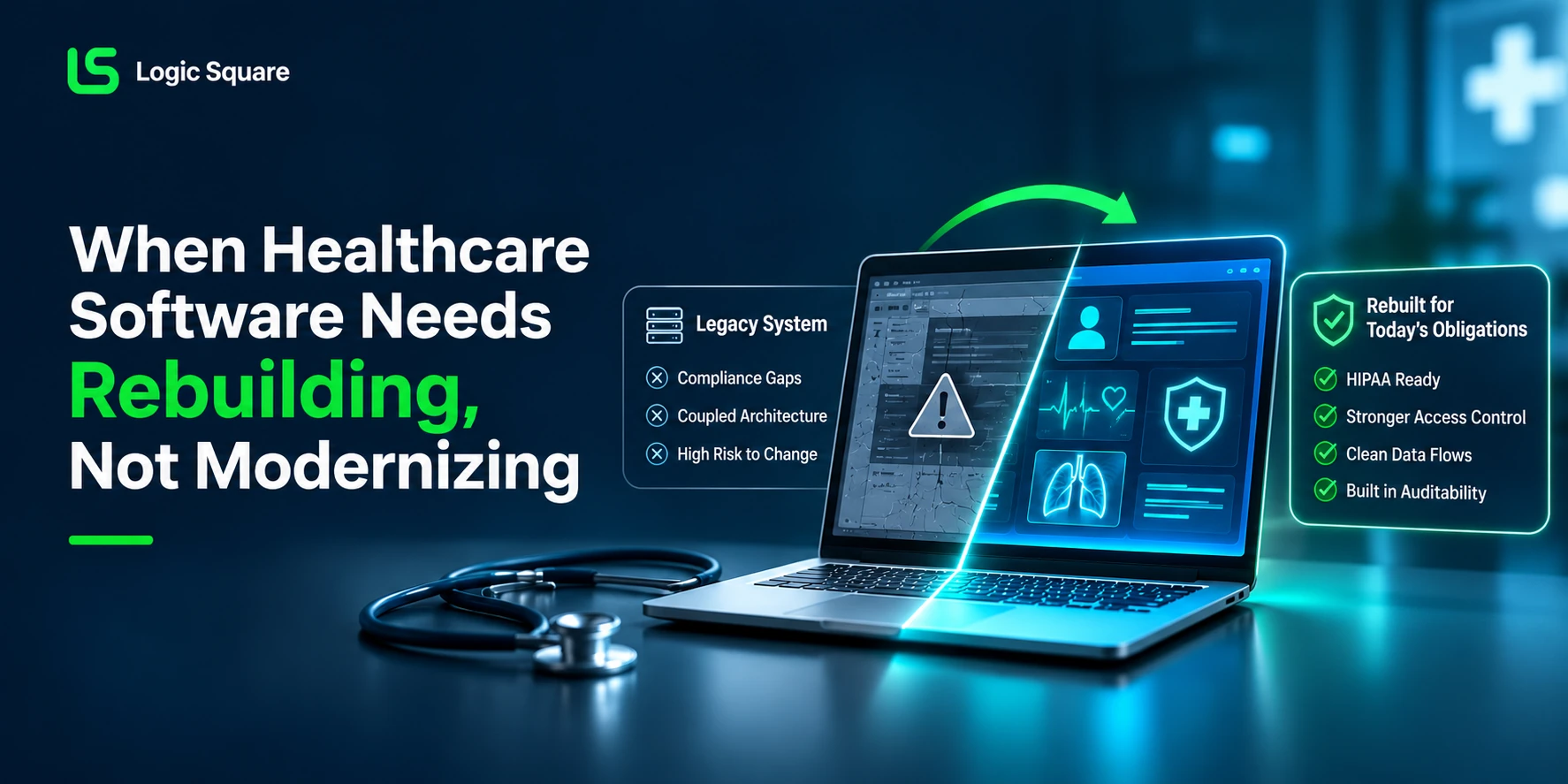
Most modernization guides, including our own pillar on the subject, treat staged modernization as the default and full rebuild as the last resort. In healthcare-adjacent systems, our delivery history has run the other way: the work has been rebuild-led, and for reasons worth stating honestly rather than hiding inside a generic framework. When a system’s data handling, auditability, and access control were never designed for today’s obligations, retrofitting compliance into coupled legacy code is often riskier and more expensive than building clean on a foundation that assumes those obligations from the first commit.
On this page+
Why healthcare systems fail the staging test
The Executive Guide’s three-door decision turns on one measurable property: isolation. Staged modernization works when the aging piece separates cleanly from the working whole, because the old path can stay live while the new one proves itself. Healthcare-adjacent legacy systems can fail that test for a structural reason: the thing that most needs fixing is often not a feature but a cross-cutting property. Access control that cannot express role and patient-context boundaries, logging that captures medical content it never should have, data models where identifiers and clinical content are inseparable, integrations that assume trust the modern environment revokes. Cross-cutting properties do not isolate; they touch every module at once. A staged program against a cross-cutting deficiency becomes a rewrite conducted in the least efficient possible order.
The compliance-debt asymmetry
Ordinary technical debt raises the cost of change. Compliance debt raises the cost of existing: every day the system runs, its logging, retention, and access patterns are either defensible or not. That asymmetry can materially change the rebuild math in systems handling patient data. In a commercial SaaS, living with known-imperfect architecture for another year is a priced business decision; when the deficiency touches patient data handling or access control, deferral also carries operational, security, compliance, and remediation exposure beyond the engineering hours. This is why our assessments in this category weight the data-path map (where PHI can travel: model, vendor, logs, observability, staging, tenant contexts, backups) above the usual change-difficulty probes. A system can be easy to change and still be indefensible in what it records.
What rebuild-led actually looks like
Rebuild-led does not mean big-bang. The working pattern in our delivery: the new system is built clean, with the compliance properties designed in (minimum-necessary data flows, access events logged without medical content, synthetic data in every non-production environment, tenant and patient-context boundaries tested deliberately), and it takes over workflows one at a time while the legacy system’s scope shrinks. The difference from staged modernization is which system is the destination: instead of improving the old platform piece by piece, workflows migrate off it piece by piece, and the legacy system’s job becomes historical record until retention rules let it retire. The old system is never trusted with new obligations; it is relieved of existing ones on a schedule.
When modernization still wins in healthcare
Honesty requires the counter-case. If the deficiency is a feature gap rather than a cross-cutting property, if the data handling was designed by people who took the obligations seriously, and if change difficulty is the real complaint, then healthcare systems modernize like anything else and the staged playbook applies unchanged. The tell is in the assessment: ask what the system logs, how identifiers separate from content, and whether access boundaries can be expressed at all. Systems that answer those questions well are more likely to have a viable modernization path. When the answers expose structural problems in data handling, access boundaries, or auditability, a rebuild deserves serious consideration before a staged approach is priced, and a vendor who promises to staged-modernize their way out of a cross-cutting deficiency is quoting the comfortable project rather than the correct one.
The Healthcare Rebuild Test
- Map. Where can patient data travel today? Production, staging, logs, observability, backups. Do this before estimating any rebuild or modernization effort.
- Classify. Is each deficiency feature-level (isolatable) or cross-cutting (structural)? That classification is the rebuild-versus-modernize decision in embryo.
- Price. Compare do-nothing, staged modernization, and rebuild, with the healthcare weighting: the do-nothing option’s cost includes the exposure, not just the workaround hours, and the staged option’s feasibility depends on whether what’s wrong actually isolates. The conclusion the test enforces: if the problem cannot be isolated, don’t assume staging is automatically the safer option. Bring the map to whoever quotes you; a vendor who starts the conversation anywhere else is starting it in the wrong place.
FAQs
Should we rebuild or modernize our healthcare application?
Classify what's wrong: feature gaps in a well-designed system modernize normally; cross-cutting deficiencies in data handling, logging, or access control usually argue for a clean rebuild that absorbs workflows over time. The data-path map decides, not the system's age.
Is a rebuild riskier than modernizing in place?
For cross-cutting compliance properties, in-place retrofit is frequently the riskier path: every intermediate state must be simultaneously operational and defensible, which staged programs against structural deficiencies struggle to guarantee. A parallel rebuild keeps the risk in the new system until it has earned production trust.
How is HIPAA handled in a rebuild?
HIPAA requirements should shape the architecture and data flows from the first commit: minimum-necessary flows, content-free access logging, synthetic data outside production, vendor and data-path review. But no vendor should describe an application as "HIPAA certified," and we don't: formal compliance assessment and organizational obligations extend beyond the application code itself, which is the same honesty our vetting guide demands of any vendor.
When should healthcare software NOT be rebuilt?
When the data model, access controls, auditability, and integration boundaries are sound and the problems are isolated feature gaps or ordinary technical debt, rebuilding creates unnecessary migration risk; staged modernization is the better choice there. The assessment exists to determine which situation you're actually in, and it sometimes concludes exactly that.
Can we keep the legacy system during a rebuild?
Yes, and you should: workflows migrate one at a time, the legacy system's obligations shrink on a schedule, and it retires when retention rules allow, not when a cutover date demands.
Facing this decision on a system that touches patient data? Bring what you know about where the data goes; we’ll map the rest and tell you which of the three paths your system actually has.
Work with us