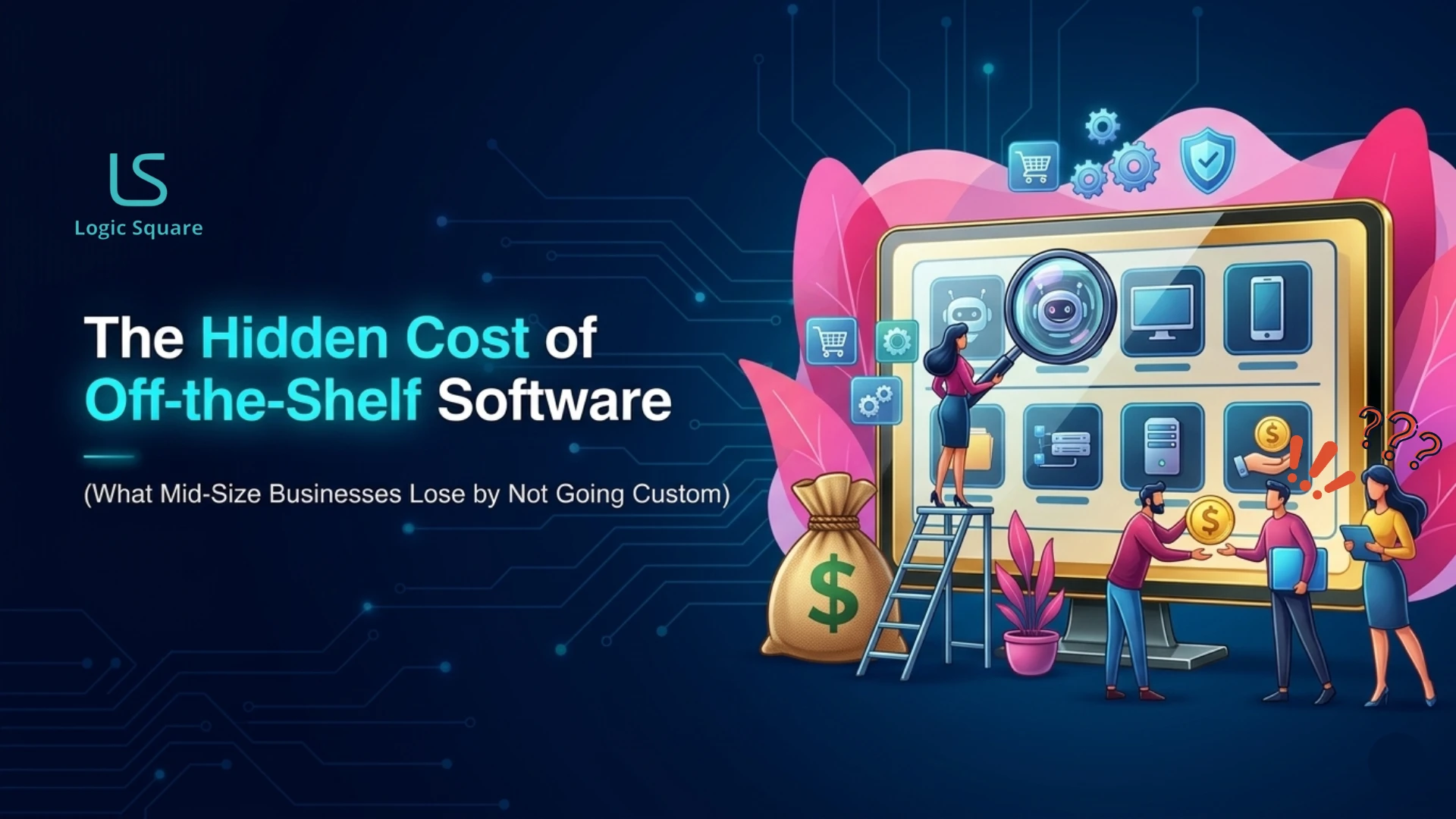
Most mid-size businesses know exactly what their SaaS subscriptions cost every month. Almost none know what those tools are costing them in total.
The monthly invoice is easy to track. The hidden operational drag is not.
New CRM, project management platform, accounting software, reporting dashboard, automation, and communication apps may all sound like reasonable expenses on their own. However, they all combine into a system of ongoing expenses that multiply yearly.
For most U.S. mid-size businesses growing past $10M–$50M in revenue, the hidden cost is rarely the subscription cost of business software. That is why custom software development for mid-size businesses is a financial strategy, if it is not a technical strategy, too. Because that hidden cost is the distance that the software has to take.
Manual workarounds. Duplicate data entry. Integration failures. Vendor dependency. Delayed reporting. Compliance gaps. Time lost switching between disconnected systems.
These are operational costs hiding inside your technology stack.
This article breaks down the hidden costs most businesses never calculate so CFOs, COOs, and operations leaders can make a smarter build-vs-buy decision when evaluating custom software development.
On this page+
The Visible Price Tag Is the Smallest Part
Most software buying decisions begin with one number: the monthly subscription fee.
That is also where many companies stop calculating.
But the real total cost of ownership goes far beyond licensing. Once a business adopts off-the-shelf software, additional expenses appear quickly:
- Implementation and onboarding
- Staff training
- Ongoing administration
- Customization fees
- API and integration costs
- Premium support plans
- Additional user seats
- Annual price increases
Many SaaS vendors increase pricing by 8–15% annually, especially after businesses become dependent on the platform.
The result is that software initially chosen for affordability slowly becomes a fixed operational burden.
This is especially true for mid-size businesses that have outgrown standard workflows. Generic platforms are designed for mass-market use, not for the complexity of your operations.
Instead of software adapting to your business, your business starts adapting to the software.
In reality, you did not simply buy software. You entered a long-term financial relationship with a vendor whose priorities are different from yours.
Their goal is scalability across thousands of customers. Your goal is operational efficiency.
Those goals are rarely identical.
The 6 Hidden Costs Most Businesses Never Calculate
1. The Integration Tax
Most mid-size businesses use multiple systems:
- CRM software
- Accounting platforms
- HR tools
- Reporting dashboards
- Marketing automation
- Inventory systems
The problem begins when these systems do not communicate properly.
Every disconnected workflow creates an integration tax.
That cost may appear as middleware subscriptions like Zapier, custom API development, or ongoing developer support just to keep systems synchronized.
For example:
- Sales updates customer data in the CRM
- Operations manually transfers it into fulfillment software
- Finance re-enters the same information into invoicing systems
Now multiply that process across hundreds of actions every week.
A stack of partially connected tools can easily create $2,000–$5,000 per month in integration overhead between software subscriptions, maintenance, troubleshooting, and lost productivity.
2. The Workaround Wage
One of the largest hidden costs in any business is repetitive manual work caused by software limitations.
Most teams normalize tasks like:
- Exporting CSV files
- Copy-pasting information
- Manual report generation
- Updating spreadsheets
- Sending follow-up reminders
Because these inefficiencies happen gradually, businesses rarely calculate their true cost.
But the math is significant.
If five employees spend 45 minutes per day on manual workarounds at an average labor cost of $40/hour, that equals more than $150,000 annually in hidden labor expense.
And that only reflects direct wage cost.
It does not include delayed response times, employee frustration, operational bottlenecks, or reporting inaccuracies.
The larger the business becomes, the more expensive these inefficiencies get.
3. Vendor Lock-In
Businesses underestimate the degree of reliance they develop on software vendors, over time.
At first, there’s a sense of simplicity in migrating platforms.
Three years down the road, it’s costly and disruptive.
You have workflows, reporting systems, automations, employee habits and processes built around software that you don’t own.
This is vendor lock-in.
What happens if:
- Pricing increases dramatically?
- The vendor gets acquired?
- Features disappear?
- Support quality declines?
- The platform shuts down?
At that point, migrating away becomes a major business disruption project involving retraining, data migration, workflow rebuilding, and operational downtime.
The longer the dependency lasts, the more expensive leaving becomes.
Custom software changes that dynamic because the business owns the infrastructure supporting its operations.
4. The Feature Ransom
Many SaaS platforms structure pricing to maximize upgrades.
The feature you actually need is often locked behind a higher-tier plan.
You may discover that:
- Advanced reporting costs extra
- API access requires enterprise pricing
- Automation tools are premium-only
- Security controls are limited on lower tiers
Suddenly, the affordable platform becomes significantly more expensive.
And businesses often pay for dozens of features they never use simply to unlock a few capabilities they actually need.
Multiply this across several tools in your stack, and upgrade costs become a permanent operational expense.
Custom software avoids much of this problem because businesses pay for functionality aligned with their actual workflows rather than bloated feature packages.
5. The Scalability Ceiling
Off-the-shelf tools are built for the average customer.
But scaling businesses are rarely average.
As operations become more complex, generic systems create friction:
- Approval workflows become rigid
- Reporting lacks operational depth
- Automation logic becomes limited
- Performance slows with larger data volumes
Eventually, the software becomes a bottleneck.
And the cost is not just inefficiency. It is lost growth opportunity.
When systems cannot support operational complexity, businesses may struggle to:
- Take on larger clients
- Expand into new markets
- Improve turnaround times
- Deliver better customer experiences
Technology should support growth, not limit it.
6. Data Secure and Ownership
Operational data is one of the most valuable assets a business possesses.
However, companies often loose sensitive data across multiple third party platforms and do not realize the risks.
Depending upon the industry compliance requirements may include:
- GDPR
- HIPAA
- SOC 2
- Financial reporting regulations
Every external platform introduces another security policy, another vendor relationship, and another breach risk.
For CFOs and COOs, this is no longer just an IT concern.
A compliance failure or data breach can create financial penalties, operational disruption, legal exposure, and reputation damage.
Custom software allows businesses to build systems around their specific security and compliance requirements instead of relying entirely on generic vendor standards.
The Real 5-Year Cost Comparison
One of the biggest misconceptions about custom software is that it is always more expensive.
In reality, it is often front-loaded rather than continuously recurring.
Consider a 75-person operations business generating $15M annually:
| Cost Category | Off-the-Shelf Stack | Custom Software |
|---|---|---|
| Year 1 Licensing | $84,000 | $0 |
| Implementation | $25,000 | $150,000 |
| Integration Work | $18,000 | $0 |
| Workaround Labor | $60,000 | $8,000 |
| Annual Increases (Years 2–5) | $47,000 | $0 |
| 5-Year Total | $487,000 | $198,000 |
Note: These numbers are for illustration, can vary by business.
A custom build looks expensive today.
But the off the shelf stack is racking up recurring costs through licensing, integration, productivity loss, and vendor price increases.
While the custom platform is becoming an operational asset owned by the business over the long run.
A better question is not “How much does software cost?”
It is:
“How much operational inefficiency is the business going to pay for every year?”
When Off-the-Shelf Still Makes Sense
Custom software is not always the right solution.
Off-the-shelf tools still make sense when:
- You are early-stage and validating your business model
- Your workflows are relatively simple
- Operational volume is still low
- An existing platform already fits your processes well
- You lack the internal capacity to manage a custom project
In these situations, speed and simplicity may outweigh customization benefits.
But once operational inefficiency becomes expensive, the economics change.
For many mid-size businesses, the hidden costs eventually outweigh the convenience.
How to Know If the Math Works
To evaluate whether custom software makes sense, start by calculating the cost of operational inefficiency.
Ask four questions:
- What is your current annual SaaS spend?
- How many hours per week does your team spend on manual workarounds?
- Have you previously been quoted for a custom solution?
- What would a 30% improvement in operational efficiency be worth annually?
If the value of Question 4 exceeds the cost in Question 3, the financial case for custom software may already exist.
Frequently Asked Questions(FAQ's)
What are the hidden costs of off-the-shelf software?
Hidden costs such as implementation fees, staff training, integration costs, manual workaround labor, an 8–15% annual price increase, feature upgrade costs, and vendor lock-in risk often, for mid-size businesses, prove to be far more than the obvious subscription fee.
Custom software more affordable than SaaS in the long run?
Yes, for the majority of mid-size businesses. The upfront cost is higher, but you don’t pay for licensing, integration overhead, and price hikes. After 5 years, custom build is usually 50-60% less expensive than a stack of off the shelf software.
What is vendor lock-in and why should I care?
Vendor lock-in is when your business becomes so dependent on a software platform that leaving it is prohibitively costly and disruptive. You can’t afford to afford to break your workflows, data, automations, and employee habits (that you don’t own) after 2–3 years, giving the vendor more pricing power over you.
When Should a Mid-Size Business Purchase Custom Software?
When you’re hitting the point where current complexity can’t be handled with existing workflows, when manual workarounds are costing you staff hours, when your SaaS stack is in need of repetitive integration chores, or when the 5 year cost of inoperability is more than a custom build , often between $5M–$50M in revenue.
What is the average software development cost for a mid-size business?
For a focused scope , a custom CRM, operations platform or workflow-specific tool , a well-scoped build might be $100,000–$250,000 depending on complexity. That’s front-loaded rather than recurring, which is why the 5-year economics will often favor custom over off-the-shelf stacks.
How does custom software differ from off the shelf software?
The off the shelf software is designed for the everyman product across 10,000s of customers. The custom software is designed with your workflows, data structure, and operations in mind. The difference here is ownership. With custom, you own the infrastructure; with SaaS, you essentially rent it.
Conclusion
Custom software development for mid-size businesses is not simply an IT project, it is a long-term operational asset
It is an operational asset.
Unlike recurring SaaS expenses that increase every year, a well-designed custom platform compounds in value because the business owns the infrastructure, workflows, and operational intelligence behind it.
For many mid-size U.S. businesses, the real financial risk is not investing in custom software. It is continuing to absorb hidden inefficiencies without measuring their true cost.
To compare those ongoing expenses with what building your own would cost, review our custom software development cost guide based on real project figures.
At Logic Square Technologies, we work with growing mid-market businesses that have outgrown disconnected tools, manual workflows, and rigid off-the-shelf systems. Our focus is helping companies build scalable custom software that improves operational efficiency, reduces long-term software dependency, and supports sustainable growth.
If you are evaluating whether custom software makes financial sense for your business, we offer a free cost-of-inefficiency analysis for mid-market companies considering a custom build.
No pressure. No obligation. Just clarity.
Work with us