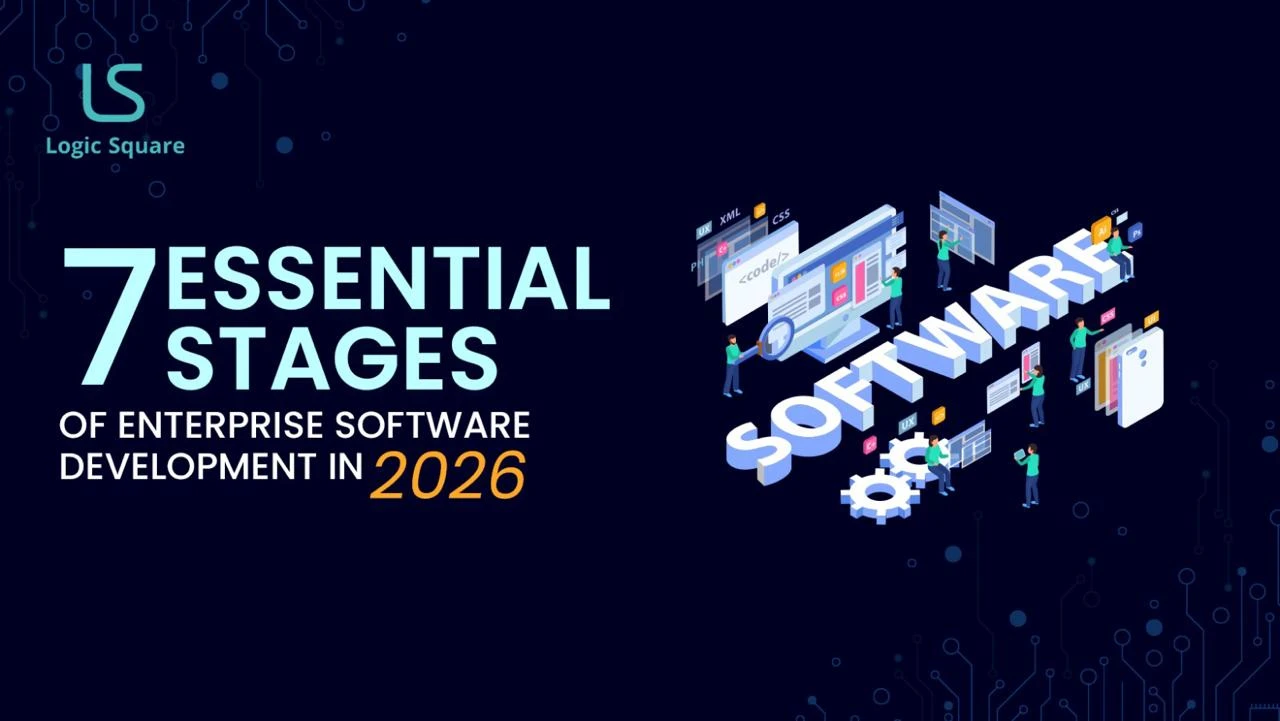
Enterprise software development in 2026 follows 7 core stages: Discovery, Architecture & Design, Sprint Planning, Development, Testing & Compliance, Deployment & Observability, and Maintenance. Each stage is non-negotiable for enterprises building systems that need to scale, pass regulatory scrutiny, and stay resilient as business requirements shift.
What\’s changed in 2026 is not the stages themselves , it\’s what runs inside them. AI-assisted tooling, shift-left security, FinOps guardrails, and low-code platforms have fundamentally altered how fast each stage moves and what governance it requires. A CIO planning a system overhaul today is operating in a different environment than the same project three years ago , the lifecycle is the same shape, but the tooling, risk surface, and speed expectations are completely different.
This guide breaks down each of the 7 stages in detail , what happens, what\’s new in 2026, and what decisions at each stage determine whether the project delivers or stalls.
On this page+
Why does the development lifecycle matter in 2026?
Enterprises face faster business cycles, tighter regulatory scrutiny, and a flood of data to manage. Yes, that’s real. Research and industry guidance point to AI-native platforms and low-code as major forces shaping development practices in 2026. These are the technologies that are going to boost developer productivity while raising governance questions that enterprises must solve deliberately.
With that context, here are the 7 stages you should treat as mandatory when building enterprise software today.
1. Discovery & Strategic Alignment
This is where the project’s success is seeded. Discovery goes beyond adding features, instead it maps business outcomes, constraints, and integration touchpoints. Why it matters in 2026: AI-assisted discovery tools can rapidly analyze legacy systems and suggest integration patterns or refactor candidates, but human validation remains essential to align with business strategy and compliance needs. A structured discovery session reduces rework and forms the foundation of the enterprise software lifecycle management plan.For an existing legacy system, use this modernization checklist to assess its architecture, dependencies, risks and business fit before bringing it into a modern delivery process.
2. Architecture & Design (Cloud-Native, Secure by Design)
Design at the enterprise scale means choosing patterns that support scale, resilience, and observability. In 2026 that commonly includes microservices, cloud-native infrastructure (managed Kubernetes, serverless where appropriate), and a “secure by design” posture, threat modelling, data classification, and encryption decisions integrated into architecture.
Design outputs should include system context diagrams, API contracts, data topology, and non-functional requirement specifications. These artifacts make integration with existing ERPs, CRMs, and data lakes predictable and auditable.
3. Product & Sprint Planning (Iterative Roadmaps)
Enterprise projects historically used monolithic plans; modern enterprises pair strategic roadmaps with iterative delivery. This stage converts discovery outputs into prioritized product backlogs, release trains, and sprint plans that balance risk, business value, and technical debt.
Key actions:
- Define MVP and incremental milestones.
- Allocate platform vs. feature squads (platform teams own infra and developer experience).
- Establish FinOps guardrails to control cloud spend and forecast cost implications.
Planning in 2026 also factors in AI-assisted estimation and low-code prototypes, making it possible to validate ideas faster while keeping governance checks in place.
4. Development & Implementation (Tools, Automation, and Governance)
This is the engine room of the enterprise application development process. Development practices must deliver high-quality code, consistent environments, and secure deployments. Enterprises increasingly rely on:
- CI/CD pipelines with policy-as-code (shift-left security and compliance).
- AI-assisted coding tools that accelerate routine implementation while developers focus on system design and complex logic.
- Internal developer platform or low-code platforms for safe citizen development under enterprise governance.
Automate as much as possible: linting, static analysis, dependency scanning, contract testing, and environment provisioning. This produces repeatable releases and reduces the risk of human error during handoffs.
Evidence shows AI and automation are boosting developer productivity — but they require updated governance to avoid “shadow IT” and compliance gaps.
5. Testing, Validation & Compliance
Testing for enterprise systems is multi-dimensional: functional, non-functional (load, resilience), security (SAST/DAST, penetration tests), data privacy checks, and compliance validation (GDPR, HIPAA, SOC 2 as relevant). In 2026, testing strategies also need to cover:
- Model governance for any embedded AI/ML (data lineage, drift detection, evaluation metrics).
- Integration testing across microservices and third-party APIs.
- Chaos engineering for critical production paths.
Continuous testing integrated into pipelines and robust test data management reduce production incidents. Enterprises should maintain an audit trail for validation activities — essential for regulators and internal compliance teams.
6. Deployment & Observability (Run with Confidence)
Deployment isn’t done when code reaches prod — it’s when the system can be observed, measured, and safely rolled back. Modern deployment practice includes feature-flag driven releases, canary deployments, and progressive delivery to limit blast radius.
Observability is non-negotiable: logs, metrics, traces, and user telemetry must be correlated into actionable dashboards. On top of classic observability, enterprises are adopting AI Ops to surface anomalies and suggest remediation steps — particularly useful when dealing with distributed systems and agentic AI components. Roadmap resources and DevOps lifecycle models provide a structured view of continuous integration and operations for enterprise contexts.
7. Maintenance, Evolution & Decommissioning
The final stage, and often the most expensive if neglected — is long-term lifecycle management. Enterprise systems must be resilient to business changes, security threats, and technology obsolescence. This stage includes:
- Scheduled maintenance and patching (dependencies, runtimes).
- Technical debt management and periodic re-architecture planning.
- Feature lifecycle governance: sunsetting unused features and decommissioning legacy services safely.
- Ongoing cost optimization and sustainability practices (green coding, resource right-sizing).
How Has the Process of Building Enterprise Software Fundamentally Changed in 2026?
Building enterprise software in 2026 is about composability and governance as much as it is about code. A few practical shifts to internalize:
- AI-assisted development becomes standard: use it for discovery, code generation, testing scaffolding, but keep human review for design and governance.
- Low-code is an enterprise tool: democratize development for non-critical flows while enforcing platform guardrails and lifecycle controls.
- Security and data governance are integrated, not bolted on: adopt shift-left security, confidential computing, and model governance where AI is used.
Organizations evaluating their next development approach can explore our custom software development services.
Is Treating the SDLC as a Strategic Capability Worth It for Enterprise Teams?
Yes, and for most enterprise teams, it is one of the highest-leverage investments they can make in engineering predictability.
A mature SDLC, with clear stages, automation, and governance, turns engineering into a predictable engine for business outcomes. The 7 stages outlined in this guide form a repeatable playbook that reduces delivery risk, accelerates value to production, and makes future-proofing manageable rather than reactive.
If you are mapping a new enterprise initiative or modernizing an existing system, start by strengthening the front-end stages, discovery and architecture, and invest in platform capabilities that make the latter stages faster and safer. The teams that get this right in 2026 will ship faster, break less, and spend less time firefighting and more time building.
If you want a development partner who treats the lifecycle as a strategic discipline, not just a delivery checklist, speak to the Logic Square team about your next enterprise initiative.
Frequently Asked Questions (FAQ)
What is the SDLC and what are its main stages?
The Software Development Life Cycle (SDLC) is a structured process enterprises use to plan, build, test, and maintain software systems. In 2026, it follows 7 core stages: Discovery, Architecture & Design, Sprint Planning, Development, Testing & Compliance, Deployment & Observability, and long-term Maintenance — each with defined outputs and governance checkpoints.
How long does enterprise software development typically take?
Enterprise software development typically takes 6 to 18 months from discovery to production launch, depending on system complexity, integration requirements, and team size. A focused MVP covering core modules can ship in 3–5 months. Large-scale ERP replacements or multi-platform enterprise platforms with compliance requirements regularly take 12–18 months or longer.
What is the difference between SDLC and Agile methodology?
SDLC is the overall framework defining every phase of software development from inception to decommissioning. Agile is a delivery methodology used within the SDLC — specifically during planning, development, and testing stages. Agile does not replace the SDLC; it replaces the rigid waterfall execution model within it, while the broader lifecycle structure remains.
How does AI change the enterprise software development process in 2026?
In 2026, AI accelerates enterprise software development across four stages: Discovery (AI analyses legacy systems and suggests integration patterns), Development (AI-assisted code generation handles routine implementation), Testing (automated test scaffolding and drift detection for embedded ML models), and Operations (AIOps surfaces anomalies in distributed systems). Governance and human review remain essential at every stage.
Work with us