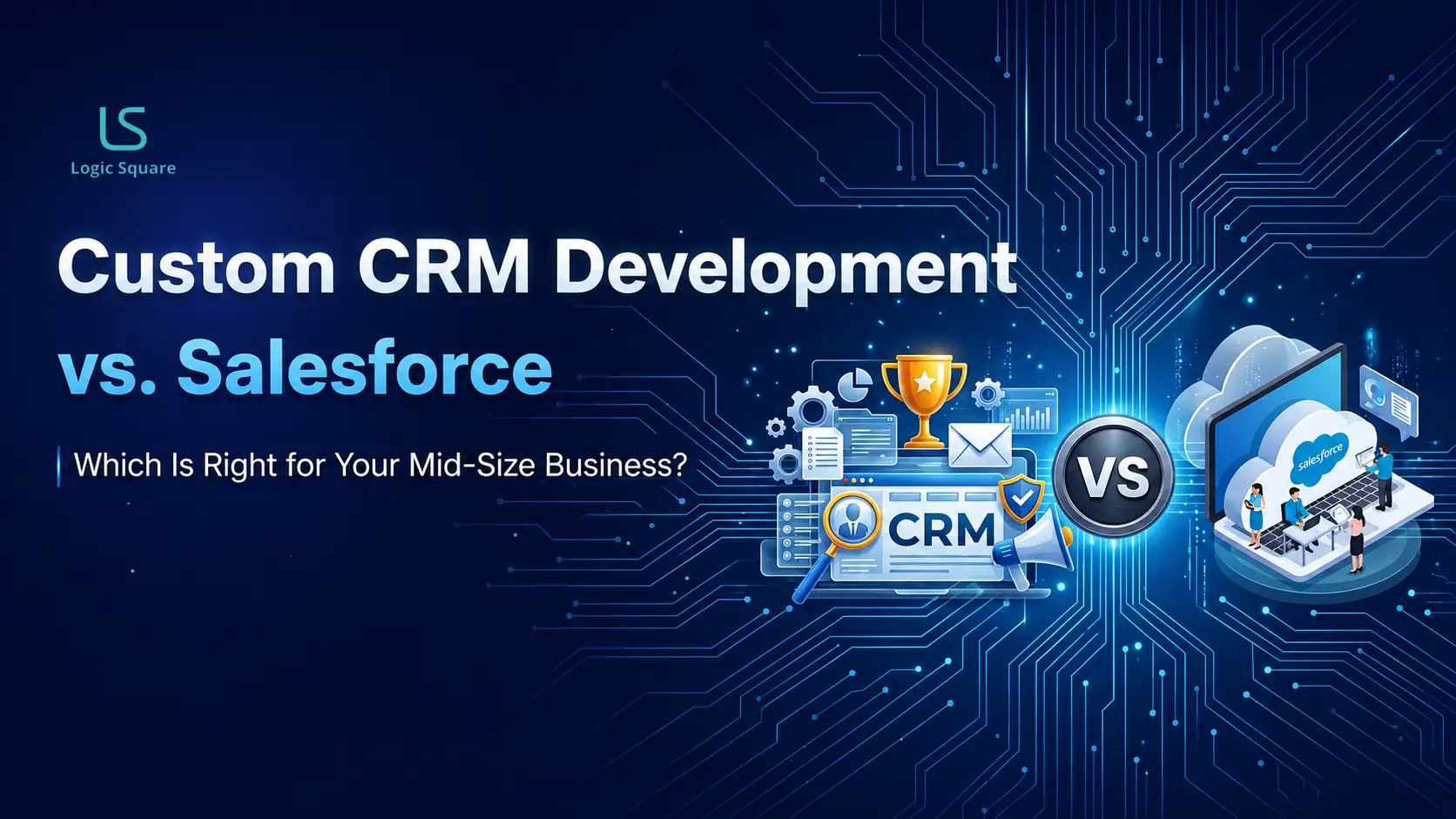
A custom CRM is software built specifically around your business workflows. Salesforce is a leading SaaS CRM platform with pre-built features and a broad ecosystem. For businesses with standard sales processes, Salesforce is often the faster, lower-risk choice. For mid-size businesses with complex workflows, proprietary processes, or deep integration needs, custom CRM development typically delivers better long-term operational fit and lower total ownership cost.
The right answer depends on your workflow complexity, growth plans, and long-term strategy, not on which platform is more popular.
As businesses scale, CRM systems stop being simple sales tools and become part of the company’s operational backbone. The challenge is no longer just managing leads or customer data , it is managing approvals, reporting, internal coordination, integrations, and workflows in a way that supports how the business actually operates.
That is why choosing between Salesforce and custom CRM development is ultimately a strategic business decision, not just a software purchase.
The right answer depends on your workflow complexity, growth plans, and long-term strategy — not on which platform is more popular.
On this page+
The CRM Decision Is Bigger Than Software
Your sales team is working around the CRM instead of inside it. Leads are scattered across spreadsheets, forecasts vary between departments, and teams rely on manual workarounds because the CRM no longer reflects how the business actually operates.
At some point, most growing businesses face the same question:
Should we invest in Salesforce, or should we build our own CRM?
This is no longer just a software decision. It is a long-term operational investment that can easily exceed $100,000 over the next few years.
Salesforce is one of the world’s leading CRM ecosystems and, for many businesses, it is absolutely the right choice. But companies with complex workflows, industry-specific processes, operational dependencies, or deeply integrated systems often find that custom CRM development delivers better workflow alignment and stronger long-term value.
At Logic Square Technologies, we have seen businesses succeed with both approaches. This article provides a practical framework to help mid-size businesses determine which path makes the most strategic sense.
Understanding Salesforce: The Market Leader
Salesforce became the dominant CRM platform for a reason.
It offers:
- enterprise-grade scalability
- mature integrations
- advanced automation
- extensive third-party support
- strong reporting capabilities
For organizations with relatively standardized sales operations, Salesforce can be incredibly powerful.
What Salesforce Does Well
Salesforce works best for companies that need:
- lead tracking
- sales pipeline management
- reporting and forecasting
- automation
- account management
without highly specialized workflow requirements.
Its biggest advantage is its ecosystem. Salesforce integrates deeply with tools like:
- Marketing Cloud
- Service Cloud
- Pardot
- analytics platforms
- AppExchange extensions
Another major benefit is deployment speed. Compared to custom software, Salesforce can often be implemented much faster.
Many executives and enterprise operators are also already familiar with Salesforce, which reduces training friction and improves adoption.
Where Salesforce Falls Short
The challenge begins when businesses evolve beyond standard CRM workflows.
Many mid-size organizations eventually discover:
- their approval systems are too layered
- their operational workflows are too nuanced
- their reporting needs are too custom
- their internal coordination is too specialized
to fit cleanly into Salesforce’s default structure.
At that point, companies start adding:
- custom objects
- Apex development
- Flow automations
- middleware integrations
- AppExchange add-ons
And costs begin compounding quickly.
The issue is not that Salesforce is bad.
The issue is operational misalignment.
The larger and more operationally complex the organization becomes, the more expensive that misalignment gets.
Understanding Custom CRM Development
Many businesses hear “custom CRM development” and imagine:
- a risky engineering project
- an unfinished internal tool
- or a modified version of existing CRM software
That is not what professional custom CRM development actually means.
A custom CRM is software designed specifically around how your business operates.
Instead of forcing your workflow into predefined software structures, the platform is designed around:
- your sales process
- operational logic
- customer lifecycle
- reporting requirements
- approval systems
- integrations
- compliance needs
The result is software aligned to your operations rather than software your operations constantly need to adapt to.
Let’s explore which path best suits your needs.
What Custom CRM Does Well
Custom CRM development allows businesses to build workflows around:
- operational reality
- proprietary processes
- industry-specific requirements
- internal coordination
rather than generic sales pipeline logic.
It also enables deep integrations with:
- accounting systems
- ERP platforms
- customer portals
- operational dashboards
- proprietary infrastructure
For many growing businesses, the CRM eventually becomes part of a much larger operational ecosystem. Custom development supports that naturally.
Another major advantage is ownership.
With custom CRM software:
- your customer data belongs to you
- your workflow logic belongs to you
- your operational history belongs to you
There are:
- no per-seat licensing fees
- no vendor lock-in
- no dependency on third-party roadmap decisions
Over time, many mid-size businesses discover that ownership becomes significantly cheaper than recurring SaaS costs.
Where Custom CRM Falls Short
Custom CRM development is not automatically the right answer for every company.
There are tradeoffs.
A serious mid-market CRM platform typically requires:
- discovery
- architecture planning
- design
- development
- testing
- launch
Most projects take around 4–6 months depending on complexity.
Custom software also requires strong operational clarity. If internal workflows are poorly defined, development becomes much harder.
And unlike SaaS tools, custom CRM systems require ongoing technical oversight and maintenance.
Salesforce vs Custom CRM: Long-Term Investment Comparison
One of the biggest mistakes businesses make during CRM evaluation is comparing Salesforce and custom CRM only at the feature level.
The better comparison is:
- operational fit
- long-term ownership cost
- scalability
- workflow flexibility
At the mid-market level, a CRM is no longer just a sales tool. It becomes part of the company’s operational infrastructure.
| Feature | Salesforce CRM | Custom CRM Development |
|---|---|---|
| Initial Investment | Lower upfront cost | Higher upfront investment |
| Licensing | Monthly per-user fees | No per-seat licensing |
| Workflow Flexibility | Limited by platform structure | Built around your workflow |
| Vendor Dependency | Salesforce ecosystem | Fully owned internally |
| Integrations | Strong ecosystem integrations | Unlimited custom integrations |
| Deployment Speed | Faster | Longer initial build |
| Best For | Standard sales operations | Complex operational workflows |
| Long-Term Cost | High recurring costs | Lower ownership cost |
| Data Ownership | Platform-controlled | Fully owned by business |
| Scalability | Salesforce ecosystem scaling | Operationally customized scaling |
The real question is not whether Salesforce works today.
The real question is whether it still works when your operations become twice as complex three years from now.
The Real Cost Equation – Salesforce vs Custom CRM
Most businesses initially evaluate Salesforce based only on licensing.
But at the mid-market level, licensing is usually only the beginning.
Salesforce Total Cost of Ownership
For many growing businesses, Salesforce costs eventually include:
| Expense Category | Estimated Cost |
|---|---|
| Licensing | $59k+ annually |
| Implementation | $25k–$150k |
| Customization | $15k–$50k annually |
| AppExchange Tools | $10k–$30k annually |
| Salesforce Admin / Support | $60k–$90k annually |
| Total Year 1 | $150k–$350k+ |
From Year 2 onward, many organizations continue spending:
- $100k–$200k annually
between licensing, support, customizations, and ecosystem tools.
Custom CRM Total Cost of Ownership
Custom CRM development for mid-size operational platforms typically ranges between:
- $60k–$180k upfront
If you want to sanity-check the build side of that comparison, we published real custom software cost figures from delivered projects.
depending on:
- integrations
- operational complexity
- reporting systems
- scaling requirements
Unlike Salesforce:
- there are no escalating seat fees
- no ecosystem dependency
- no vendor lock-in
And the software becomes an owned operational asset.
Strategic Factors Beyond Cost
The CRM decision is not purely financial.
Several strategic considerations matter equally.
Speed to Market
If deployment speed is critical, Salesforce often wins.
If long-term operational alignment matters more, custom CRM may create greater value.
Process Complexity and Workflow Fit
Industries like:
- healthcare
- logistics
- legal
- real estate
- infrastructure
- fintech
often require workflow structures that generic CRM systems struggle to support without heavy customization.
Data Ownership and Compliance
For businesses handling:
- sensitive customer data
- compliance-heavy operations
- proprietary workflows
Ownership and portability become increasingly important.
Competitive Advantage
In some businesses, operational workflow itself becomes the competitive advantage.
That is often where custom software becomes strategically valuable.
Where Salesforce Wins — Be Honest
Salesforce is genuinely the right answer in certain situations.
Salesforce is often the better fit if:
- you need deployment within 30–60 days
- your workflows are relatively standard
- your team already understands Salesforce
- ecosystem integrations matter heavily
- acquisition-readiness is important
- you have budget for ongoing licensing and administration
If several of these points apply to your organization, Salesforce may genuinely be the smarter operational decision.
And any responsible development company should be willing to say that honestly.
Where Custom CRM Wins
Custom CRM development becomes significantly more valuable when operational complexity extends beyond standard pipeline management.
At Logic Square Technologies, we have worked on systems involving:
- workflow-heavy coordination
- high-volume transactions
- multi-party relationships
- operational reporting
- permission-driven workflows
- real-time process tracking
For example, platforms like CloseWise involve far more than traditional CRM functionality.
The system manages:
- order coordination
- workflow tracking
- scheduling
- permissions
- status management
- document visibility
Replicating those operational layers inside Salesforce would likely require extensive customization and ongoing engineering overhead.
At that point, many businesses begin asking:
“If we are heavily customizing everything anyway, should we simply own the system?”
The Decision Framework — How to Choose
Choose Salesforce If:
- you prioritize deployment speed
- your workflows are relatively standard
- your team already uses Salesforce tools
- you have recurring CRM budget capacity
Choose Custom CRM Development If:
- your workflows are operationally complex
- your CRM must integrate deeply with internal systems
- your industry requires specialized processes
- ownership matters strategically
- your long-term cost analysis favors building
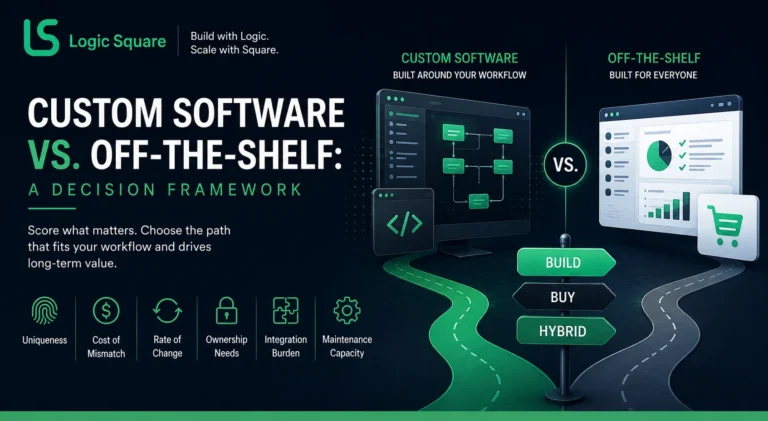
There is also a middle ground.
Some businesses start with HubSpot or Salesforce initially, then move toward custom development once workflows become more defined.
That approach can sometimes make strategic sense as well.
What the Custom CRM Build Process Actually Looks Like
Professional CRM development typically follows this structure:
| Phase | Estimated Timeline |
|---|---|
| Discovery & Workflow Mapping | 2–3 weeks |
| Design & Architecture | 2–3 weeks |
| Development | 8–16 weeks |
| Testing & Launch | 2–4 weeks |
For most mid-size operational CRM systems, total development time ranges between:
- 4–6 months
That timeline can initially feel long.
Until businesses compare it against:
- failed CRM implementations
- operational workarounds
- endless customization cycles
- and software that never truly fits the business.
Frequently Asked Questions(FAQS)
How much does custom CRM development cost?
For a mid-size business, custom CRM development typically ranges between $60,000 and $180,000 upfront, depending on the complexity of your workflows, the number of integrations required, and your reporting and compliance needs. Simpler platforms with fewer integrations can fall below this range; complex operational platforms with multi-party workflows may exceed it.
How long does it take to build a custom CRM?
Most professional custom CRM projects for mid-size businesses take between 4 and 6 months from discovery to launch. This includes 2–3 weeks of workflow mapping, 2–3 weeks of architecture and design, 8–16 weeks of development, and 2–4 weeks of testing and go-live.
What is the difference between Salesforce and a custom CRM?
Salesforce is a pre-built SaaS CRM platform that businesses subscribe to on a per-user, per-month basis. A custom CRM is software built from scratch to match your specific business workflows, integrations, and operational logic. Salesforce deploys faster and works well for standard sales processes. Custom CRM takes longer to build but is owned outright, has no ongoing seat fees, and can be tailored to workflows that no off-the-shelf software can replicate.
When does Salesforce stop being cost-effective for a mid-size business?
Salesforce licensing, administration, and customization costs typically reach $100,000–$200,000 annually for mid-size businesses. Once a company has 50+ users, requires heavy custom development, or runs workflows that don’t fit Salesforce’s default structure, the 5-year total cost of ownership often exceeds what a custom-built platform would cost — including ongoing maintenance.
Can a custom CRM integrate with my existing systems?
Yes. Unlike SaaS platforms, which have defined integration frameworks, custom CRM systems can be built to integrate with any system — ERP platforms, accounting software, customer portals, operational dashboards, proprietary databases, or third-party APIs. Integration scope is typically scoped during the discovery phase.
What industries benefit most from custom CRM development?
Industries with complex, specialized, or compliance-driven workflows tend to benefit most. These include healthcare, legal services, logistics and supply chain, real estate and title services, financial services and fintech, infrastructure and construction, and any industry where the operational workflow itself is a competitive differentiator.
Is it possible to migrate from Salesforce to a custom CRM?
Yes, and many mid-size businesses do exactly this after outgrowing Salesforce’s workflow flexibility or finding recurring costs unsustainable. Migration involves exporting customer and operational data from Salesforce, mapping it to the new system’s data structure, and running parallel systems briefly to validate accuracy. A well-planned migration typically takes 4–8 weeks alongside the main development timeline.
Conclusion: There Is No Universal Answer — But There Is a Right Answer for Your Business
There is no universally right answer between Salesforce and custom CRM development.
There is only the right answer for:
- your workflow
- your operational complexity
- your growth plans
- your systems
- your budget
- and your long-term strategy
For some organizations, Salesforce is absolutely the correct investment.
For others, ownership, workflow alignment, flexibility, and operational scalability eventually become more valuable than fitting inside a predefined software ecosystem.
The goal is not choosing the most popular CRM.
The goal is choosing the operational system your business can realistically scale on for the next five years.
At Logic Square Technologies, we help businesses evaluate both paths honestly through:
- workflow mapping
- operational analysis
- CRM architecture planning
- build-vs-buy consulting
- long-term cost evaluation
And sometimes, after that evaluation, our recommendation genuinely is Salesforce.
If you are evaluating CRM options for your business, schedule a workflow consultation with Logic Square Technologies.
We will:
- map your operational process
- identify workflow bottlenecks
- compare long-term CRM costs
- and provide a straightforward recommendation based on your actual operational needs
—not a generic software pitch.
Work with us