In the last 12 months, our engineers at Logic Square have reviewed more than a dozen AI-generated codebases — products built by founders using Lovable, Bolt, and Cursor without professional engineering support.
Most of them worked. None of them were production-ready.This gap becomes easier to understand when you examine when AI actually helps and when it does not.
Here is what we found, what it means for your product, and what to do about it.
On this page+
What Is Vibe Coding?
Vibe coding is building software by describing what you want in plain English to an AI tool — Lovable, Bolt, Cursor, or similar — and shipping whatever it generates without reviewing the underlying code.
The term was coined by Andrej Karpathy, OpenAI co-founder, in early 2025. It spread quickly because it described something real: founders going from idea to working application in a weekend, without writing a single line of code.
The question is not whether vibe coding works. It does. The question is what you actually have when it is done.
Add- Before choosing this approach, understand when to use vibe coding and when professional engineering oversight is necessary.
What Is AI DevOps, And Why Is It Useful?
In traditional DevOps development and operations work together to automate how code is built, tested, deployed, and monitored so software can run reliably at scale.
AI DevOps couples that discipline in two directions.
Using AI inside the engineering pipeline: AI reviews code before it merges, writes automated tests, monitors production systems, and assists incident diagnosis. Engineers move faster. The process stays rigorous.
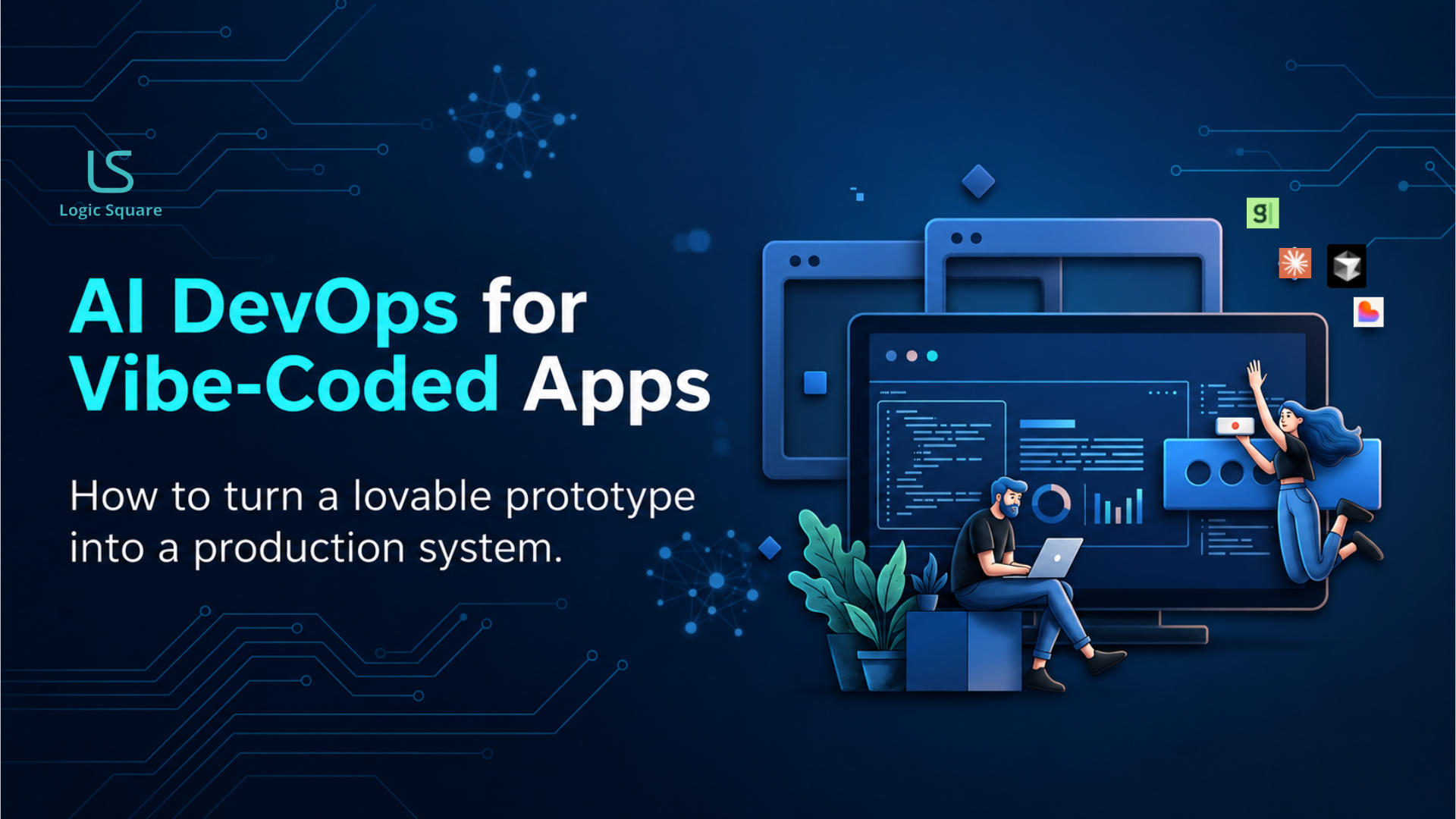
Applying DevOps discipline to AI-generated code: Vibe-coded products have no DevOps at all — no tests, no CI/CD, no monitoring. AI DevOps is the structured process of auditing what was built, hardening the weak points, and making it maintainable — using AI tools throughout, but with senior engineering judgment directing every step.
In plain terms: AI DevOps is the difference between AI without judgment and AI with judgment. Vibe coding gets you the first version fast. AI DevOps is what makes that version survivable.
Does Somebody Actually Believe Vibe-Coded Software Works?
Yes , and this is important to say, because a lot of engineers write this off.
We’ve gone through many codebases that are working. Users actually rely on them. Some are surprisingly well-structured for products shipped without any engineering review. Anyone who believes AI tools can’t produce working software hasn’t seen what’s shipped recently.
BUT, there’s a gap between “it works” and “it works right.” That only opens up in production. Stack Overflow’s 2025 survey is the perfect illustration: 84 percent of developers use AI coding tools , only 29 percent trust them. Usage jumped. Trust didn’t. That gap is where systems fail.
What Are the Real Problems With Vibe-Coded Applications?
AI tools fail in specific, predictable ways.
Poor architectural choices: The AI picks whatever stack is fastest to generate. React and Supabase is fine for a prototype — it becomes a problem when your platform needs enterprise integrations, role-based access, and compliance audit logs that were never in the original prompt.
No memory across sessions: AI tools do not remember what they generated 20 minutes ago. The result is duplicated logic, inconsistent patterns, and technical debt that compounds silently.
Authentication that fails under real conditions: Auth flows look correct and pass basic testing. They often break under real concurrency, multi-role access, or edge cases that only surface with actual user volume.
Happy path engineering: AI builds confidently for the scenario that works. Error handling, failure states, retry logic, and graceful degradation are systematically undertreated.
Nobody understands the codebase: When something breaks — and something will — no one can diagnose it because no one built it. Re-prompting the AI and hoping it reconstructs enough context is not a maintenance strategy. It is a liability.
The 5-Step AI DevOps Process We Use for Vibe-Coded Products
When a founder comes to us with an AI-generated codebase, we do not start by telling them to rebuild. We start by understanding what they have.
Step 1 AI-assisted code audit: We run the codebase through structured AI review, architectural issues, security gaps, integration risks, dependency vulnerabilities. The output is a prioritised findings report in plain English: what is working, what is fragile, what needs to change before the product can scale.
Step 2 Iterative AI-assisted remediation: We feed audit findings back into the AI toolchain and apply fixes in cycles — typically three to five iterations. This addresses surface-level issues quickly without manually rewriting code that does not need rewriting.
Step 3 Senior engineering cleanup: What AI cannot fix, engineers handle. These are the places where remediation requires understanding the business: workflow logic, data relationships, compliance requirements, the feature roadmap for the next 18 months. There is no shortcut here.
Step 4 CI/CD pipeline and observability setup: We implement automated testing, deployment pipelines, error tracking, and alerting. From this point the product is observable, testable, and deployable without fear.
Step 5 Ongoing AI-assisted development: New features are built using AI tools under senior engineering oversight. Velocity stays high. The codebase stays coherent.
The result is a product that started as a prototype and operates as a production system — reached faster and at lower cost than a full rebuild.
Can a Vibe-Coded App Be Fixed Without Starting Over?
Usually yes , if you act before the technical debt becomes structural.
The cost-effective window is roughly the first 6 to 12 months after the initial build, or before 500 to 1,000 active users , whichever comes first. After that, architectural choices become load-bearing and the cost of changing them rises sharply.
What the right intervention looks like depends on the audit. Some apps need light hardening , a few weeks to close critical gaps and establish observability. Others need a phased rebuild of specific modules , auth, data layer, integration points , while the rest continues to run. Very few need a complete rewrite.
The founders who navigate this well treat the vibe-coded version as what it is: a validated prototype. Then they make it production-ready before the cracks become crises in front of customers.
How to Know If Your Vibe-Coded App Needs Attention Now
If your product was built with an AI tool and real users depend on it, work through this honestly:
- Do you know what happens when two users edit the same record simultaneously? If uncertain, concurrency gap.
- Do you have error monitoring? If a user complaint is how you\’d find out something broke, observability gap.
- Do you have automated tests? If every deployment involves manual checking, reliability gap.
- Do you know what your auth flow does when a session token expires mid-action? If not, security gap.
- Could a new engineer understand the codebase without the AI that built it? If no, maintainability gap.
Two or more of these gaps in a product with active users is a clear signal to act — before something breaks in front of a customer, a compliance auditor, or an investor doing technical due diligence.
What an Engagement With Logic Square Looks Like
We work with founders who can’t afford upsell chances and deadlines that are six months out.
Week 1, Full AI-assisted code audit delivered as a prioritised findings report
Weeks 2-4, Critical fixes across security, auth, data integrity and core integration points
Month 2 onward , Structured roadmap for hardening, features, ongoing AI-assisted maintenance
Most initial engagements end up in the $5,000-15,000 range depending on codebase size, complexity, significantly less than a full rebuild, but we keep the validation work the prototype already proved.
Logic Square is a veteran-led, US-headquartered software development company of 14+ years experience in production systems for clients in the US, UK, EU and Australia. SDVOSB certified. Clutch: 4.9. Engineering teams in Kokomo IN, San Diego CA, Kolkata and Gurugram.
Frequently Asked Questions(FAQs)
What is the difference between vibe coding and professional software development?
Vibe coding uses AI tools to generate a working application from plain English descriptions, with no code review, architecture planning, or engineering oversight. Professional software development involves deliberate stack choices, structured testing, security review, and code that a team can understand and maintain over time. Vibe coding optimises for speed to a first version. Professional development optimises for what happens after that version meets real users.
How do I know if my AI-built app is ready for real users?
Five signals that it is not: you do not know what happens when two users edit the same record simultaneously; you have no error monitoring beyond user complaints; every deployment is manually checked; your auth flow behaviour on session expiry is unknown; and a new engineer could not understand the codebase without the AI that built it. Two or more of these gaps in a live product means the risk is already present — it just has not surfaced yet
Does a vibe-coded app always need to be rebuilt from scratch?
Rarely. Most AI-generated codebases can be hardened through a structured audit and remediation process — fixing architectural gaps, securing auth flows, establishing automated tests, and setting up proper deployment pipelines — without discarding the existing codebase. A full rebuild is typically only necessary when the original stack is fundamentally incompatible with where the product needs to go, or when the codebase has accumulated so much duplicated and undocumented logic that remediation costs more than replacement.
What is AI DevOps and how is it different from regular DevOps?
Traditional DevOps automates how code gets built, tested, deployed, and monitored. AI DevOps does two things traditional DevOps does not: it uses AI tools to accelerate the engineering work itself — code review, test generation, incident diagnosis — and it applies DevOps discipline to AI-generated codebases that were shipped without any engineering rigour in the first place. For founders with vibe-coded products, AI DevOps is the structured path from a working prototype to a system that can scale, be maintained, and be audited.
How long does it take to make a vibe-coded app production-ready — and what does it cost?
For most AI-generated codebases under 18 months old with fewer than 1,000 active users, a structured AI DevOps engagement takes four to eight weeks for the critical work — audit, security hardening, auth fixes, CI/CD setup, and observability. Cost typically falls between $5,000 and $15,000 depending on codebase size and complexity. This is significantly less than a full rebuild and preserves the validation the prototype already provided. Acting within the first 6 to 12 months after the initial build keeps remediation in this range — waiting longer raises costs sharply as architectural choices become harder to change.
Book a Free AI Codebase Audit
If your product was built with AI tools and you’re not certain what’s underneath it, we’ll give you a straight answer — at no cost.
Our senior engineers will review your codebase and deliver a plain-English report covering what is working, what is fragile, and what needs to change before you scale. If there’s work to do, we’ll show you exactly what it would involve — no pressure, no obligation.
We’ve reviewed more than a dozen AI-generated codebases. We know exactly what to look for and we’ll tell you honestly what we find.
Book your free audit → Here
Work with us