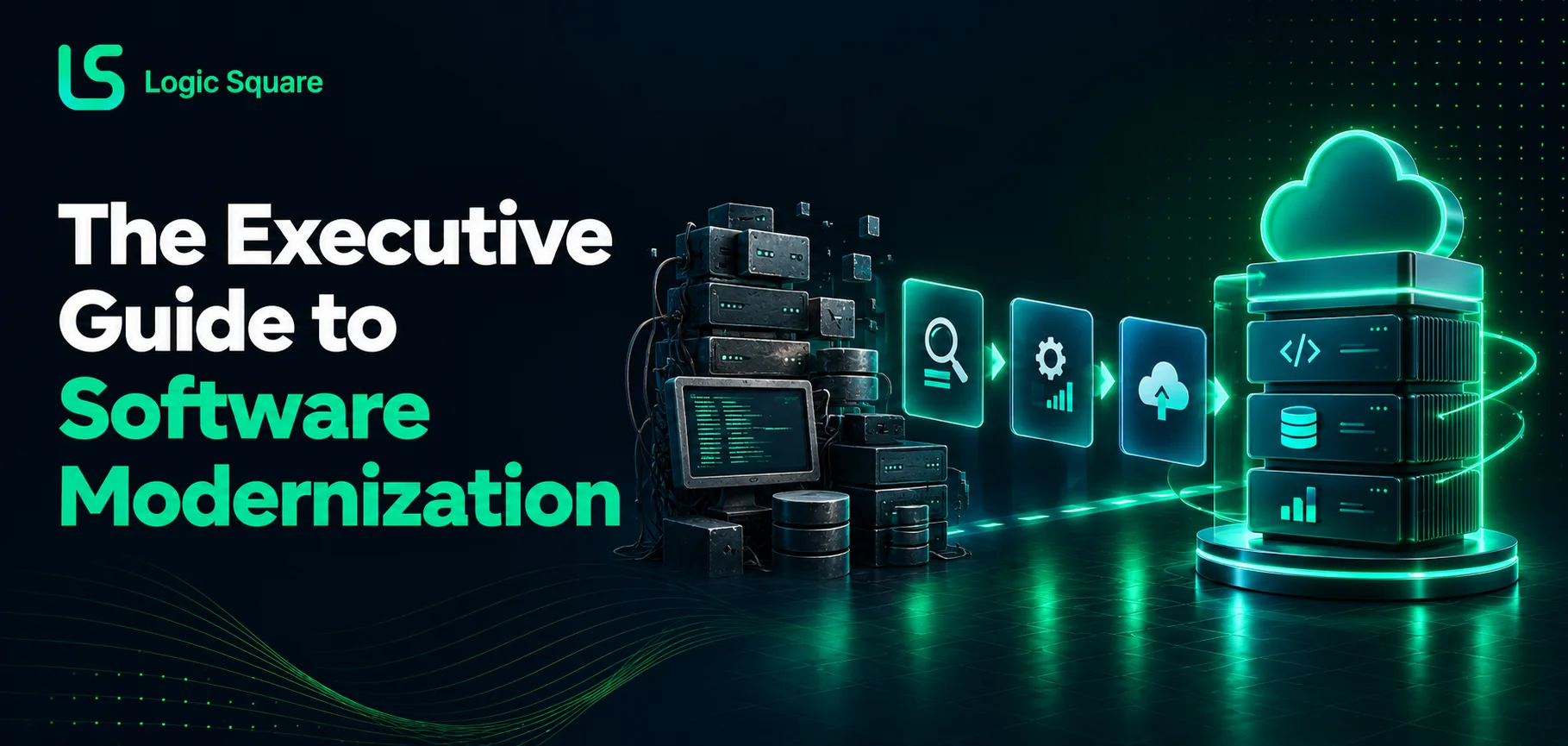
Software modernization is a sequence of decisions, not a project type: establish what is actually broken versus merely old, price all three options honestly (modernize, replace, leave alone), and if you proceed, stage the work so the business never stops running. We’ve made these calls on client systems and on our own products, including one measured staged modernization: about fifteen days of planning and two months of execution on a platform that kept operating throughout.
On this page+
Step one: the assessment that prevents the wrong project
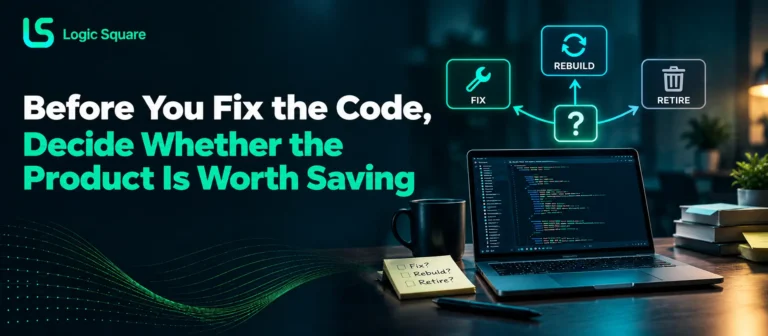
The initial assessment examines the codebase, deployment, database, integrations, dependencies, error logs, and the workflows the business cannot operate without, anchored by one probe: how difficult are small changes? The output is a three-door decision. Modernize when architecture is modular and the product works: you’re improving a living system. Replace when coupling, deployment fragility, or unsafe-to-change critical functions make incremental improvement disproportionately risky. Leave alone when the system is stable, understood, and cheap to keep: age alone is not a reason, and we say so even though modernization is what we sell.If the assessment supports incremental improvement, our legacy software modernization services use slice-by-slice migration to improve the system without exposing the business to a single high-risk cutover.
Step two: price the boring option
The do-nothing option has a real cost (the workaround hours, the rising catch-up price, the capability the system prevents), and it is frequently still the cheapest option. Write its number next to the other two. Executives who skip this step buy rebuilds from fear; executives who do it sometimes discover their “legacy crisis” is a backlog of small fixes: query optimization, dependency upgrades, caching, monitoring, the unglamorous list that resolves a surprising share of rebuild conversations at a fraction of the cost.
Step three: if you proceed, stage it
Our own measured case: modernizing a core workflow of our recruitment platform with AI-driven capability, on a live system with real users. Fifteen days of planning, two months of staged execution, zero downtime for the business. That is a case, not a benchmark, and the transferable principles are: isolate the piece being modernized, keep the old path alive until the new one has proven itself on real usage, and sequence by risk rather than by architecture diagram. What makes staging possible or impossible is isolation, which is exactly what step one measured.
Step four: govern the temptations
Two temptations kill modernization programs. Scope creep (“while we’re in there”) turns a staged program into a rewrite with extra steps; the change-batching discipline from our delivery history applies doubly here. And AI-assisted analysis, which genuinely accelerated our own legacy investigation, gets oversold as a decision-maker: it surfaces gaps and speeds code archaeology, but legacy systems carry business rules invisible in code, and engineers still validate against business risk. Use the accelerant; keep the judgment.
What the assessment actually examines, and what each finding means
The first-pass assessment is concrete, not a vibe check. Codebase: structure, duplication, and whether the last five small changes were routine or hazardous; change difficulty is the single most predictive probe we use. Database: query performance, index health, growth trajectory, and whether the pain attributed to “old architecture” is actually three missing indexes. Deployments: frequency, failure rate, rollback ability; a system deployed quarterly out of fear is telling you where its risk lives. Integrations: which external systems it touches and what breaks when they change. Dependencies: what is unsupported versus merely unfashionable, because those are different risk classes with different price tags. Error logs: a month of them, read for recurrence, because recurring errors are a map of what actually fails as opposed to what worries people. Each finding maps to a door: routine changes, healthy data layer, and reliable operation point to modernize or leave alone; hazardous changes concentrated in isolatable areas point to staged modernization; hazard spread through coupled core logic points to replacement.For a structured first review, use our web app modernization checklist to assess change difficulty, dependencies, performance, risk and isolation.
A worked example: what “staged” meant in practice
On our own recruitment platform, the staged modernization replaced the CV-intake workflow with an AI-driven pipeline while the platform served daily production use. This work was completed within Smoothire, our recruitment platform, which continues to support daily recruitment operations while new capabilities are introduced in controlled stages.The stages, concretely: the new pipeline was built beside the old one, not in its place; both ran in parallel while the new path was evaluated against real documents; the old path remained the default until the new one measurably beat it; cutover happened per-workflow, not platform-wide; and the old path stayed available as a fallback after cutover. Fifteen days of planning, roughly two months of execution, zero downtime. What made it possible was isolation: CV intake had clean boundaries with the rest of the system. The honest corollary: a workflow tangled through the core could not have been staged this way, which is why the assessment measures isolation before anyone promises a staged plan.
The three objections executives raise, answered
“We can’t freeze features for a modernization.” You shouldn’t. A staged program runs beside feature work by design; what it cannot survive is scope creep into the modernization itself. Keep the two backlogs separate and the program ships. “Our vendor says only a full rebuild is safe.” Sometimes true, and the assessment will show it: coupled logic, fragile deploys, unsafe-to-touch core. But a vendor who prescribes rebuild before measuring change difficulty and isolation is quoting their preferred project, not your system’s needs. Ask to see the finding that rules out staging. “The board wants it done in one release.” Big-bang replacements concentrate risk at a single cutover on the business’s busiest system. Staging spreads risk across small reversible steps. The board’s real interest is continuity of operations, and staged is how continuity is engineered; one release is how it is gambled.
The one-page version for the board
What’s broken versus merely old. Three doors, three honest prices, including doing nothing. If proceeding: isolate, stage, keep the old path until the new one earns trust. Expect the assessment to occasionally conclude “leave it alone,” and treat that answer as a win, because it is one.
FAQs
How long does a software modernization take?
he only honest general answer is a range anchored to isolation. Our measured staged case ran fifteen days of planning plus two months of execution for one well-isolated workflow; a program across several coupled areas is a multiple of that. Any vendor quoting a timeline before assessing isolation is guessing.
How much does modernization cost versus rebuilding?
The cheap-fix tier (indexes, dependencies, caching, monitoring) costs a small fraction of any rebuild and resolves a surprising share of "legacy crises." Staged modernization prices per isolated workflow. Full replacement is the most expensive door and sometimes still correct; the assessment exists to stop you paying for it when it isn't.
Can we keep running the old system during modernization?
In a staged program, yes, by design: the old path stays live and default until each new piece proves itself on real usage.
What should we do first, before hiring anyone?
Measure change difficulty yourselves: how long did the last five small changes take, and what broke? That one number tells you which conversation to have.
Facing a modernization decision? The first-week assessment produces the three-door answer for your system.
Work with us