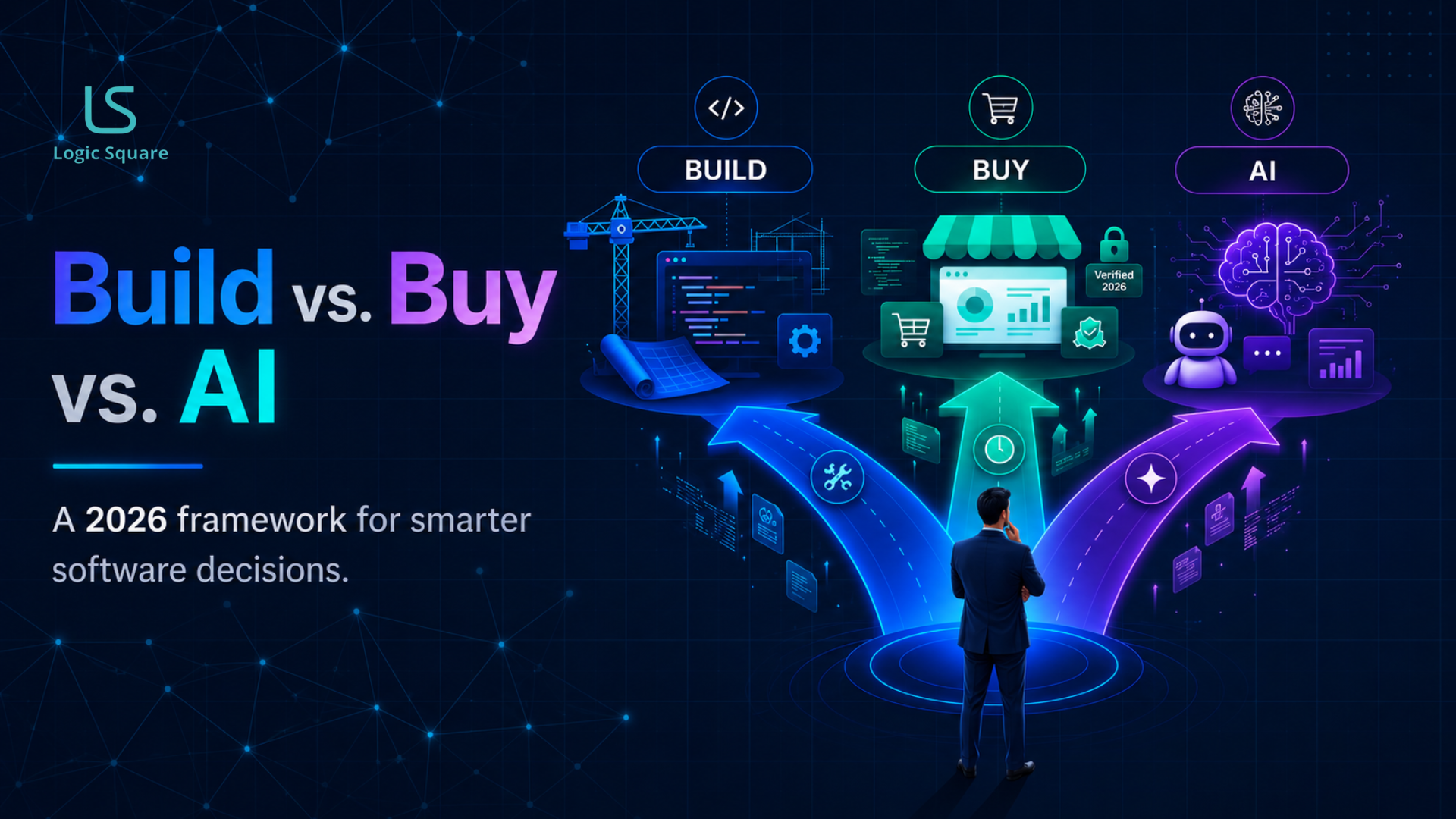
For 20 years of the last century so far, the software question was simple: buy SaaS for standard business flows. Build custom for anything that was different, for anything that promised operational advantage.
In 2026, there\’s a third way, build fast with AI-driven development tools. The old rules no longer answer the question, even half-right.
So what\’s the practical solution to the software question today?
Buy if it\’s a standard flow, that is, if it\’s already being served by mature software.
Build if it\’s a core flow that may deliver operational advantage (or consume a lot of operating costs) for decades.
Use AI to accelerate delivery and experimentation, not to avoid the architectural choice.
Use our interactive Build vs Buy vs AI framework to compare the three options based on workflow stability, strategic importance, operational friction, risk, and long-term ownership.
And avoid the expensive mistake of defending the software choice based on speed, \”AI boost\” or hype.
On this page+
What Actually Changed in 2026
Two major shifts have changed how organizations evaluate software decisions.
1. The Cost of Building Custom Software Has Dropped
AI-assisted development has significantly reduced the time required to prototype and ship applications. Work that once required large engineering teams and long implementation cycles can now be completed much faster by smaller, experienced teams.
This has expanded the number of businesses considering custom software for workflows that previously would have remained inside spreadsheets, manual operations, or rigid SaaS platforms.
That shift is real and it is unlikely to reverse.
2. Businesses Are Actively Moving Toward Custom Internal Tools
According to Retool’s 2026 Build vs. Buy report, based on a survey of 817 professionals across engineering, operations, finance, and IT:
- 35% of teams reported replacing at least one SaaS tool with a custom-built solution.
- 78% expected to build more internal software in 2026.
- 60% reported creating software outside formal IT oversight during the previous year.
The build-versus-buy conversation is no longer isolated within engineering departments. Operations leaders, finance teams, and business stakeholders are increasingly involved because software decisions now directly affect operational flexibility and cost structure.
However, cheaper to build does not automatically mean correct to build.
That distinction matters more than ever.
The Three Paths and Where Each Goes Wrong
There are now three realistic approaches available to most mid-market organizations. Each can be the correct decision in the right context and a costly mistake in the wrong one.
1. Off-the-shelf SaaS (Buy)
- This means you license a platform that already satisfies a common operational problem.
- SaaS is usually the right decision when:
- The process is standardized.
- The workflow does not differentiate the business.
- There already mature products on the market.
Examples include:
- accounting systems
- expense management
- email platforms
- standard HR operations
- basic CRM functionality
In these cases, rebuilding what already exists rarely creates meaningful advantage.
Where SaaS Starts to Break Down
The problems usually emerge over time:
- teams adapt their workflows to the tool instead of the reverse
- per-seat licensing costs compound as the organization grows
- integrations become increasingly complex
- businesses pay for functionality they barely use
- operational workarounds appear because the platform only partially fits the process
SaaS is often inexpensive to adopt initially, but operationally expensive to live with at scale.
2. Build (Custom Software)
Custom software is built around the organization’s actual workflow and operational model.
This becomes the stronger option when:
- the workflow is core to the business
- operational processes are difficult to standardize
- existing tools require significant compromises
- manual workarounds are creating measurable inefficiency
- the workflow itself creates competitive advantage
In these situations, forcing the business to operate inside generic tooling often becomes more expensive than owning the software directly.
Where Custom Software Goes Wrong
Custom development becomes risky when organizations:
- build functionality already solved effectively by mature SaaS tools
- begin development before workflows are stable
- underestimate long-term maintenance responsibilities
- treat custom software as a one-time project instead of an operational asset
The advantage of custom software is ownership and flexibility.
The responsibility is ownership and flexibility as well.
3. Build Fast with AI
AI-assisted development tools can now generate working applications from natural-language prompts and lightweight specifications.
This approach is highly effective for:
- prototyping ideas quickly
- validating workflows
- internal operational experiments
- proof-of-concept systems
- early-stage product validation
The speed improvements are genuine.
Where AI-Built Systems Become Dangerous
The risk emerges when prototypes move directly into production environments without proper engineering oversight.
AI can accelerate the first working version of software.
It does not automatically solve:
- scalability
- architecture
- security
- maintainability
- observability
- operational resilience
- edge-case handling
Many AI-generated systems perform well in demonstrations but fail under real operational conditions.
The gap between “works in a demo” and “works reliably in production” remains substantial.
In practice, the prototype is often the easiest 20% of the lifecycle.
The Three Questions That Decide the Right Path
Before you decide whether to build, buy or use AI tools head to workflow first , not tech.
In most cases there are three questions that help you choose the right one.
1. How Stable Is the Workflow?
Does the process remain relatively consistent, or does it change every few weeks?
A stable process is a stronger candidate for either SaaS or custom development.
A rapidly evolving process is dangerous to hard-code into software because:
- requirements continue shifting
- operational assumptions change
- teams repeatedly rebuild the same system
In these cases, lightweight experimentation or AI-assisted prototyping is often the better short-term approach until the workflow matures.
2. How Core Is the Workflow to the Business?
Not every operational process deserves custom engineering investment.
The critical distinction is whether the workflow creates strategic value or simply supports basic operations.
Organizations rarely benefit from custom-building operational plumbing.
However, the workflows that directly affect:
- customer experience
- delivery operations
- internal efficiency
- specialized workflows
- proprietary processes
are often exactly where generic tooling creates long-term friction.
This is where custom systems tend to generate the most value.
3. What Does It Cost Over Three Years?
One of the most common mistakes in software strategy is evaluating only the upfront implementation cost.
The better question is:
What does this decision cost over the next three years?
For SaaS, that includes:
- expanding seat licenses
- premium feature tiers
- vendor lock-in
- integration overhead
- migration complexity
For custom software, it includes:
- development
- maintenance
- infrastructure
- ongoing iteration
For AI-generated prototypes, it includes:
- re-architecture
- security hardening
- production readiness engineering
- long-term maintainability
When organizations evaluate software over a multi-year horizon instead of a quarterly budget cycle, the correct direction usually becomes much clearer.
Use the software cost calculator to estimate the likely investment based on project type, complexity, platforms, integrations, security requirements, and ongoing maintenance.
AT A GLANCE
The simplest version of the framework is this:
- Buy the standard operational plumbing.
- Build the workflows that genuinely define how the business operates.
- Use AI to accelerate experimentation and delivery, not to bypass engineering discipline.
When the Right Answer Is “Don’t Build”
One of the most important realities in software strategy is that custom development is not always the correct decision.
These five situations where you should not build custom software explain when buying an existing product, validating with a prototype, waiting, or fixing the underlying process is the better choice.
If an existing SaaS platform already solves most of the operational requirement without introducing major workflow friction, buying is often the more responsible choice.
Similarly:
- if the workflow changes constantly, development will likely become wasted effort
- if internal ownership does not exist after launch, even well-built systems deteriorate
- if the operational advantage is minimal, the engineering investment rarely produces meaningful return
At Logic Square Technologies, we regularly advise organizations not to pursue custom development when the economics or operational realities do not support it.
Long-term trust matters more than selling unnecessary software.
The Bottom Line
AI has reduced the cost of starting software projects.
It has not reduced the cost of making the wrong strategic decision.
In many ways, the build-versus-buy decision matters more now because organizations can move faster than ever before — including in the wrong direction.
The most reliable framework remains relatively simple:
- start with the workflow, not the technology
- evaluate long-term operational impact, not short-term implementation speed
- distinguish experimentation from production engineering
- understand where software actually creates business value
Organizations that approach the decision this way tend to build less unnecessary software — and create better systems when they do choose to build.
Frequently Asked Questions(FAQs)
Is it cheaper to build custom software now that AI exists?
Often, yes — building is meaningfully cheaper and faster than it was a few years ago, which is why more companies are choosing it. But cheaper to build is not the same as cheaper to own. Custom software still has to be maintained, and an AI-built prototype still has to be hardened before it survives production. Compare three-year cost, not build cost.
Should we just build it ourselves with AI tools?
For a prototype or an internal experiment, often you can, and we’ll tell you when that’s the right call. For something customers or operations depend on, AI gets you the first working version but not the reliability, security, and maintainability that production demands. The gap between “works in a demo” and “works every day” is exactly the engineering AI doesn’t remove.
How do we know if we’ve outgrown our SaaS tool?
The usual signs: you’re paying for far more than you use, you’ve built manual workarounds because the tool almost-fits, per-seat costs are climbing faster than the value, or your team re-enters data because the tool won’t integrate. When the workarounds cost more than the tool saves, you’ve outgrown it.
When is SaaS the better choice over custom?
When the process is standard, not core to your differentiation, and well served by an existing product. Don’t build your own version of something a mature SaaS product already does well — buy it, and spend your build budget on the parts that are genuinely yours.
Can you help us decide without selling us a build?
Yes. A short conversation will usually tell us both whether custom software is the right answer. If it isn’t, we’ll say so — sometimes the honest recommendation is to buy SaaS or to wait until your workflow settles.
Evaluating Whether to Build, Buy, or Modernize?
If your organization is evaluating custom software, SaaS replacement, workflow modernization, or AI-assisted development, our team can help assess the operational and long-term implications of each path.
Logic Square Technologies has delivered production systems for operationally complex businesses since 2012, with engineering delivery across healthcare, fintech, operations, logistics, recruitment, and regulated industries.
And if custom software is not the right answer for your situation, we will tell you that too.
Work with us