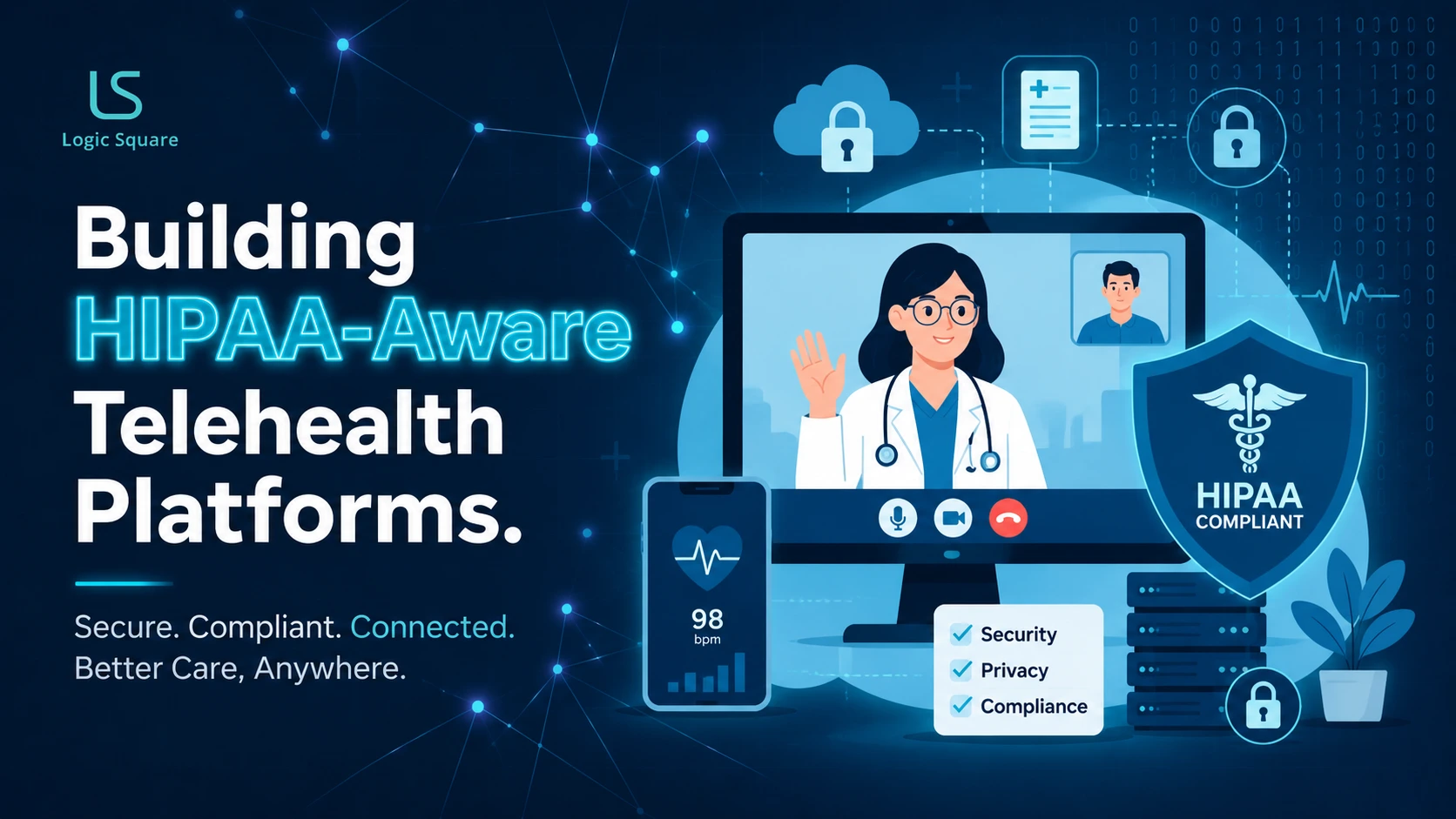
Building telehealth software involves far more than enabling video consultations. A successful telehealth business must coordinate intake, patient history, payments, provider workflows, prescriptions, fulfillment, and sensitive data handling, all working together reliably and responsibly. The engineering challenge extends beyond compliance. The real work lies in creating systems that operate efficiently without introducing unnecessary risk or operational friction.
It is also important to clarify that software itself is not “HIPAA certified.” Compliance is a property of the broader operation, including policies, infrastructure, administrative safeguards, and software together. What healthcare businesses need is an engineering partner experienced in building systems that support HIPAA-aware practices and responsible handling of protected health information.
We’ve built healthcare platforms, including a white-label telehealth platform for a healthcare venture and an embeddable telemedicine intake widget designed to integrate into existing healthcare websites while supporting a complete patient workflow. Healthcare founders consistently ask the same underlying question: how do we build this without mishandling the sensitive parts of the system?
One of the underlying questions that feeds into the bulk of telehealth conversations is how to launch a platform with minimal workflow friction and risk. Unfortunately, when it comes to healthcare software, the software fails as often from operational reasons as it fails from technical bugs. Both make the system weak and deserve serious consideration from day one.
Healthcare software must be reliable because the cost of failure is significant.
On this page
First, a clarification about “HIPAA compliance”
There is a common misconception that we need to address because it has an impact on how healthcare enterprises assess vendors. The software itself is never HIPAA certified. HIPAA compliance is a property of the full operation , including policies, hosting environments, administrative safeguards and software combined.
Vendors describing standalone software as “HIPAA certified” are often oversimplifying how compliance actually works.
What health care organizations need is a partner that has built systems for HIPAA-Aware organization practices, as well as responsible management of protected health information with controls for proper access, encryption, audit trail and deliberate data handling.
That is the framework we follow when building healthcare software. We build with HIPAA-aware practices and real-world experience handling protected health information responsibly. Compliance ultimately extends beyond software and includes operational, legal, and administrative processes as well.
Responsible vendors should also sign a BAA (Business Associate Agreement), which formalizes how protected health information is handled and managed under HIPAA requirements.
What HIPAA-aware engineering actually involves
Setting the language aside, here is what building responsibly with health data looks like in practice.
1.Access control that assumes least privilege
Access to all information is not appropriate for all users. Role-based permissions should prevent patients, providers and administrators from seeing what they do not need to see. A key requirement.
2.Encryption, in transit and at rest
Patient data should be protected both while stored and while moving between systems. This is a baseline requirement and should be designed into the system from the beginning rather than retrofitted later.
3.Audit trails
Health systems should keep track of who accessed what information and when. Auditing helps health systems enforce compliance as well as employ best security practices.
4.Careful data handling and minimization
Healthcare systems should collect and retain only the information genuinely required. Data handling should remain deliberate and controlled, especially when third-party services or AI capabilities are involved.
Sensitive patient information should never flow into systems that are not designed to protect it appropriately.
Reliability is part of the safety story
In most software products, downtime is an inconvenience. In healthcare, reliability directly affects trust and continuity of care. Platforms people depend on for healthcare services cannot treat downtime as a minor issue.
That raises the engineering standard significantly. Healthcare systems must be built for real-world operating conditions, designed to fail gracefully, and tested against realistic usage patterns rather than ideal scenarios.
Reliability and safety are closely connected in healthcare software in ways they often are not in ordinary business systems.
Put simply: in healthcare, reliability is not a feature. It is part of trust.
Build for both sides: patients and providers
A telehealth platform serves two very different groups of users, and the system must work effectively for both.
Patients need a simple, trustworthy experience that often works on mobile devices and under stressful conditions. Providers and operational staff require workflows that support how they actually work throughout the day without adding unnecessary friction.
A platform that works well for patients but creates friction for providers will struggle operationally. Likewise, a provider-friendly system that confuses patients will reduce engagement and conversion.
Designing effectively for both sides simultaneously is a major part of building successful telehealth software.
What a telehealth platform actually has to do
Compliance and security are baseline expectations, not differentiators.
Strong telehealth platforms are designed around the complete operational journey:
- Supporting patient onboarding, intake, history collection, and required documentation
- Equipping providers with intake information and workflows that align with clinical operations
- Managing documentation, prescriptions, fulfillment, and follow-up workflows
- Integrating storefronts, payments, subscriptions, and operational systems into a unified experience
We’ve built platforms supporting exactly this type of end-to-end journey. In one implementation, a patient selects a product, completes intake questionnaires, submits payment, and connects with a medical professional through a unified workflow rather than disconnected systems.
Fitting into the systems a clinic already runs
A common operational concern for healthcare businesses is integration: will the system work with existing workflows and operational tools?
For large hospital systems, integration often involves deep interoperability with electronic health record systems. However, most telehealth and wellness operators primarily need platforms that integrate cleanly into the websites and practice-management systems they already use.
That is the integration work we focus on. We’ve embedded telehealth capabilities into existing websites across WordPress, Shopify, Wix, and custom environments while integrating with the practice-management systems clinics already rely on.
The goal is straightforward: introduce new capabilities without forcing businesses to rebuild their entire operational infrastructure.
Questions worth asking any telehealth vendor
If you’re evaluating telehealth software or choosing a development partner, these are important questions to ask:
- Who sees what information?
- How is patient data protected?
- Are audit trails available?
- Is data handled deliberately and minimally?
- Will the vendor sign a BAA?
- Does the platform integrate with existing systems?
- Is reliability engineered for real-world conditions?
A strong engineering partner should welcome these questions.
Where AI fits – carefully
AI has meaningful applications within healthcare software, but it should be applied carefully and responsibly.
AI is well suited for intake assistance, summarization, search, workflow support, and repetitive operational tasks surrounding clinical decisions. It should not replace human clinical judgment.
Any capability involving patient data should be handled with the same rigor as the rest of the healthcare platform. The more sensitive the decision, the more important human oversight becomes.
We approach AI in healthcare with additional scrutiny, not less.
Frequently asked questions (FAQs)
1. Can you build us a HIPAA-compliant platform?
We build healthcare software using HIPAA-aware engineering practices, including access controls, encryption, auditability, and careful data handling. Full HIPAA compliance depends on the broader operational environment, including policies, hosting, and administration in addition to software.
2. Is software ever “HIPAA certified”?
No. Compliance applies to the broader operational environment rather than standalone software.
3. How do you handle sensitive patient data with AI features?
With deliberate controls and additional scrutiny. AI can support workflows like intake and summarization, but clinical decisions should remain human-led.
4. Can you build something that embeds into our existing site?
Yes. We’ve built embeddable telemedicine workflows for WordPress, Shopify, Wix, and custom healthcare environments.
5. How do you make telehealth fit our existing systems?
By integrating into the operational systems businesses already use rather than forcing complete infrastructure rebuilds.
6. What should we verify before choosing a telehealth vendor?
Access controls, encryption, auditability, data handling practices, willingness to sign a BAA, integration capabilities, and reliability engineering.
Building a healthcare or telehealth platform?
We build healthcare software with HIPAA-aware practices, operational reliability, and experience handling sensitive patient data responsibly. Veteran-led, building production software for operationally complex businesses since 2012.
If you\’re evaluating a healthcare platform, telehealth workflow, or patient-facing digital product, explore how Logic Square Technologies approaches production-grade healthcare software engineering.
Work with us