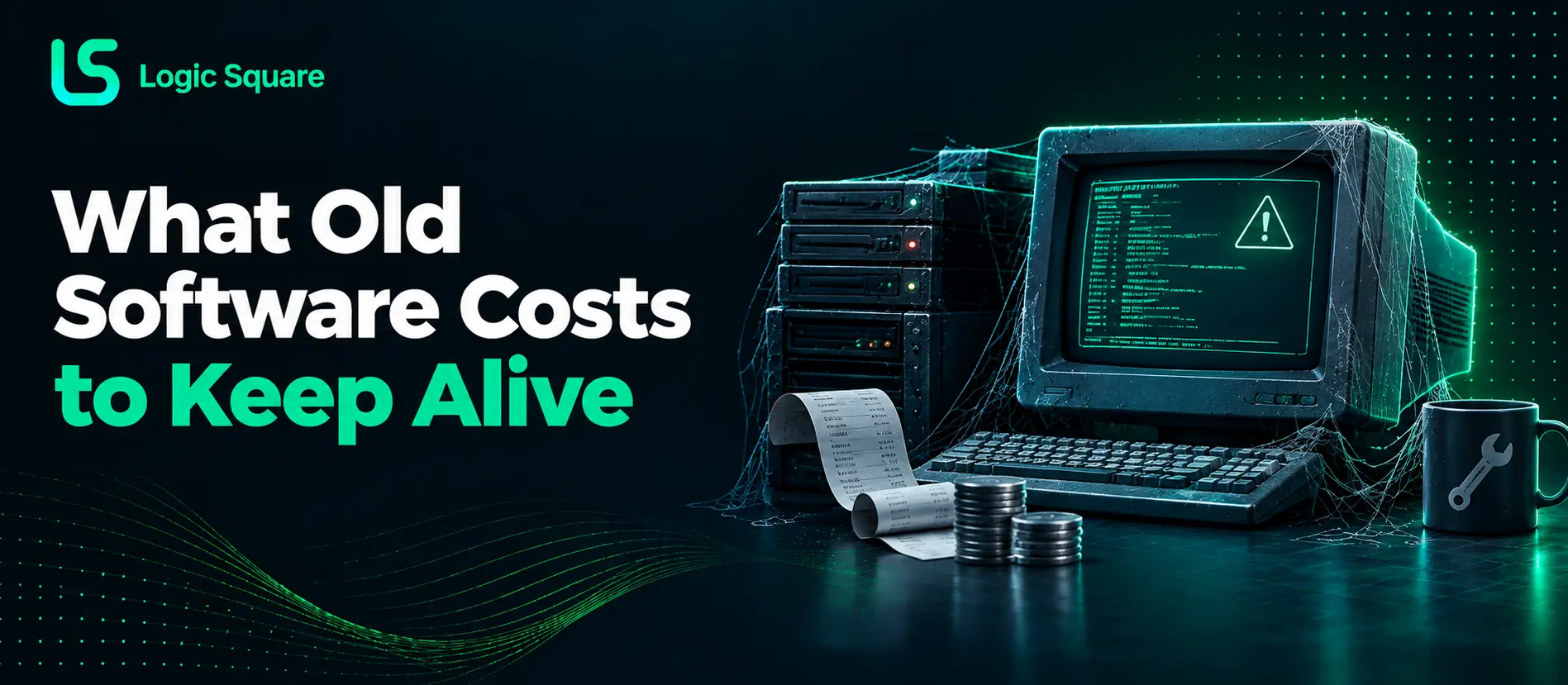
The cost of keeping old software alive is rarely the hosting bill. It is the widening gap between what small changes should cost and what they do cost, plus the opportunity cost of what the system prevents you from doing. We know because we operate our own aging production software, and because we recently modernized one of our platforms: roughly fifteen days of planning and about two months of execution, on a system that never stopped running.Our executive guide to software modernization explains how to assess the system and decide whether to modernize, replace or leave it alone.
On this page+
The honest ledger, from systems we own
One of our own products has been in production for six to seven years. Its direct costs are unremarkable: hosting, dependency patching, the occasional compatibility fix. The real costs are quieter. Every major version it falls behind can increase the complexity and coordination cost of catching up later. Every workaround its age requires becomes something a new engineer must learn. And the system taxes attention: the hours our team spends keeping it comfortable are hours not spent on what it could become. In our experience, much of legacy cost shows up as internal time and foregone options, which is exactly why it rarely appears on an invoice and rarely triggers a decision.
What modernization actually took, measured
When we modernized a core workflow of our recruitment platform, adding AI-driven capability to a live system, the arithmetic was: about fifteen days of planning and roughly two months of staged execution, with the platform operating throughout. That is a case, not a benchmark; we publish it because a measured example is more useful than a vendor promise at either extreme. Your system’s number depends on isolation: how cleanly the aging part separates from the working whole. That is the first thing our assessment establishes.
The three quiet costs, itemized
- The workaround tax: Every age-driven workaround (the manual step a modern system would automate, the export that bridges what an integration should, the “don’t touch that module” folklore) costs a few minutes many times a week, across everyone who touches the system. Nobody invoices it, so nobody decides about it.
- The catch-up escalator: Falling one major framework version behind is a routine upgrade. Falling three behind can mean migration guides that no longer chain, dependencies that conflict, and a compressed, riskier catch-up when a security issue finally forces it. The price of the eventual upgrade grows while you defer it, which is precisely why deferral feels free.
- The option you’re not exercising: For our own platform, the sharpest legacy cost was capability: the AI-driven workflow we eventually added in the staged modernization was worth more than every maintenance dollar saved by waiting, and the waiting was the cost. Ask what the system is the reason you don’t have; that answer prices the age better than the hosting bill does.
The do-nothing option, priced honestly
Sometimes the right answer is to keep paying the quiet costs. A stable, understood, adequately secure system whose maintenance is cheap and whose limitations aren’t blocking the business can be left alone for years, and we tell clients that even though modernization is what we sell. The point is not that doing nothing is free. It is that its cost should be calculated (current maintenance plus the workaround tax plus the rising catch-up price) rather than assumed to be zero, and then compared like any other option. Use our modernize, replace or leave it alone framework to compare those three options against cost, risk and business impact.
If the numbers show that continued maintenance is becoming more expensive than controlled change, explore our legacy software modernization services for a phased approach that keeps the existing operation running.
Three numbers to write down for your own system
What did the last five small changes actually cost, in elapsed days? How many hours a month does anyone spend on workarounds the system’s age requires? And what is the one capability the business wants that this system is the reason you don’t have? Those three numbers give you a first-pass estimate of what the legacy system is costing the business. If they’re small, leave it alone. If they’re growing, the checklist is next.
FAQ
How often should working software be modernized?
On evidence, not calendars: when change difficulty, workaround hours, or a blocked capability crosses the threshold you set in advance. Our own six-plus-year-old platform earns its keep some years and demands investment in others.
Is a rewrite cheaper than years of maintenance?
Sometimes, and the arithmetic is checkable: compare the modernization quote against the workaround tax plus the catch-up escalator over your planning horizon. Our measured staged case (fifteen days planning, two months execution) is the kind of number to demand instead of a feeling.
When is keeping an old system simply correct?
Stable, understood, adequately secure, cheap to run, and not blocking anything the business wants. That describes more systems than the rebuild industry admits.
One caution as you gather the numbers: measure them against business impact, not nostalgia in either direction. Teams overvalue systems they built and undervalue systems they inherited, and both biases misprice the same code.
Want the three numbers measured on your system? That’s the first week of our assessment, and sometimes its conclusion is “keep it”:
Work with us