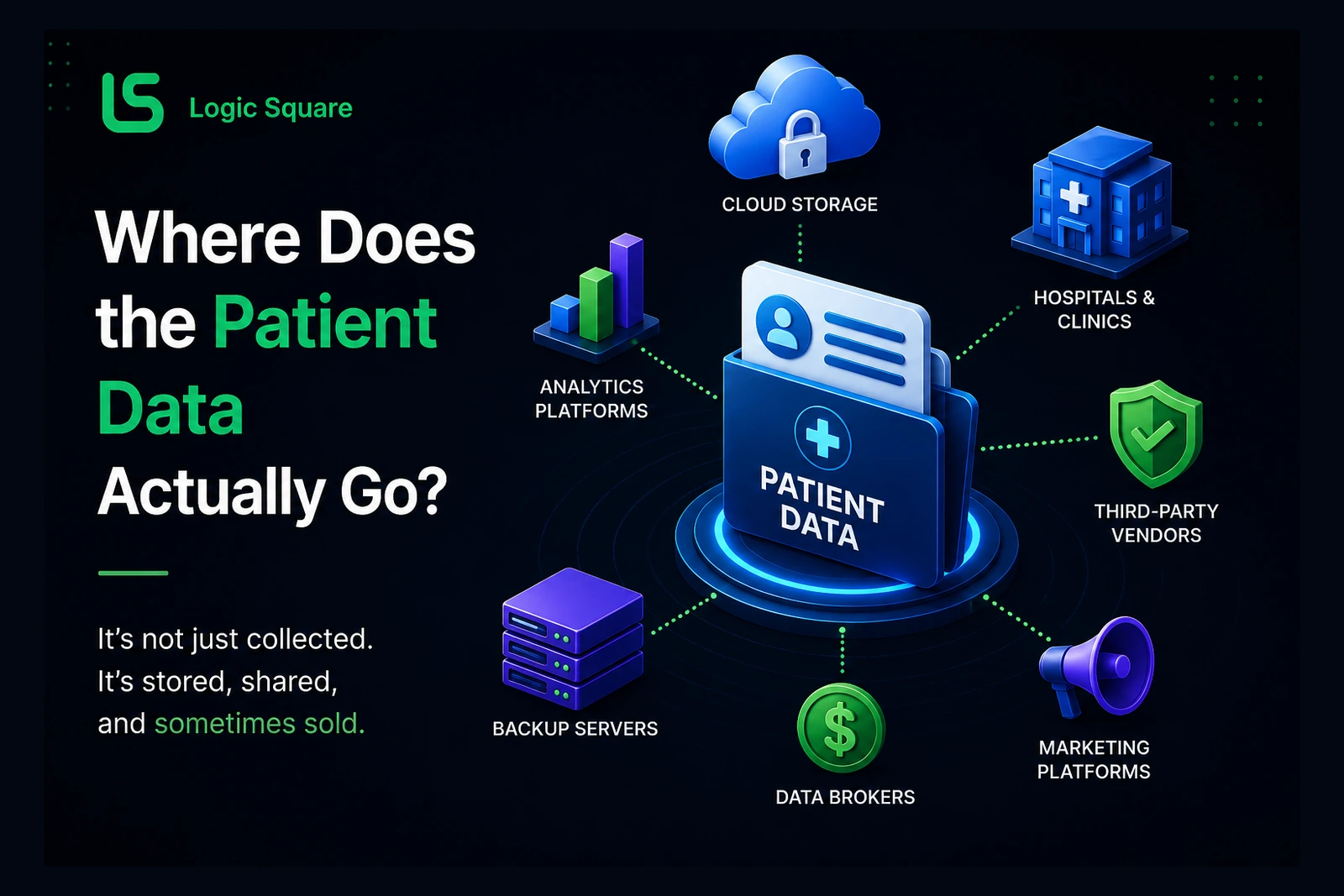
The useful question in healthcare AI is not “should we use AI?” It is “where does the patient data actually go?” Every AI feature creates data paths: to models and APIs, into logs and observability tools, through staging and development environments, to vendors, into backups. HIPAA-aware engineering is the discipline of knowing and controlling every one of those paths. We build healthcare-adjacent systems with AI assistance, and this is how we handle the data. This data-path discipline forms part of our broader approach to healthcare software development, where sensitive workflows, operational reliability and access boundaries must be designed together.
On this page+
Our actual position, stated plainly
The important question is not whether AI helped build the feature. It is where PHI can travel once the feature exists. Our review effort rises with the sensitivity and blast radius of the function, regardless of who or what wrote the code: more manual review, more sampling, targeted testing of high-risk functions, independent AI cross-review. The caution lives in the controls, not in abstinence.
The seven paths patient data can travel
The map, in sequence: model → vendor → logs → observability → staging and development → tenant and context boundaries → backups. Then each path, briefly.
- To the model: The core rule is minimum necessary: the model receives only the data the feature requires, and where the workflow allows it, identifiers are separated or de-identified before any API call.
- To the vendor: Any AI vendor touching PHI gets evaluated like any other business associate, agreement included; “it’s just an API” is not an exemption. Our guide to building HIPAA-aware telehealth platforms explains how BAAs, access controls, encryption, audit trails and operational safeguards fit around the software.
- Into logs: A common leak we see designed in by accident: debug logging that captures request payloads. Our rule is to log the access event, never the medical content; you can prove who did what without storing what they saw.
- Into observability: Tracing and monitoring tools replicate whatever you send them; they are part of the data map or they are a hole in it.
- Into staging and development: Real patient data does not belong in development environments; synthetic data does, and building with synthetic data from day one is cheaper than remediating later.
- Across tenants and contexts: Systems serving multiple providers get leak-tested across patient contexts deliberately, because retrieval features fail exactly there.
- Into backups: Whatever paths exist, backups inherit them, retention rules included.
Running the seven-path review on a real feature
The map becomes a working tool when you run one feature through it. Take an AI intake-summarization feature: the model path asks what the summary genuinely requires (symptoms and history, or also identifiers that could be stripped first); the vendor path asks whether that model’s operator has signed the right agreements; the log path asks what your debug logging captures when the call fails at 2 a.m.; observability asks what your tracing tool replicates; staging asks what data the feature was developed against; context boundaries ask what happens when a clinician has two patients open; and backups ask how long yesterday’s payloads live and where. Thirty minutes of honest answers per feature, and the output is an architecture instead of an assurance. The HyrTech telehealth platform shows this boundary-first approach in practice, with patient intake, role-scoped access and merchant-separated data built into the platform architecture.
Teams that cannot answer path three are the ones that discover their compliance posture in an incident report.
Where the caution actually concentrates
Not in whether AI wrote code, but in which functions the code performs. Authorization boundaries, data retrieval, export, and anything that crosses patient contexts get the heaviest review and testing regardless of authorship. AI-generated code in a styling component and AI-generated code in a records query are not the same risk, and treating them identically wastes review where it isn’t needed and thins it where it is.
Stage intelligence behind evidence
We once lost roughly two months automating a compliance-adjacent workflow before demand justified it; in healthcare that instinct is riskier still. Stage AI features behind real usage and let the workflow prove what deserves intelligence.
FAQs
What is the most commonly missed data path?
Logging, in our review experience: debug capture of request payloads quietly stores the very content the architecture elsewhere protects.
Can AI-assisted development be HIPAA-compliant?
The development approach isn't what compliance attaches to; the system's data handling is. AI-assisted engineering with escalated controls is how we build; the data paths above are what make the result defensible.
Do we need a BAA with our AI vendor?
If PHI reaches an external AI service, BAA and business-associate obligations become part of the architecture and vendor review; the exact requirement depends on the service and the data flow. If your architecture keeps PHI away from the model entirely, you've answered a better question.
Is on-premise AI safer?
Sometimes, and often uneconomic: see our private-AI-versus-API guide for the actual decision logic.
The map’s deeper value is cultural: once a team runs it three times, “where does the data go” becomes a reflex asked at design time, which is the cheapest moment any compliance question will ever be answered.
Work with us