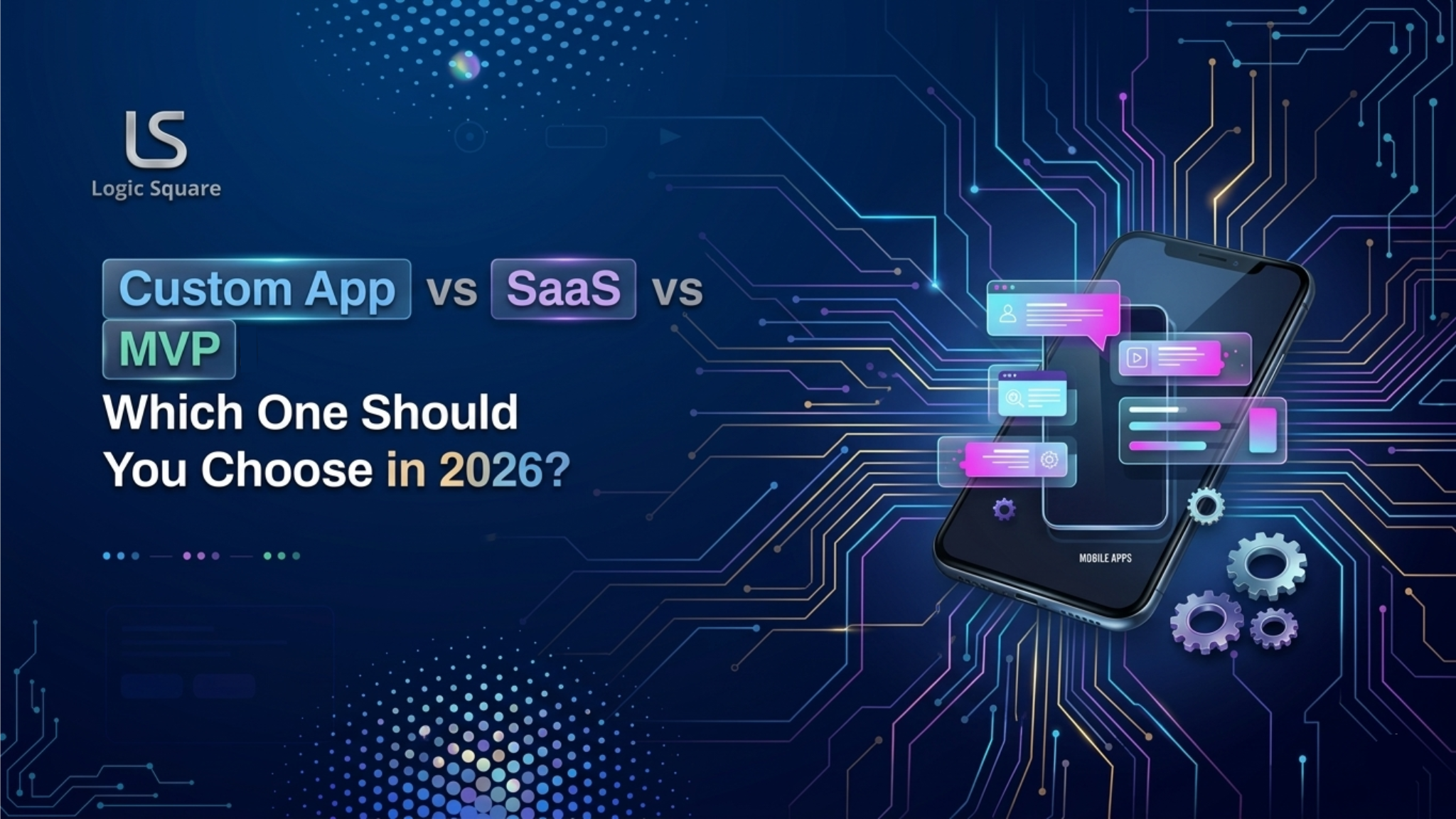
Selecting a Custom App, SaaS, or an MVP is one of the most important technology decisions a business makes. Pay attention and you’re prolifically productive. Miss the mark and you waste budget, you waste time, you waste momentum.
Yet often, businesses make this decision on buzz – not on strategy. They build over too early, overpay for SaaS too long, or skip validation entirely , and pay for it later in wasted dev cycles and missed market windows.
The margin for error in 2026 is fine. Investor focus is intense. Users have higher expectations. Competition is brisk. The businesses moving ahead are not necessarily those with the biggest budgets , they are the businesses making more intelligent tech bets at the optimal point.
This guide gives you a clear, no-fluff breakdown so you can make the right call for your stage and goals in 2026.
On this page+
What Is the Difference Between a Custom App, SaaS, and an MVP?
Custom App | SaaS | MVP | |
What it is | Software built from scratch for your specific needs | Subscription-based, ready-made software | A stripped-down first version of your product |
Ownership | Full | None | Full |
Setup time | Weeks to months | Immediate | Days to weeks |
Upfront cost | High | Low | Low–Medium |
Customization | Complete | Limited | Partial |
Scalability | High | Depends on vendor | Moderate |
Best for | Scaling businesses with unique needs | Standard workflows, early operations | Startups validating a new idea |
The core distinction: SaaS is a service you rent. An MVP is a product you test. A Custom App is a product you own and scale.
To compare what each option actually costs, consider the initial build, subscription fees, integrations, maintenance, infrastructure, and long-term ownership expenses.
What Is a Custom Application?
A custom application is software custom-built for your business , your processes , your data model ,your end users.
Choose a Custom App when:
- Your processes are too unique for off-the-shelf tools
- You need complete ownership and control of your data
- You are building a proprietary platform (fintech, marketplace, healthcare, logistics)
- You are at a growth stage where vendor limitations are slowing you down
Advantages: Full flexibility, competitive differentiation, no recurring licensing costs, built to scale exactly as you need.
Disadvantages: Morein initial costs, longer initial build time.
Bottom line: Custom Apps aren\’t for testing out early-stage ideas. They\’re for businesses that have validated their needs and are ready to own it.
What Is SaaS (Software as a Service)?
SaaS is ready-made software you use through subscription , like CRM software, accounting software, project management software, or scheduling software.
Choose SaaS when:
- You need a working solution immediately
- Your requirements are standard and well-served by existing tools
- You want to avoid the overhead of building and maintaining software
- You are in early operations and cost control is critical
Advantages: Instant setup, predictable monthly cost, maintained and updated by the vendor, no infrastructure to manage.
Disadvantages: Limited customization, ongoing subscription costs that compound over time, no ownership of the software, potential data lock-in.
Bottom line: SaaS is an excellent starting point. It becomes a ceiling if you stay too long.
What Is an MVP (Minimum Viable Product)?
An MVP is the simplest possible version of your product, developed with only enough features to address the key problem and have actual users interact with it.
Choose an MVP when:
- You have a new product idea and need to validate market demand
- You want early user feedback before committing to full development
- You want to reduce the risk of building the wrong thing
- You need to demonstrate traction to investors or stakeholders
Advantages: Quick to deploy (usually under a month), much cheaper than the complete product, use real-world feedback to guide further work.
Disadvantages: Limited functionality, requires follow-on investment to evolve into a full product.
Bottom line: An MVP is not a shortcut,the end is the speed with which you learn and waste less.
How Do You Choose Between a Custom App, SaaS, and an MVP?
Use this decision framework:
Solving an unvalidated problem? → Try to create an MVP. Validate demand before writing much code.
Do you have a validated need and standard workflows? → Use SaaS. Don\’t build what already exists and works.
Do you have unique requirements, validated demand, and long-term scale goals? → Build a Custom App. Own your technology and your advantage.
Are you unsure? → Talk to a product strategist before spending a dollar on development.
What Is the Smartest Strategy in 2026?
The most effective approach in 2026 is not choosing one option — it is sequencing them correctly:
- Validate with an MVP — confirm the problem is real and users want your solution
- Run operations on SaaS — use proven tools for HR, finance, CRM, and communication
- Build a Custom App as you scale — when your growth demands ownership and flexibility that SaaS can\’t provide
This hybrid approach reduces early-stage risk, keeps costs manageable, and positions you to scale without technical debt holding you back.
What Mistakes Should You Avoid?
Building a full Custom App before validating your idea This is the most expensive mistake in software development. You spend months and significant budget building a product, only to discover users want something different.
Staying on SaaS tools beyond their usefulness SaaS is a starting point, not a permanent solution. As your business grows, subscription costs compound and the limitations of off-the-shelf tools increasingly constrain your operations and differentiation.
Skipping the MVP entirely Launching a full product without market validation is a high-risk bet. An MVP is not a compromise , it is the professional way to test before you invest.
Why Does This Decision Matter So Much?
Your technology choice directly shapes:
- Time to market – the wrong approach adds months of delay
- Capital efficiency – building the wrong thing is the most expensive mistake in tech
- Product-market fit – MVPs help you find it; custom apps help you scale it
- Competitive advantage – custom software can become a moat; SaaS cannot
In 2026, the businesses winning are those that validate fast, operate lean, and build to own when the time is right.
How Logic Square Technologies Helps You Choose the Right Path
At Logic Square Technologies, we help businesses make the right technology decision before a single line of code is written.
Whether you need:
- A rapid MVP to test your idea in weeks
- A scalable custom application built for long-term growth
- A technology review to determine when to move beyond your current SaaS stack
We align your technology choices with your business goals — not the other way around.
We bring you product strategy, technology recommendation, cost and timeline estimate, and a roadmap from idea to scale.
If you are still uncertain about the right route, use the build decision guide to assess your workflow, business value, internal ownership, available alternatives, and long-term requirements.
Frequently Asked Questions
When should a startup choose an MVP over a custom app?
An MVP is best suited for when a product idea hasn’t been validated. If you haven’t validated real user need, building a full custom app is premature and costly. You can test your underlying assumption in weeks with an MVP, get feedback, and only invest in a full build after the market has responded.
Is SaaS cheaper than building a custom app?
SaaS is cheaper up front but not always cheaper in the long run. Every month subscription costs increase as you scale team and usage. A custom app has a higher upfront cost but you own it and avoid ongoing licensing costs. SaaS is preferable for most companies early on. Custom apps are cheaper at scale.
What is the biggest risk of skipping the MVP stage?
Your biggest risk is building something no one wants. You’ll spend months of development time and a decent portion of your budget, making assumptions instead of data. Most failure to launch is due to this, not execution, but validation. An MVP exists to negate that prior to it becoming expensive.
Can a business use SaaS and a custom app at the same time?
Yes, and most scaling businesses do. The most effective approach is to run standard operations (HR, finance, CRM) on proven SaaS tools while investing in custom software for the workflows that drive competitive advantage. There is no rule that forces a single choice; the goal is to own what differentiates you and rent what doesn’t.
How long does it take to build an MVP compared to a custom app?
An MVP typically takes 4 to 8 weeks depending on complexity. A custom application generally takes 3 to 6 months or more, depending on scope, integrations, and team size. The gap reflects purpose: an MVP is built to learn fast, while a custom app is built to last and scale. Starting with an MVP before committing to a full build is the most time-efficient path for new products.
Work with us