A loan management system is not one workflow. It is a chain of financial states: application, underwriting, approval, disbursement, servicing, repayment, collections, restructuring and closure. Every feature you will ever see on a vendor’s comparison page is a window onto one of those states. Evaluate the chain, not the windows.
Most guides to loan management software list modules. Origination module, servicing module, reporting module, a paragraph each, and a conclusion that you need all of them. That structure hides the thing that actually makes lending software hard: at any moment, the system must be able to answer exactly how much is owed, by whom, as of when, and prove how it arrived at that number. Everything else is furniture.
The lifecycle, state by state
Application and origination. Data capture, identity, document collection. The design question is not the form. It is what happens to an application that stalls: partial data, expired documents, a co-borrower who never signs. Half built systems treat these as edge cases. In production they are Tuesdays.
Underwriting and approval. Rules, scores, human overrides. The requirement people miss is explainability. When a regulator or an auditor asks why applicant A was approved and applicant B was declined, “the system decided” is not an answer. Decisions need recorded inputs, recorded rules versions, and recorded overrides with names attached.
Disbursement. Money moves. This is the first state where a software bug becomes a financial event. Idempotency matters here in a way most business software never encounters: a retried disbursement that fires twice is not a bug ticket, it is a reconciliation incident with a customer attached.
Servicing and repayment. Schedules, interest accrual, escrow where relevant, payment application order. Interest calculation is where correctness dies quietly. Day count conventions, leap years, partial payments applied against fees versus principal versus interest: each is a small decision, and every small decision compounds monthly for the life of every loan.
Collections and restructuring. Delinquency states, communication trails, modified terms. A restructure is the hardest test of your data model, because the original schedule and the new schedule must both remain true: one as history, one as reality.
Closure. Payoff quotes, final accounting, document release, retention rules. Loans end. Systems that never modeled the ending produce the worst support tickets in the business.
Financial-state correctness is the product
Threaded through all of this is one property: the ledger must always be right, and provably right. That means an append only audit trail, not editable balances. It means every state transition is an event with an actor and a timestamp. It means reconciliation against payment processors and bank feeds is a designed subsystem, not a monthly spreadsheet ritual. Our article on the bugs that cost you money covers why financial software failures are classification failures: money in the wrong state, not code that crashes.
Compliance follows the same logic, with one honest caveat: requirements differ by loan product, geography and regulator, so treat everything here as architecture practice that makes compliance achievable, not as a statement of what any specific law mandates. Controls are architecture, not paperwork. On CloseWise, a platform we engineered to support more than $21 billion in loan closings, we built the controls that later mattered for the client’s SOC 2 certification: access controls, audit logging, and change discipline. The client’s internal team completed the audit. The lesson transfers: if the controls are designed in from the start, certification becomes documentation of what already exists rather than a rebuild.
Integrations are half the system
A loan platform that cannot talk to the outside world is a calculator. In practice you will integrate with credit bureaus for underwriting data, payment processors and bank rails for money movement, e-signature providers for documents, accounting systems for the general ledger, and communication channels for statements and notices. Each integration is a boundary where someone else’s downtime becomes your incident. Design for failure at every boundary: queued retries, reconciliation jobs, and human visible exception states. The integrations, not the screens, are where loan platform budgets are won or lost.
Build, buy, or extend
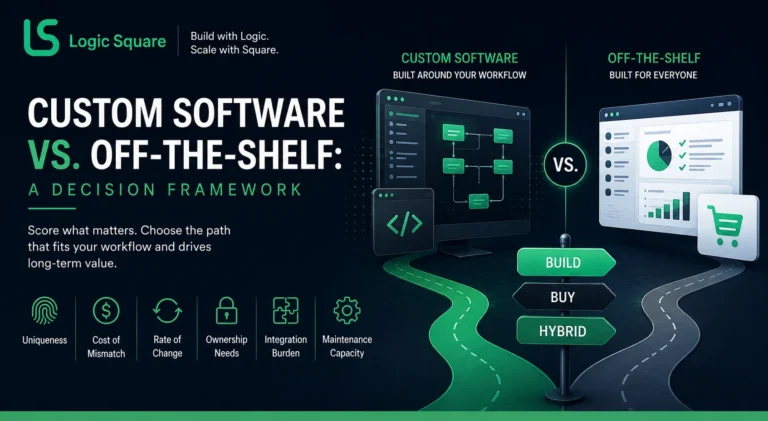
Buy when your lending model is standard and volume is modest. Established servicing platforms encode decades of edge cases you have not met yet, and for a conventional product that encoding is worth the license.
Build when the loan product itself is your differentiation: non standard structures, embedded lending inside another product, or workflows that off the shelf platforms force you to bend around. Bending a servicing platform is a slow way to build a custom system anyway, with someone else holding the data model.
Extend when a platform covers eighty percent and the remaining twenty is genuinely yours: a custom origination front end on a standard servicing core is a common and sane architecture.
Whichever direction, cost the whole lifecycle. Our custom software development cost guide breaks down where budgets actually go; for lending, weight the integrations and the correctness work, because that is where estimates from generalist vendors run thin. And vet the partner on this domain specifically. Our 12 questions to ask a software development company apply doubly when the software moves money.
If you are scoping a lending platform, book a strategy call at calendly.com/logicsquare. Bring your loan product’s actual states, including the ugly ones, and we will walk the lifecycle with you and tell you which parts justify custom engineering.
On this page+
FAQs
Coverage of the full lifecycle: origination, underwriting with explainable decisions, disbursement with idempotent money movement, servicing with correct interest accrual, collections, restructuring, and closure. Plus an append only audit trail and designed reconciliation. Feature lists that skip the audit trail are describing a demo, not a lending system.
Licensed servicing platforms run from modest monthly fees to significant enterprise contracts depending on portfolio size. Custom builds are a different economic object: budget for the correctness and integration work, not just the screens. The honest answer is that cost follows the complexity of your loan product, which is why we scope from the lifecycle, not the feature list.
Origination covers everything up to the money moving: application, underwriting, approval, closing. Servicing is everything after: payments, accrual, statements, escrow, collections. They are often separate products because they are genuinely different systems with different correctness demands.
When the loan product is the differentiation and off the shelf platforms force the business to bend around their data model. If your lending is conventional, buy. If your lending is the reason customers choose you, the data model is strategy and you should own it.
Work with us