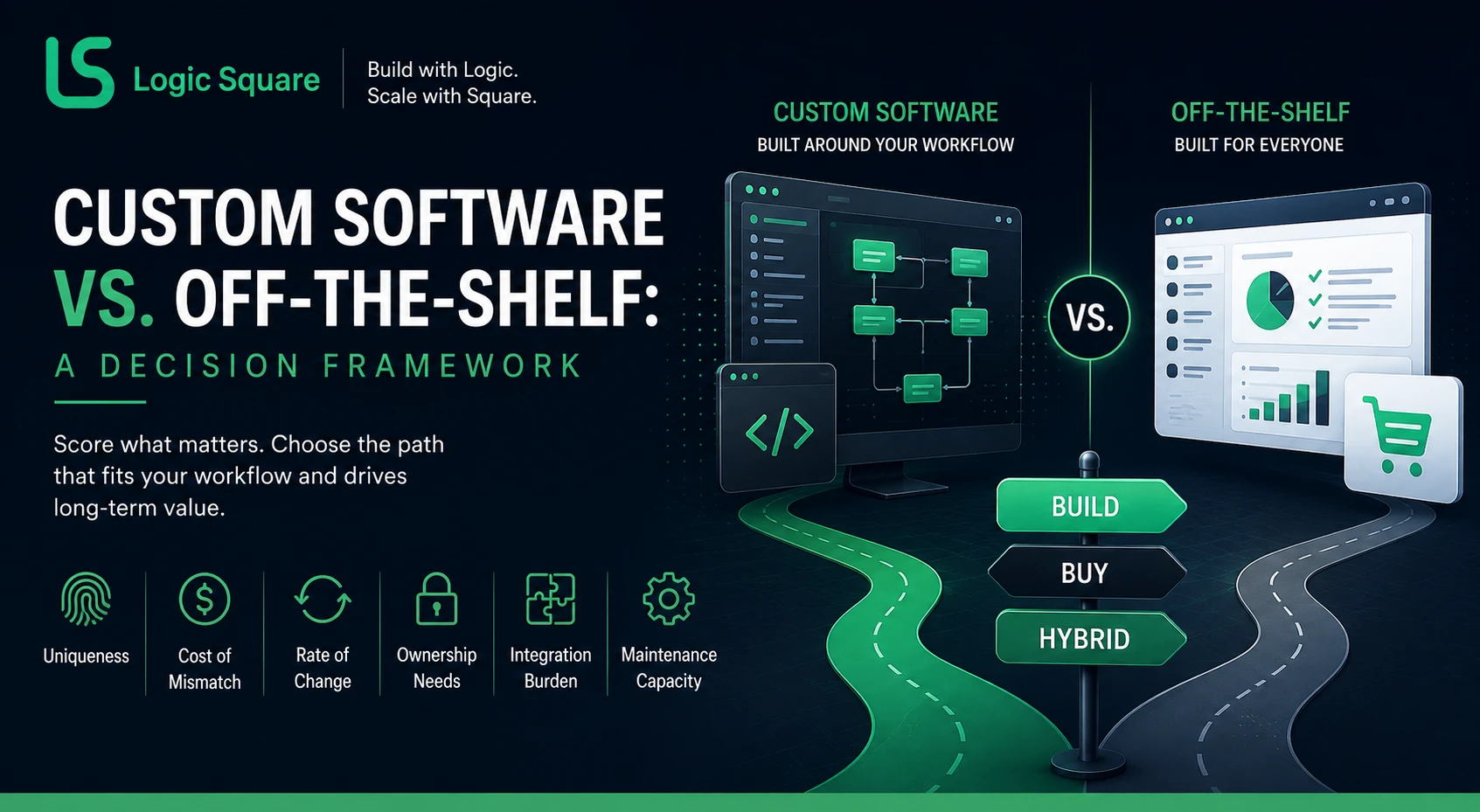
The custom-versus-off-the-shelf decision is not a feature comparison. It is a question of how much of your competitive workflow you are willing to redesign around someone else’s assumptions. Off-the-shelf wins when your process is genuinely standard. Custom wins when the workflow IS the business, and the tool’s assumptions start costing you people, accuracy, or customers.
On this page+
Where off-the-shelf breaks, observed rather than theorized
The breakpoint we’ve watched most closely: an organization ran comfortably on spreadsheets and standard tools at seven people and 50,000 records, because everyone knew the informal rules. At around 25 people and 180,000 records, the informal rules stopped transferring to new hires, interpretations diverged, and the process that lived in people’s heads stopped being a process. The tools didn’t get worse. The organization outgrew the assumptions under which the process worked. That’s the honest form of every “when do I need custom software” answer: it is not a record count, it is the moment shared context stops scaling.
The workaround signal
Before any breakpoint becomes visible in metrics, it shows up as workarounds: the export-to-Excel step that exists because the tool’s report is almost right, the field repurposed to mean something the vendor never intended, the parallel spreadsheet that is quietly the real system. Each workaround is evidence about missing functionality. When your team’s real process lives in the workarounds rather than the tool, the tool is documentation of what you used to do.
What each path really costs
Off-the-shelf: subscription growth with seats, the workflow tax of adapting your process to the tool’s assumptions, and integration sprawl (one organization we assessed ran four to five separate tools across attendance, records, tasks, messaging, and fees at an estimated $500 to $1,000 per site per month). Custom: the build (real project arithmetic lives in our cost guide), plus annual maintenance, which for planning purposes we model at roughly 20 percent of build cost depending on the system, plus the discipline to not rebuild the breadth you were escaping. Switching between them: almost never the software itself. Data migrates; the expensive part is habits, integrations, retraining, and the institutional knowledge encoded in the old system’s quirks. Price the switch honestly or the comparison is fiction.
When off-the-shelf is simply right
If your workflow is genuinely standard, buy the tool; a custom build of a standard process is expensive imitation. If you can’t yet name the workflow you’d protect, you’re not ready for custom. If a good specialized system already handles part of your operation, integrating it often beats replacing it; we tell clients this even when replacement is what we sell. And ownership arguments matter most when you plan to scale on the workflow: one client chose custom not to save money but because growing from five sites toward fifty on rented assumptions was a risk they refused.
Reading your own workaround inventory
The workaround audit is worth doing formally, because the results sort themselves. List every export-reshape-reimport loop, every repurposed field, every parallel spreadsheet, and every rule that lives only in a veteran employee’s head. Then mark each one: does it exist because the tool lacks a feature (fixable by configuration or a better tool), or because the tool’s underlying model doesn’t match how your business works? Feature gaps argue for switching tools. Model mismatches argue for custom, because no amount of tool-shopping fixes a wrong model; the agency-versus-corporate ATS distinction in our own history is exactly this line. Most inventories contain both kinds, which is why the honest answer is often a smaller custom core beside kept specialist tools rather than a grand replacement.
The decision in five questions
Which workflow, if it broke tomorrow, breaks the business? How much of that workflow currently lives in workarounds? What does your stack actually cost per month, added up honestly? What would switching cost in habits and integrations, not just data? And are you buying a capability, or renting the shape of your own business?
FAQs
When the workflow that differentiates you lives mostly in workarounds, and the informal rules holding it together stop transferring to new hires; in the case we watched closest, that arrived between roughly seven people with 50,000 records and 25 people with 180,000.
Only if the workflow is the business. Standard processes deserve standard tools at any company size; our cost guide holds the real arithmetic for when the answer flips.
The workflow tax of adapting your process to the tool's assumptions, per-seat growth, integration sprawl, and the switching cost that accumulates around any tool the longer it stays.
Not sure which side your workflow is on? Describe it in one paragraph and we’ll tell you honestly, including when the answer is “keep the tools.
Work with us