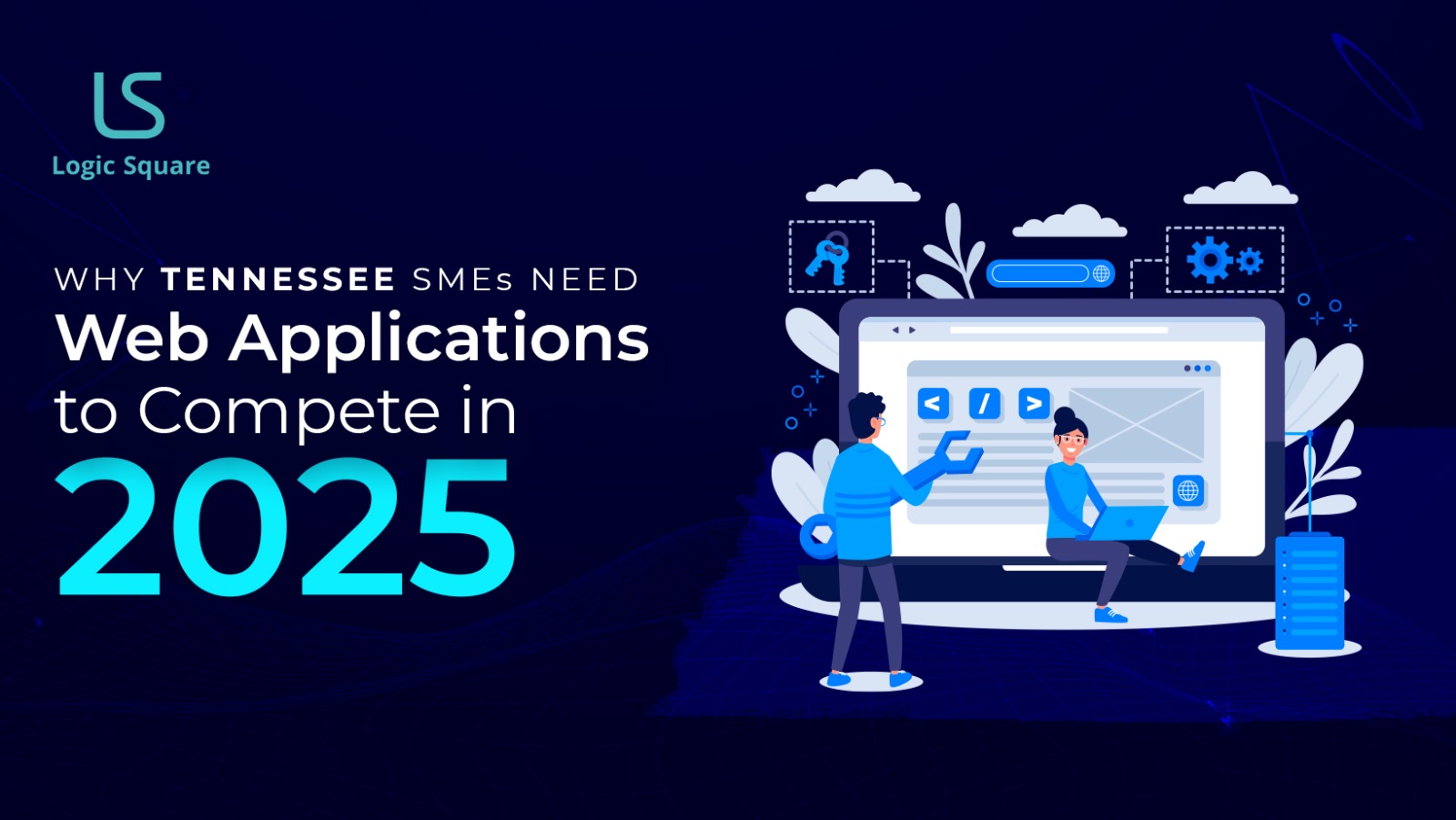
A question to all Tennessee SMEs: What steps do you think you should take to compete in 2025?
Social media, website, or web app – which does a Tennessee SME actually need?
For Tennessee SMEs, the answer is a custom web application, not a standalone website or social media presence. A web app combines the reach of a website with the automation and customer-engagement tools of enterprise software, built specifically for your business workflows
Table of Contents
ToggleIn this blog post, we’ll explore why that’s especially critical for Tennessee SMEs, and how Logic Square Technologies can partner with you.
Why is digital transformation urgent for Tennessee SMEs in 2025?
Tennessee’s SME ecosystem, from Knoxville’s manufacturing hubs to Nashville’s hospitality sector, Memphis’ logistics network, and statewide retail,is under growing pressure from digitally native competitors. Today’s customers expect speed, convenience, and seamless online experiences across every touchpoint.
In fact, over 60% of customers now expect businesses of all sizes to offer digital self-service options, from online bookings to real-time support. For Tennessee SMEs, the cost of delaying digital transformation is rising rapidly,lost customers, reduced efficiency, and limited scalability, while the benefits of adapting early include stronger competitiveness, improved customer retention, and long-term growth.
What Is a Web Application – And Why It’s More Than a Website
A web application is a software that is accessed through a web browser. Examples of web applications are software that manage customer orders, handle payments and automate workflows . A web application is typically distinct from a website, which is a set of web pages that only present information.
Key differences between a web app and a website:
- Dynamic – content updates in real time based on user actions or data
- Interactive – users can log in, submit data, book appointments, and take action
- Integrated – connects with your existing CRMs, ERPs, and payment gateways
- Scalable – grows with your business without rebuilding from scratch
For Tennessee SMEs, this distinction matters practically. A static website tells customers you exist. A web application lets them place orders, track deliveries, book services, and get support, without your team lifting a finger for each interaction.
What are the key benefits of custom web applications for Tennessee SMEs?
Here are the key ways a web application can drive value for your Tennessee-based SME:
Streamlined operations and improved productivity
By automating workflows, reducing manual tasks, and centralising operations, a custom web app lets your team focus on value-adding work instead of repetitive administration.
Increased customer engagement and satisfaction
A well-designed web app can deliver personalized experiences, self-service portals, real-time updates and mobile-friendly interaction — which builds loyalty and differentiates you in a crowded market.
Cost-effectiveness and scalability
Rather than investing in many disparate tools or legacy systems, a custom web app can scale as you grow, integrate existing systems, and reduce total cost of ownership.
Data-driven insights and decision making
Web applications enable you to collect, analyse and act on customer and operational data. That means better decisions and more targeted strategies.
Better security, integration and competitive edge
Custom web applications allow for stronger security (vital in today’s risk-aware world), smooth integration with third-party systems (CRMs, ERPs, payment gateways) and unique features that your competitors may not have.
For Tennessee SMEs operating in sectors like manufacturing, retail, logistics, hospitality or professional services, these benefits are not theoretical, they are the difference between staying relevant and being out-paced.
Why 2025 Is the Year to Invest: Not Delay
Waiting until later to invest in a web application may cost you more than the upfront investment. Here are the pressing reasons:
- Market expectations are changing: Your customers expect seamless digital interactions. If they don’t find them with you, they’ll find them with someone else.
- Competition is intensifying: National players, digital-first start-ups and non-local competitors are expanding into Tennessee. Without digital agility, SMEs might be squeezed.
- Technology is maturing: The tools, frameworks and hosting environments for web applications are more mature, more reliable and more accessible.
- Scalability matters: A custom web app built today can be extended as you grow — into new product lines, new markets (e-commerce, subscription models), or new services. Delaying means you’ll have to bolt things on later, which costs more.
- Regional benefits and incentives: Tennessee offers business incentives, and there’s a growing digital ecosystem. SMEs that act now position themselves to benefit from local talent, infrastructure and market growth.
Tailoring Web Applications for Tennessee SME Needs
Not all web apps are built the same. For Tennessee SMEs, a successful web application addresses specific local and business-specific needs. Here’s how to think about it:
Understand your workflow: Whether you’re in retail, manufacturing, hospitality, logistics or professional services, you need a solution aligned with your operations. A one-size-fits-all won’t cut it. A custom web app ensures your unique processes are supported.
Focus on customer experience (CX): For a Tennessee business, your local reputation matters. A web application can reinforce your brand, deliver localised support, showcase testimonials, and enable self-service tools — deepening customer trust.
Mobile responsiveness and accessibility: Many users will access your services on mobile or tablet, whether via field teams, remote workers or customers. Your web application needs to be responsive, accessible across devices, and fast.
Integration with your current systems: You may already have accounting software, CRM, inventory tools, email marketing tools. A good web app will integrate rather than disrupt — ensuring seamless workflows and minimal training overhead.
Security, compliance and scalability: Particularly if you serve regulated industries (e.g., healthcare, manufacturing, logistics) or handle sensitive data, your web app must have robust security features, comply with relevant standards, and scale fluidly as you grow.
Regional/local market relevance: Tennessee has its own business culture, customer expectations and regulatory environment. Your web application should reflect that local flavour — whether it’s regional shipping options, local payment gateways, favourable mobile-internet usage, etc.
How Logic Square Technologies Helps Tennessee SMEs Succeed
At Logic Square Technologies, we understand the unique needs of SMEs, especially in regions like Tennessee where business agility, local roots and cost-effectiveness matter. Here’s how we partner with you:
- Consultative discovery: We don’t just build code — we learn your business, your workflows, your competitive landscape and your growth plans.
- Custom web application development: From green-field designs to extending existing systems, we build web applications tailored to your needs — offering scalability, integration and security.
- Agile delivery and iterative improvement: We believe in rapid-value delivery: launch minimum-viable features, test with real users, refine based on feedback. This lowers risk and accelerates time to value.
- Support for local and regional growth: Whether you’re targeting Tennessee, the broader US, or even international clients, our solutions are built for growth.
- Ongoing maintenance and evolution: Technology changes fast — we provide support, updates and enhancements so your web application keeps delivering competitive advantage.
Take the First Step: 5 Questions to Ask Before You Build
Before diving into a web application project, ask yourself the following:
- What business problem am I solving? Identify a clear pain-point or opportunity (e.g., high manual workload, poor customer self-service, low mobile engagement).
- Who are the users? Both internal (staff) and external (customers) — what do they need? What devices do they use?
- What are the must-have features vs. nice-to-have? Prioritise core functionality for 2025, plan the rest for future phases.
- How will it integrate with existing systems? Don’t rebuild everything — ensure seamless data flow, minimal duplication, and interoperability.
- How will we measure success? Define metrics: time saved, customer satisfaction, new revenue channels, mobile usage, etc.
Conclusion
A well-designed web application offers operational efficiency, stronger customer engagement, scalability, and real competitive differentiation. No matter where you belong, web apps in 2025 are a must for SMEs.
If your business is still relying on a static website, spreadsheets and disjointed tools, then this may be the year you fall behind. On the other hand, if you partner with Logic Square Technologies to build a tailored custom web app, you position your business for growth, resilience, and relevance. Let this year be the year you move from seeing technology as a cost-centre to embracing it as a growth-centre.
Frequently Asked Questions (FAQs)
A custom web application for a Tennessee SME costs between $15,000 and $75,000. Basic MVPs start at $15,000–$30,000. Mid-level applications with integrations and automation range from $30,000–$75,000. Unlike SaaS subscriptions, it is a one-time investment that scales with your business.
A website displays information. A web application performs business functions — processing orders, automating workflows, managing bookings, and integrating with your CRM or payment systems. For Tennessee SMEs, the difference is passive presence versus active business operation.
Yes. If your team still handles orders, bookings, or customer data manually via phone or email, your website is not working hard enough. A web application automates those interactions 24/7 and typically pays for itself within 12–18 months through saved admin time and improved customer retention.
Healthcare and health-tech in Nashville, logistics and supply chain in Memphis, manufacturing in Knoxville, and retail and hospitality statewide. These sectors involve complex workflows, compliance requirements, and high customer interaction volume — exactly where a custom web app delivers the strongest ROI.